What Is an Apparel Tech Pack?
If you are starting a clothing brand or preparing a new garment for production, you may have heard the term apparel tech pack. But what exactly is it, and why is it so important?
An apparel tech pack is a detailed document that explains how a garment should be made. It gives manufacturers the technical information they need to turn a designer’s idea, sketch, or sample into a finished product.
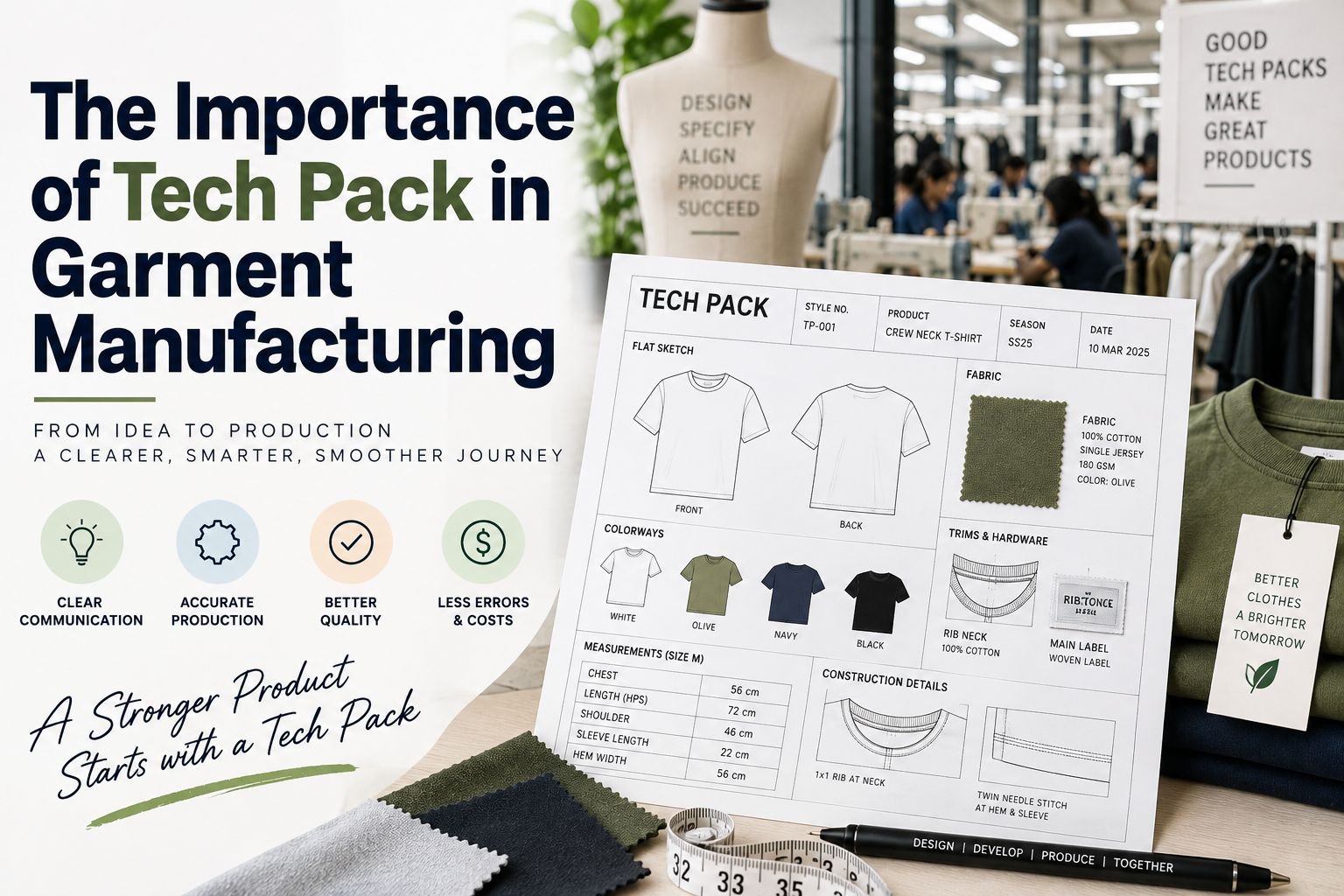
A good apparel tech pack can include technical drawings, measurements, fabric details, trims, construction details, color information, labels, packaging instructions, and a Bill of Materials (BOM).
Think of a tech pack as a blueprint for a garment. Instead of relying on guesswork or explaining every detail through emails and messages, the manufacturer can use one organized document as a production reference.
In this guide, we will explain what an apparel tech pack is, what it includes, why you need one, and how it helps you work with clothing manufacturers.
What Is an Apparel Tech Pack?
An apparel tech pack is a technical document containing the specifications and instructions required to manufacture a garment correctly.
It translates a fashion designer’s creative idea into clear technical information that a pattern maker, sample room, factory, or garment manufacturer can understand.
For example, a designer may know that they want to create an oversized cotton T-shirt. But a manufacturer needs much more information.
They may need to know:
- What type of cotton should be used?
- What is the fabric weight?
- What should the finished measurements be?
- How oversized should the fit be?
- What type of neckline should the T-shirt have?
- What thread should be used?
- What stitching method is required?
- Where should the logo be placed?
- What are the print or embroidery specifications?
- What labels are required?
- How should the garment be packed?
An apparel tech pack brings these details together in one structured document.
What Is the Purpose of an Apparel Tech Pack?
The main purpose of an apparel tech pack is to communicate exactly how a garment should be manufactured.
Without a detailed tech pack, manufacturers may have to make assumptions about the design. Those assumptions can lead to incorrect samples, poor fit, material changes, production mistakes, and additional costs.
A well-prepared clothing tech pack creates a common reference for everyone involved in product development.
The designer, technical designer, pattern maker, sample maker, and manufacturer can all work from the same information.
An apparel tech pack helps to:
- Communicate design requirements clearly
- Reduce production errors
- Improve sample accuracy
- Control garment measurements
- Specify materials and trims
- Communicate construction details
- Make costing easier
- Speed up manufacturer communication
- Reduce unnecessary revisions
- Maintain consistency between production batches
In simple terms, an apparel tech pack helps turn a design concept into a manufacturable garment.
What Does an Apparel Tech Pack Include?
The exact contents of a tech pack can vary depending on the garment and the manufacturer. However, a professional apparel tech pack normally contains several important sections.
1. Technical Flats
Technical flats are detailed two-dimensional drawings of the garment.
Unlike a fashion illustration, a technical flat focuses on construction rather than appearance. It normally shows the front and back of the garment and may include side views or detail views where necessary.
Technical flats help manufacturers understand the garment’s construction and design features.
For example, a shirt technical flat may show:
- Collar shape
- Sleeve construction
- Cuffs
- Button placement
- Pocket position
- Seam lines
- Hem construction
- Topstitching
A clear technical drawing is one of the most important parts of a fashion tech pack.
2. Bill of Materials (BOM)
The Bill of Materials, commonly called the BOM, lists the materials and components required to make the garment.
Depending on the product, the BOM may include:
- Main fabric
- Lining
- Interlining
- Thread
- Buttons
- Zippers
- Snaps
- Elastic
- Labels
- Hangtags
- Drawcords
- Packaging materials
The BOM can also include supplier information, material codes, colors, quantities, and other specifications.
This gives the manufacturer a clear understanding of what materials are required for production.
3. Measurement Specification
The measurement specification, or spec sheet, defines the garment’s measurements.
Typical measurements may include:
- Chest
- Waist
- Hip
- Body length
- Shoulder width
- Sleeve length
- Neck width
- Armhole
- Cuff opening
- Hem width
Measurements are normally provided for different sizes.
For example:
| Measurement | S | M | L | XL |
|---|---|---|---|---|
| Chest | 52 cm | 54 cm | 56 cm | 58 cm |
| Body Length | 68 cm | 70 cm | 72 cm | 74 cm |
| Shoulder | 44 cm | 46 cm | 48 cm | 50 cm |
The exact measurements and grading rules depend on the garment and brand’s fit requirements.
4. Point of Measurement (POM)
A Point of Measurement (POM) explains exactly where each measurement should be taken.
This is important because two people can measure the same garment differently if measurement instructions are unclear.
For example, a tech pack may specify:
Chest: Measure straight across the garment, approximately 1 inch below the armhole, then multiply by two.
Clear POM instructions help the manufacturer measure samples consistently.
5. Grade Rules
Grade rules explain how measurements change between sizes.
For example, if the chest measurement increases by 2 inches between sizes, the tech pack should communicate that grading clearly.
Grade rules help ensure that the garment maintains the intended fit across the entire size range.
6. Fabric Specifications
The fabric section explains exactly what material should be used.
It can include:
- Fiber composition
- Fabric construction
- Fabric weight
- Fabric width
- Fabric finish
- Stretch percentage
- Color
- Shrinkage requirements
- Performance requirements
For example:
Fabric: 100% Cotton Jersey
Weight: 220 GSM
Finish: Enzyme Washed
These specifications help prevent the manufacturer from substituting an unsuitable fabric.
7. Color Specifications
A professional garment tech pack should clearly communicate the colors required for the product.
This may include:
- Main garment color
- Contrast color
- Thread color
- Trim colors
- Print colors
- Embroidery colors
Brands may use standardized color references, such as Pantone codes, when precise color matching is important.
8. Garment Construction Details
Construction details explain how different parts of the garment should be assembled.
This section may specify:
- Seam types
- Stitch types
- Seam allowances
- Stitch density
- Topstitching
- Hem construction
- Binding
- Pocket construction
- Collar attachment
- Sleeve attachment
Construction details are particularly important when a garment contains complex design features.
9. Artwork and Branding Details
If the garment includes a print, embroidery, patch, applique, or other branding element, the tech pack should explain its specifications.
This can include:
- Artwork
- Placement
- Dimensions
- Technique
- Colors
- Thread specifications
- Print method
- Embroidery details
For example, instead of simply saying “logo on chest,” a tech pack can specify the exact placement and finished dimensions.
10. Label and Packaging Information
Labels and packaging are also part of the product specification.
An apparel tech pack may include:
- Main label
- Size label
- Care label
- Country-of-origin label
- Hangtag
- Polybag
- Folding instructions
- Carton information
Including these details helps ensure the finished garment is prepared correctly for delivery.
Apparel Tech Pack vs. Fashion Design Sketch
An apparel tech pack is not the same as a fashion sketch.
A fashion sketch communicates the creative appearance of a garment. It may show the silhouette, styling, colors, and overall aesthetic.
A tech pack goes much further.
It communicates the technical information needed to manufacture that design.
For example:
Fashion sketch:
“This is what the garment should look like.”
Apparel tech pack:
“This is exactly how the garment should be made.”
Both are valuable, but they serve different purposes.
Why Do Clothing Brands Need an Apparel Tech Pack?
A professional tech pack for clothing can save a brand significant time and money during product development.
1. It Reduces Miscommunication
A written specification is much clearer than relying on verbal explanations.
Instead of sending multiple messages to a manufacturer, the brand can provide one organized document.
2. It Improves Sample Accuracy
Manufacturers can use the tech pack as a reference when creating the first sample.
This increases the chance that the sample will match the intended design.
3. It Reduces Production Errors
Clear information about measurements, fabrics, trims, construction, and artwork helps reduce mistakes during manufacturing.
4. It Makes Costing Easier
Manufacturers need to understand the materials and construction of a garment before they can accurately estimate production costs.
A detailed tech pack provides the information needed for better costing.
5. It Makes Manufacturer Communication Easier
If you work with manufacturers in different countries or time zones, communication can become difficult.
A detailed tech pack creates a common technical reference that everyone can follow.
6. It Helps Maintain Consistency
Once a product enters bulk production, the tech pack can continue to act as a production reference.
This is especially useful when a brand works with different factories or produces the same product over multiple seasons.
Who Uses an Apparel Tech Pack?
An apparel tech pack can be used by almost everyone involved in the technical development and manufacturing of a garment.
This may include:
- Fashion designers
- Clothing brands
- Technical designers
- Product developers
- Pattern makers
- Sample makers
- Garment manufacturers
- Factories
- Quality control teams
- Sourcing teams
For a growing fashion brand, the tech pack becomes an important communication tool between the creative and manufacturing sides of the business.
When Should You Create an Apparel Tech Pack?
An apparel tech pack should generally be created once the design concept is sufficiently developed and before the product moves into serious sampling and production.
A common workflow looks like this:
Design concept → Technical drawing → Tech pack → Pattern → Sample → Fit corrections → Final tech pack → Production
The tech pack may be updated several times during product development.
For example, after reviewing a sample, the brand may change:
- Body measurements
- Sleeve length
- Fabric
- Stitching
- Trim specifications
- Print placement
- Construction details
The tech pack should be updated so that the latest approved specifications are clearly documented.
What Is the Difference Between an Apparel Tech Pack and a Tech Pack Template?
An apparel tech pack template is a reusable structure used to create tech packs.
It may contain sections such as:
- Cover page
- Technical flats
- BOM
- Measurement chart
- POM
- Construction details
- Fabric information
- Color information
- Artwork
- Labels
- Packaging
- Revision history
A template can save time because the brand does not need to create the structure from scratch for every product.
However, simply downloading a tech pack template does not mean the garment is ready for manufacturing.
The template needs to be filled with accurate product-specific information.
What Makes a Good Apparel Tech Pack?
A good apparel tech pack should be clear, accurate, complete, and easy to use.
It should answer the manufacturer’s important questions before production begins.
A strong tech pack should have:
Clear technical drawings
The manufacturer should be able to understand the garment’s construction from the drawings.
Accurate measurements
Measurements should be realistic, consistent, and clearly defined.
Complete material information
Fabrics, trims, labels, and other components should be specified.
Clear construction instructions
Important sewing and construction requirements should not be left to guesswork.
Proper artwork specifications
Prints, embroidery, logos, and other graphics should have clear dimensions and placement information.
Revision control
The document should identify the latest version so that the manufacturer does not accidentally work from an outdated specification.
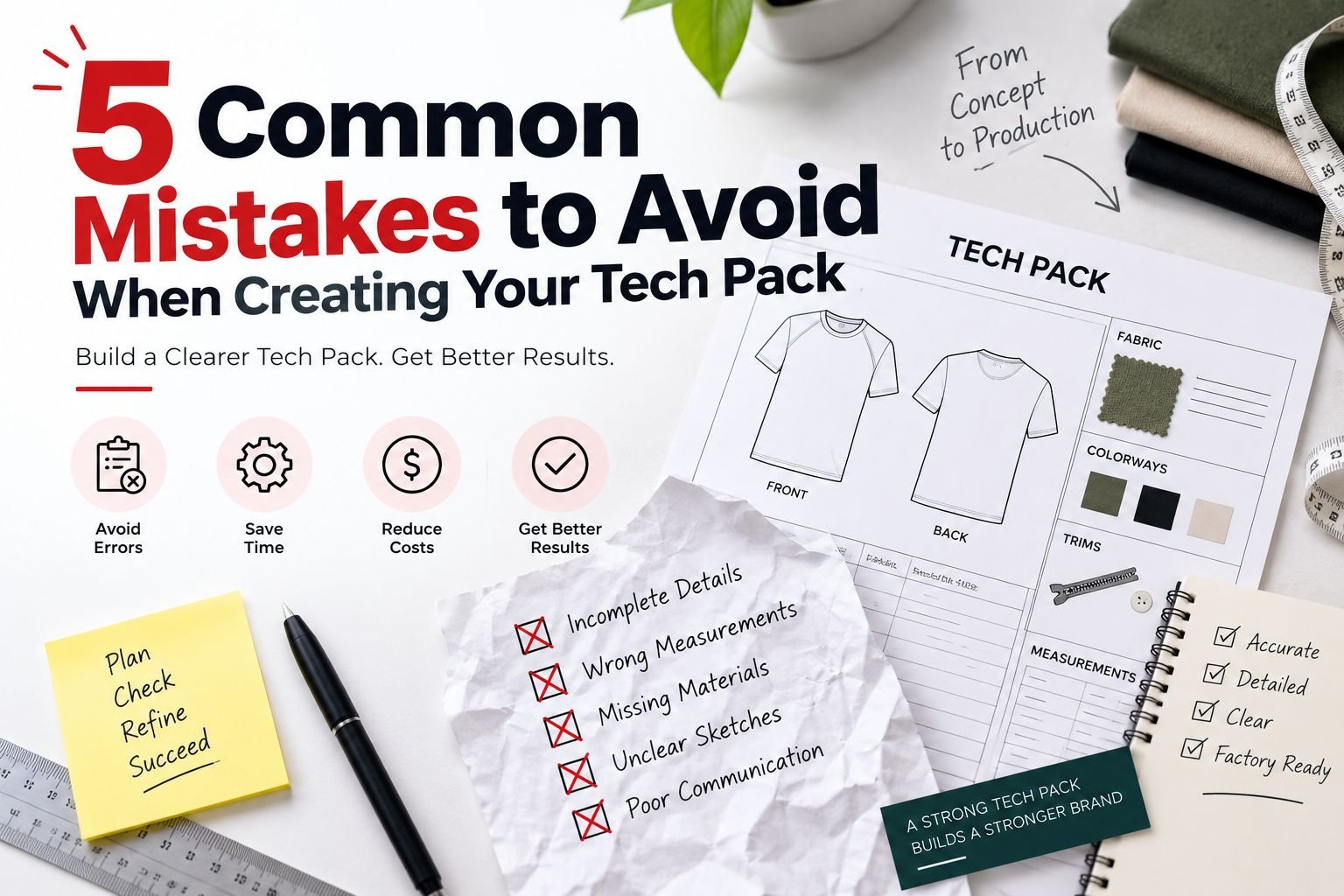
Common Mistakes in Apparel Tech Packs
Even experienced brands can make mistakes when creating technical documentation.
Some common problems include:
Using vague instructions
Instructions such as “use good quality fabric” are not specific enough.
The manufacturer needs measurable specifications.
Missing measurements
A technical drawing alone usually does not provide enough information for accurate production.
Incorrect measurement points
If the POM instructions are unclear, the brand and manufacturer may measure the garment differently.
Missing BOM information
Leaving out trims, labels, thread, or other components can create problems during sampling or production.
Not updating the tech pack
If changes are made during sampling but the tech pack is not updated, the factory may use outdated specifications.
Overcomplicating the document
A tech pack should be detailed, but it should also be organized and easy to understand.
The goal is clarity, not unnecessary complexity.
How Much Does an Apparel Tech Pack Cost?
The cost of an apparel tech pack can vary depending on the garment and the amount of technical detail required.
A simple T-shirt may require fewer specifications than a complex jacket with multiple pockets, zippers, linings, trims, and construction details.
Factors that can affect the cost include:
- Garment complexity
- Number of views and technical drawings
- Number of colorways
- Number of sizes
- Artwork requirements
- Measurement specifications
- BOM complexity
- Construction details
- Number of revisions
- Whether the tech pack is created from a sketch, reference sample, or existing garment
For brands, it is useful to view a tech pack as a product-development investment, rather than simply another design expense.
Can You Create an Apparel Tech Pack Yourself?
Yes. A brand can create its own apparel tech pack if it has the necessary technical knowledge and software.
However, creating a professional fashion tech pack requires more than putting a sketch and measurements into a PDF.
You need to understand areas such as:
- Garment construction
- Pattern measurements
- Fabric specifications
- Size grading
- Sewing terminology
- Technical drawing
- BOM development
- POM definitions
- Manufacturing requirements
For brands without in-house technical design expertise, working with a professional tech pack designer or tech pack service can make the process easier.
Apparel Tech Pack Checklist
Before sending your tech pack to a manufacturer, check that it includes the essential information.
Design
- Front technical flat
- Back technical flat
- Detail drawings where necessary
- Design features clearly identified
Measurements
- Measurement chart
- POM definitions
- Size range
- Grade rules
- Tolerances
Materials
- Main fabric
- Lining
- Trims
- Thread
- Buttons/zippers/fasteners
- Labels
Construction
- Seam details
- Stitch details
- Hem details
- Pocket construction
- Collar/cuff details
- Other special construction instructions
Branding
- Print specifications
- Embroidery specifications
- Logo placement
- Label specifications
Production
- Color information
- Packaging instructions
- Revision number
- Approval status
Final Thoughts
An apparel tech pack is one of the most important technical documents in the clothing product development process.
It takes a creative garment idea and turns it into a clear set of instructions that a manufacturer can follow.
A strong tech pack can help improve communication, reduce production mistakes, make sampling more efficient, and create greater consistency between the approved design and the final garment.
Whether you are developing a T-shirt, hoodie, shirt, dress, trousers, jacket, or another type of apparel, a detailed clothing tech pack gives your manufacturer the information needed to understand your product correctly.
In simple terms:
Your design shows what you want to make. Your apparel tech pack explains how to make it.
For emerging fashion brands, getting this technical foundation right can make the entire product-development process smoother and more professional.
Frequently Asked Questions About Apparel Tech Packs
What is an apparel tech pack?
An apparel tech pack is a technical document that contains the specifications and instructions required to manufacture a garment. It can include technical drawings, measurements, materials, construction details, artwork, labels, packaging, and other production information.
Is an apparel tech pack the same as a tech pack?
Yes, in the fashion and clothing industry, the terms are often used interchangeably. An apparel tech pack specifically refers to a tech pack created for an apparel product.
Do I need a tech pack to manufacture clothing?
While requirements vary between manufacturers, having a detailed tech pack is strongly recommended. It gives the manufacturer a clear reference for the garment’s design, measurements, materials, and construction.
What is included in a clothing tech pack?
A clothing tech pack commonly includes technical flats, a Bill of Materials, measurement specifications, POMs, grade rules, fabric information, color details, construction instructions, artwork, labels, and packaging requirements.
Who creates an apparel tech pack?
An apparel tech pack may be created by a technical designer, fashion designer with technical skills, product developer, or professional tech pack designer.
Can I create a tech pack from a sketch?
Yes. A professional tech pack can be developed from a fashion sketch, design concept, reference garment, or sample. The available information determines how much technical development is required.
What is a tech pack template?
A tech pack template is a pre-structured document containing the sections needed to create a tech pack. It can make the documentation process faster, but it still needs accurate product-specific information.
How does a tech pack help a manufacturer?
A tech pack gives the manufacturer a clear technical reference for producing the garment. It helps communicate measurements, materials, construction methods, artwork, trims, and other requirements while reducing guesswork and miscommunication.
Ready for Production?
Get a professional tech pack for your fashion design.
Table of Contents