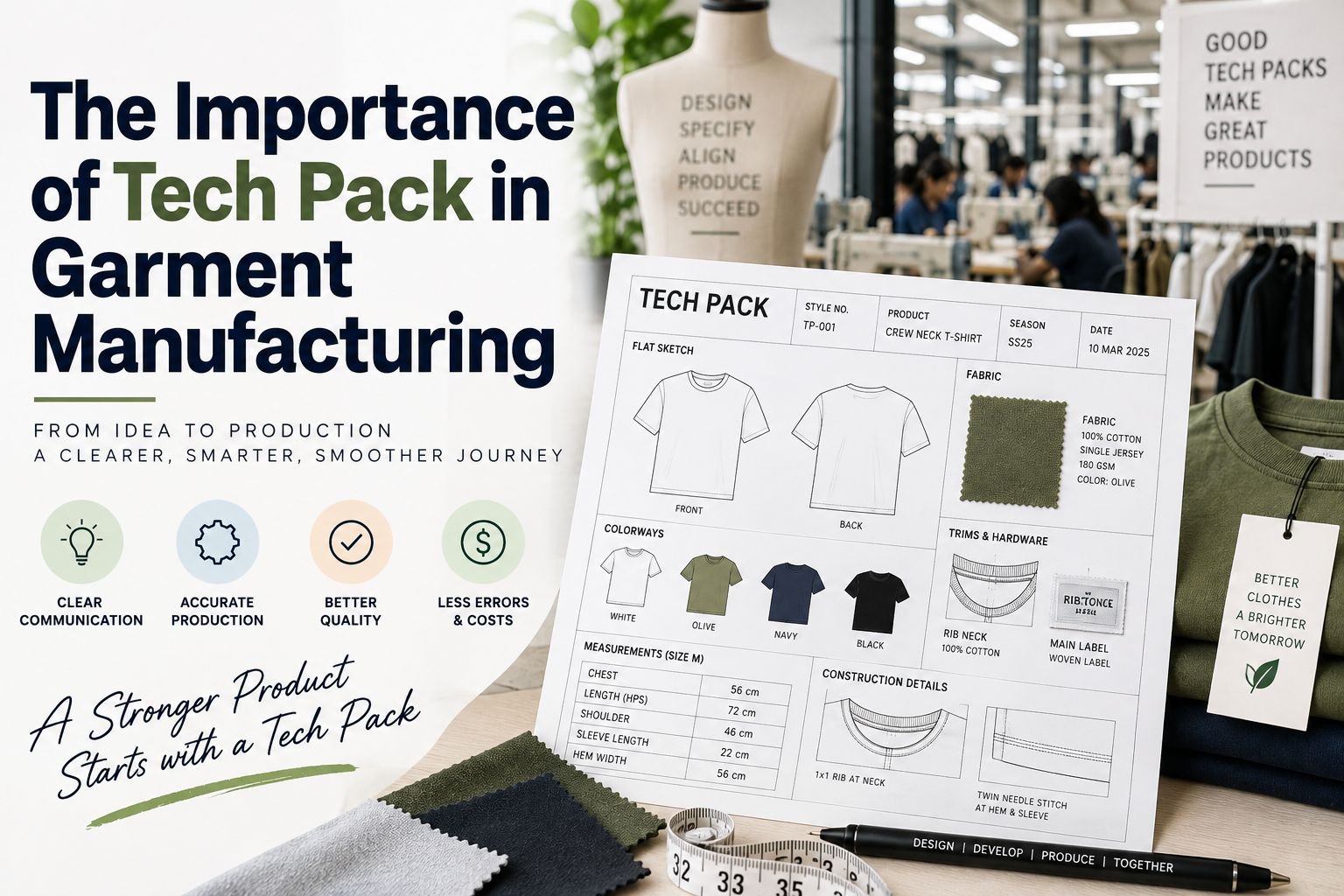
Tech Pack The Complete Guide for Fashion & Clothing Brands
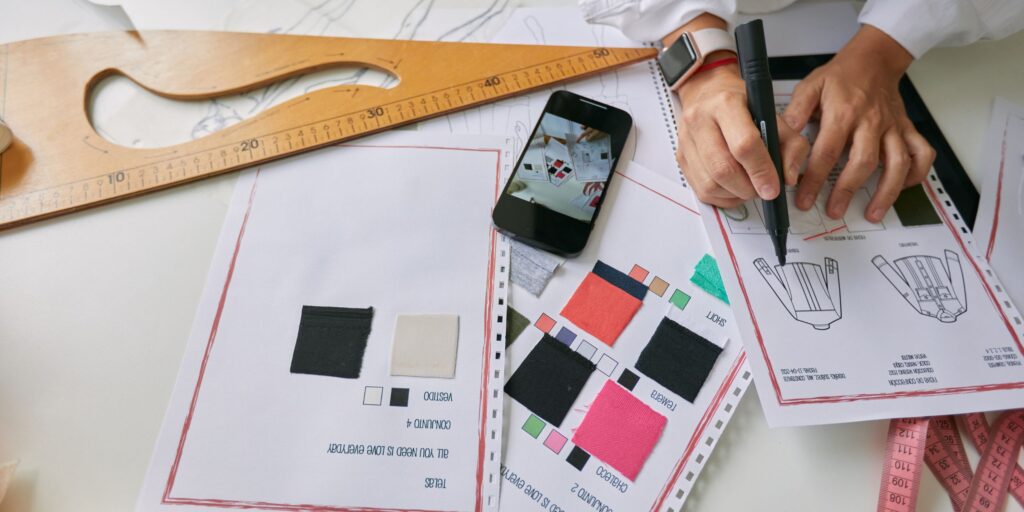
If you are starting a clothing brand, working with a garment manufacturer, or developing a new fashion product, you have probably heard the term tech pack.
But what is a tech pack, and why do clothing manufacturers ask for one before making your product?
A tech pack, short for technical package, is a detailed production document that communicates exactly how a garment should be made. It translates a designer’s creative idea into precise instructions that a pattern maker, sample room, and clothing manufacturer can understand and follow.
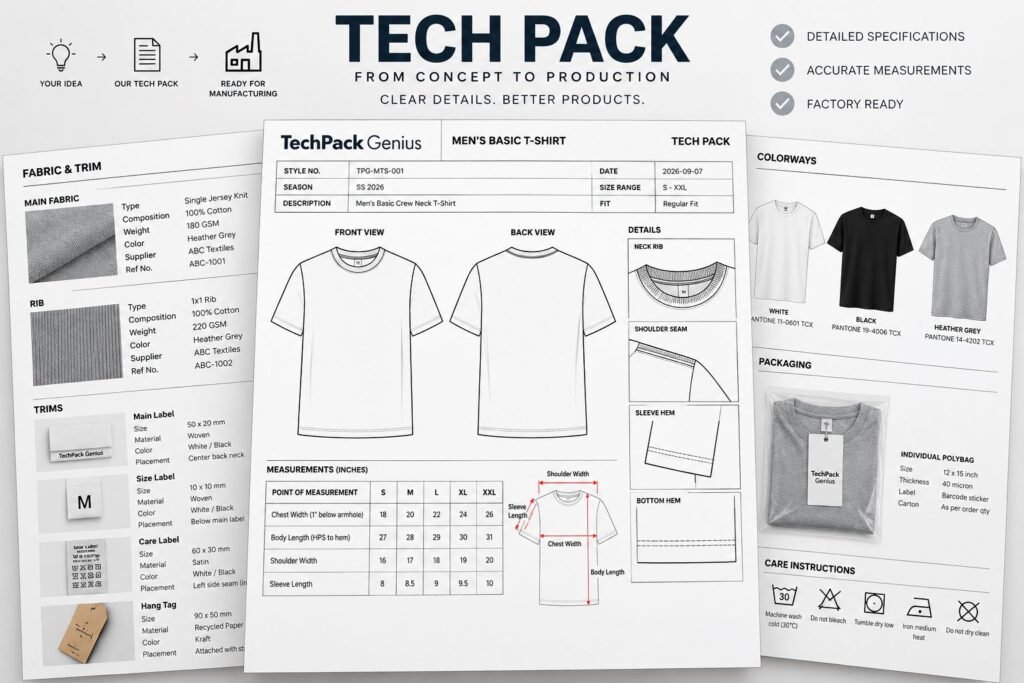
A professional fashion tech pack typically contains technical flat sketches, measurements, a bill of materials (BOM), construction details, fabric and trim specifications, color information, artwork placement, labeling requirements, and other production instructions.
Think of a tech pack as the blueprint for a garment.
A sketch may show what your clothing design should look like. A tech pack explains how to manufacture it accurately.
What Is a Tech Pack?
A tech pack is a technical specification document used in apparel and fashion manufacturing to communicate the exact requirements for producing a garment.
It serves as a central reference between a fashion brand, designer, pattern maker, product developer, and manufacturer.
A clothing tech pack can specify everything from:
- Garment measurements
- Fabric composition and weight
- Colorways
- Seams and stitching
- Construction methods
- Zippers, buttons, and other trims
- Labels and branding
- Artwork and print placement
- Size grading
- Measurement tolerances
- Packaging requirements
- Sample comments and revisions
The purpose is simple: remove guesswork from garment production.
When a manufacturer receives a complete tech pack, they have a much clearer understanding of what needs to be produced and how the finished garment should meet the brand’s specifications.
Tech Pack Meaning in Simple Words
In simple terms:
A tech pack is a detailed instruction manual for manufacturing a clothing product.
For example, imagine you want to manufacture a hoodie.
A basic fashion sketch might show a hood, kangaroo pocket, ribbed cuffs, and a logo.
But the manufacturer still needs to know:
- What fabric should be used?
- What is the fabric composition?
- What is the GSM?
- What are the finished garment measurements?
- How should the hood be constructed?
- What stitch type should be used?
- What rib fabric should be used?
- Where exactly should the logo be placed?
- What size should the logo be?
- What colors are required?
- How should the garment be labeled?
- What are the acceptable measurement tolerances?
The tech pack documents these requirements.
What Does a Tech Pack Include?
The exact contents of a tech pack can vary depending on the product and manufacturer, but a professional garment tech pack generally contains several core sections.
1. Technical Flat Sketches
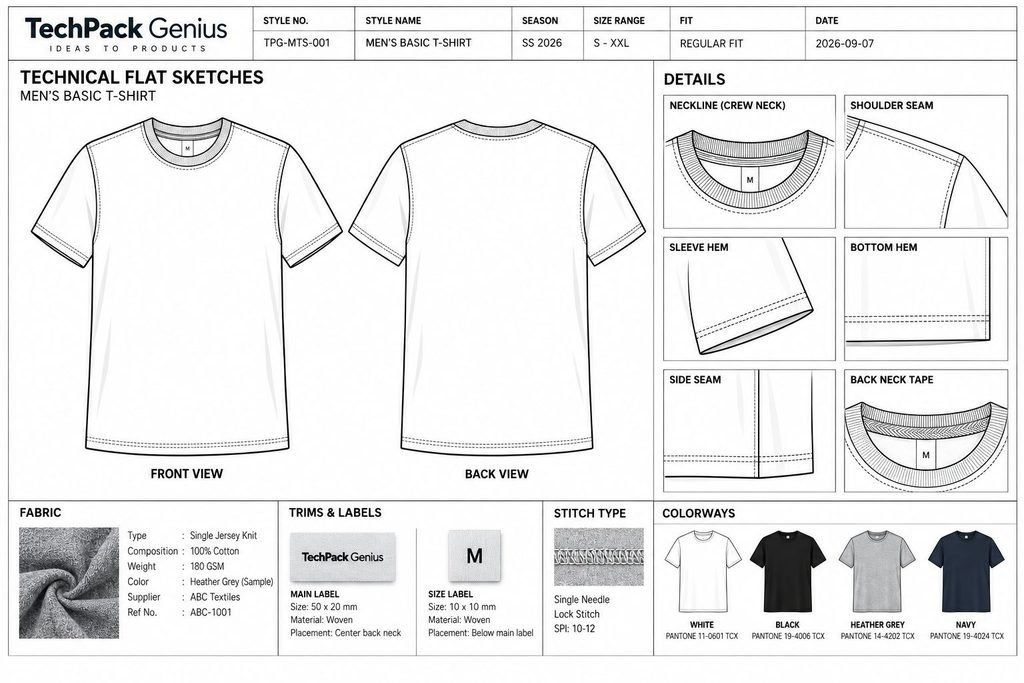
Technical flat sketches, often called fashion flats or technical drawings, visually communicate the construction and appearance of the garment.
Unlike a fashion illustration, a technical flat is generally a clean, production-oriented drawing showing details such as:
- Front view
- Back view
- Side view when necessary
- Seams
- Panels
- Pockets
- Collars
- Cuffs
- Plackets
- Zippers
- Buttons
- Stitch lines
- Construction details
Callouts can be added to identify specific components or construction requirements.
Technical flats help manufacturers understand the physical structure of the garment rather than simply its visual style.
2. Bill of Materials (BOM)
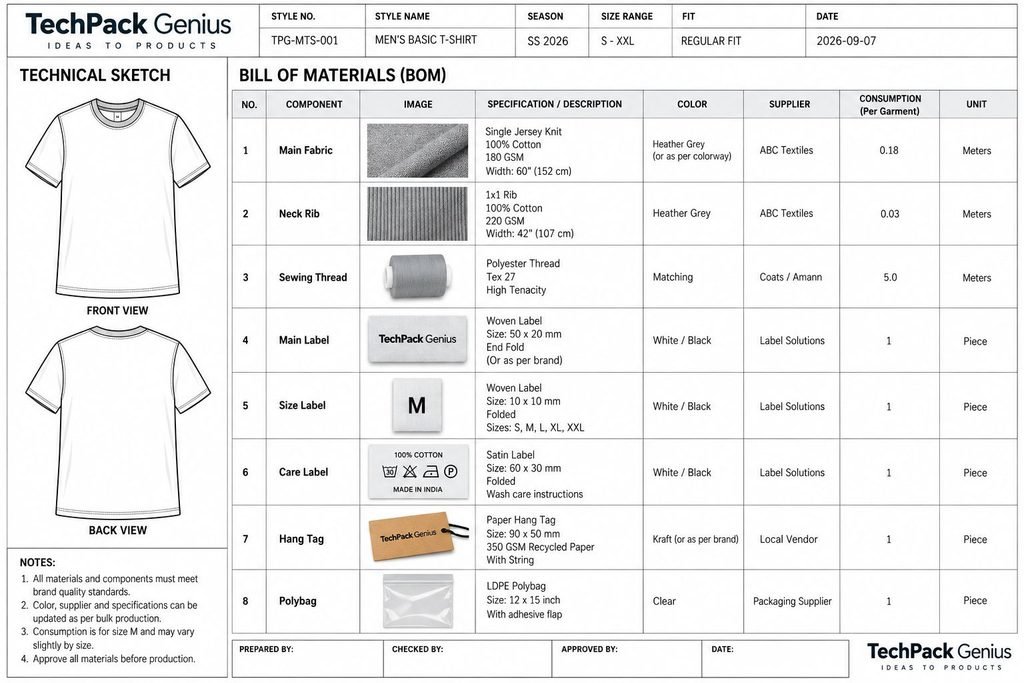
The Bill of Materials, commonly called a BOM, lists the materials and components required to manufacture the garment.
A clothing BOM may include:
| Component | Example |
|---|---|
| Main fabric | 100% cotton jersey |
| Lining | Polyester |
| Thread | Polyester thread |
| Zipper | Nylon coil zipper |
| Buttons | Metal snap buttons |
| Labels | Woven brand label |
| Hangtag | Printed paper hangtag |
| Elastic | 20 mm waistband elastic |
| Packaging | Polybag and carton |
The BOM helps the manufacturer understand what materials are required to make the product.
It can also contain information such as supplier references, material codes, color codes, consumption, and quantities depending on the production workflow.
3. Measurement Specification Sheet
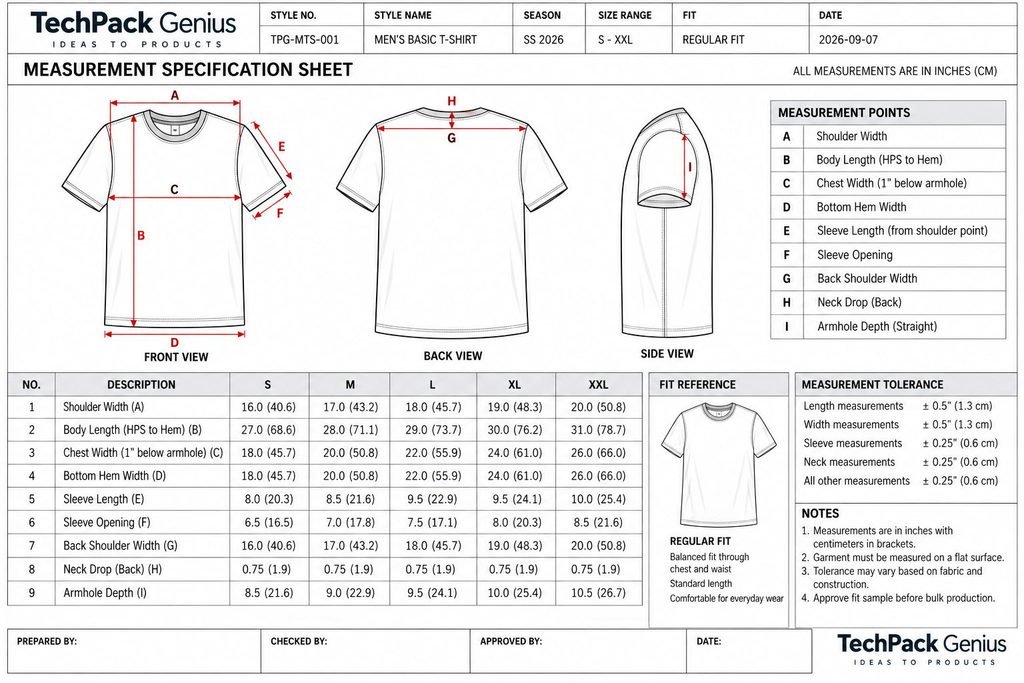
One of the most important parts of a tech pack for clothing is the measurement specification sheet.
It defines the finished measurements of the garment.
For example, a T-shirt specification may include:
- Chest width
- Body length
- Shoulder width
- Sleeve length
- Sleeve opening
- Neck width
- Bottom opening
Each measurement is normally associated with a specific Point of Measure (POM).
The tech pack may also specify:
- Base size
- Full size range
- Grade rules
- Measurement tolerances
This gives the manufacturer a measurable standard for evaluating samples and production garments.
4. Size Grading
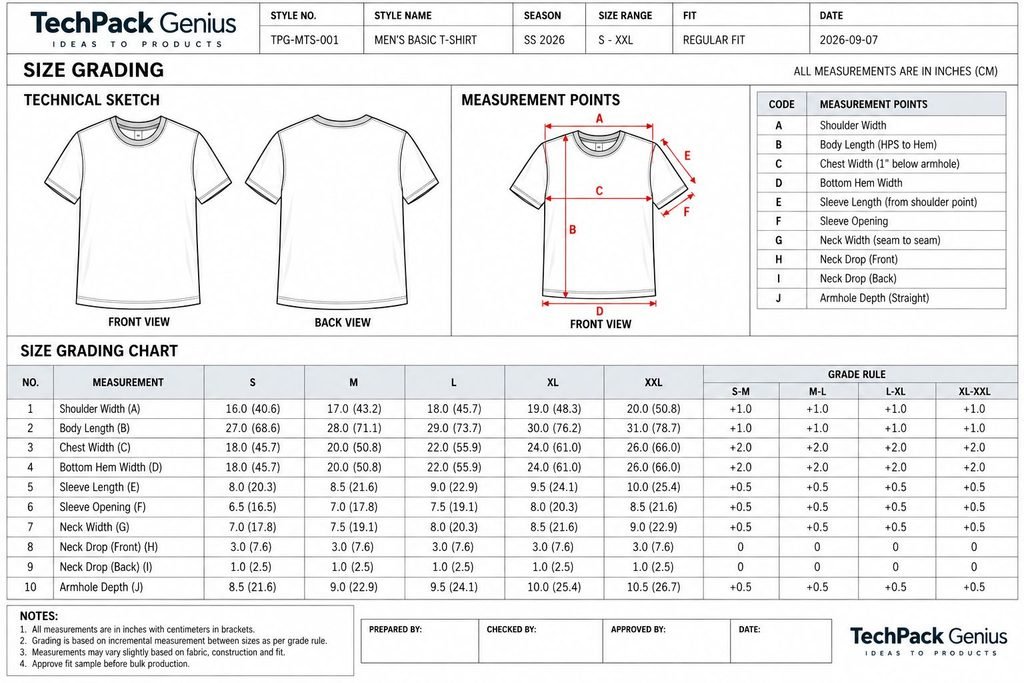
If a garment is being produced in multiple sizes, the tech pack can include size grading specifications.
For example:
XS → S → M → L → XL → XXL
The grading instructions explain how measurements should change between sizes.
Accurate grading is particularly important because a garment should maintain the intended fit and proportions across the entire size range.
5. Fabric Specifications
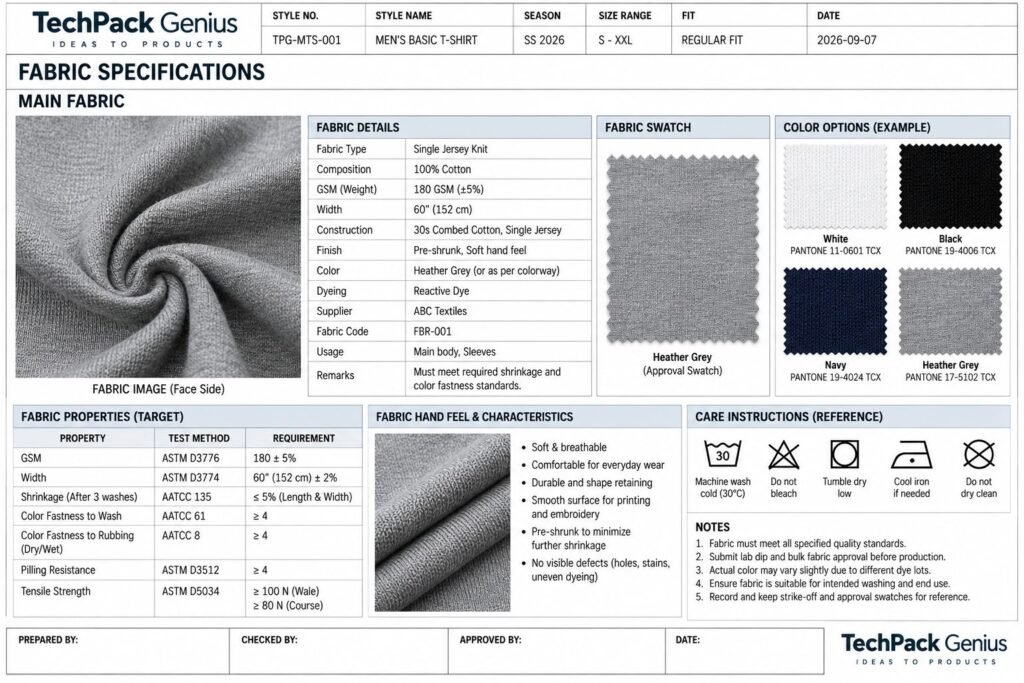
A professional tech pack should clearly communicate the fabric requirements.
Depending on the product, this may include:
- Fiber composition
- Fabric type
- Fabric weight/GSM
- Fabric construction
- Stretch percentage
- Finish
- Color
- Supplier reference
- Fabric code
- Shrinkage requirements
For example:
Fabric: Cotton Jersey
Composition: 95% Cotton / 5% Elastane
Weight: 220 GSM
Color: Black
Stretch: 4-way stretch
The more precise the fabric specification, the less room there is for misunderstanding.
6. Construction Details
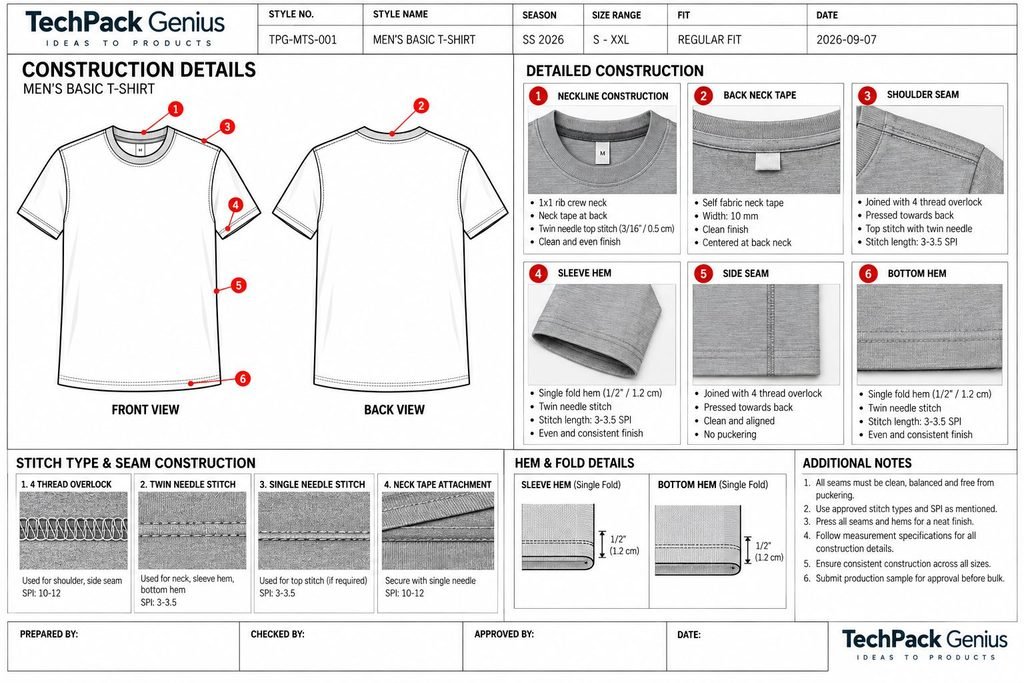
Construction information explains how the garment should be assembled.
This may include:
- Seam types
- Stitch types
- Seam allowances
- Hem construction
- Pocket construction
- Collar construction
- Sleeve attachment
- Reinforcement requirements
- Topstitching
- Seam finishing
Construction details are especially important for garments with complex designs or specialized manufacturing requirements.
7. Colorways
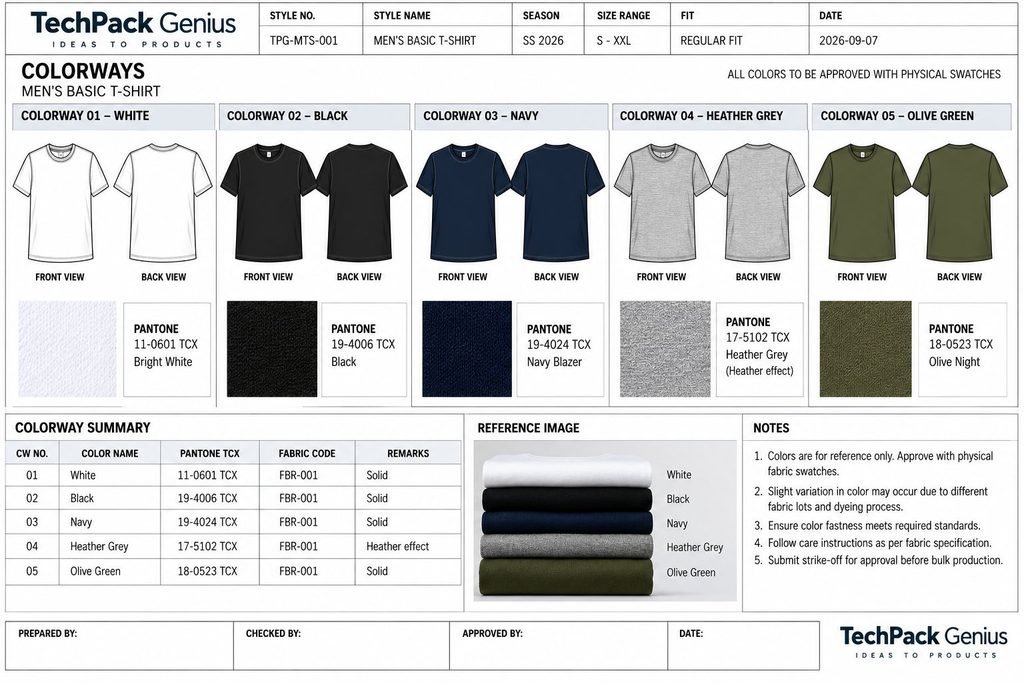
A clothing brand may manufacture the same style in several colors.
A tech pack can document each approved colorway.
For example:
- Black
- White
- Navy
- Burgundy
- Olive
Professional tech packs may use Pantone references, approved swatches, color codes, or other standardized references to reduce color interpretation between the brand and manufacturer.
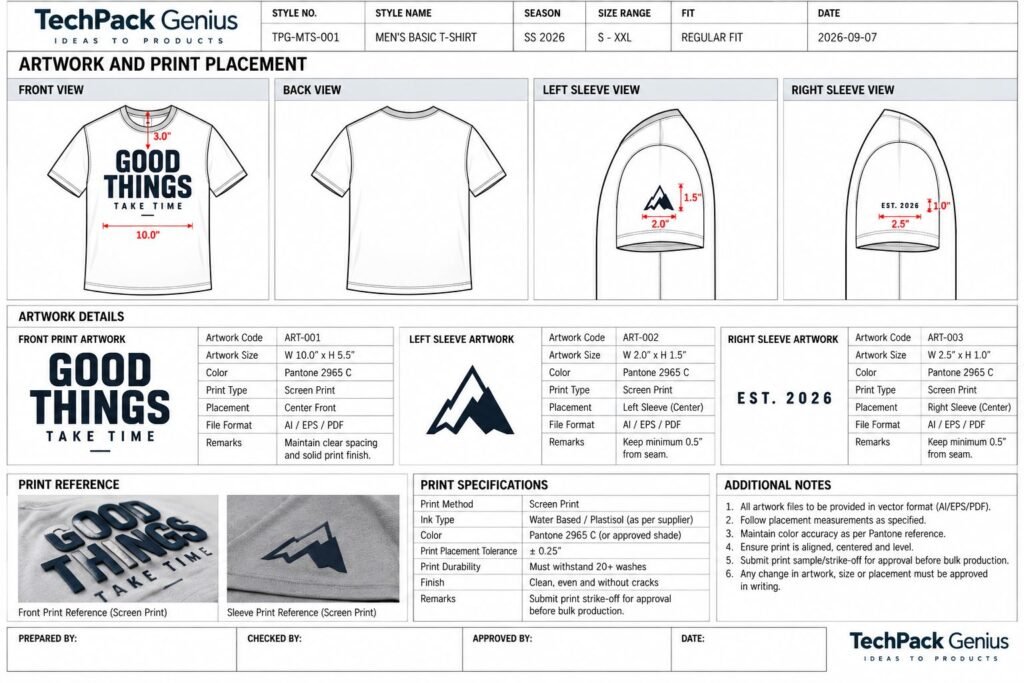
8. Artwork and Print Placement
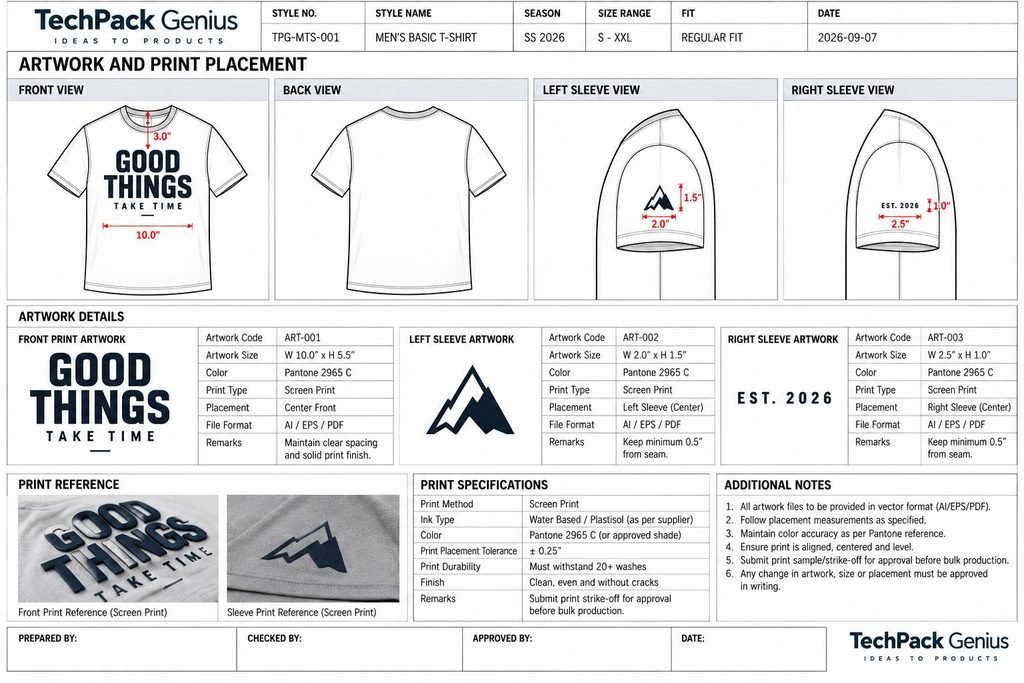
If the garment contains graphics, embroidery, screen printing, sublimation, labels, or other artwork, the tech pack should explain where and how the artwork should be applied.
It may specify:
- Artwork dimensions
- Placement
- Print technique
- Embroidery size
- Thread colors
- Print colors
- Distance from seams
- Artwork files
- Repeat information
For example:
Front logo: 80 mm wide, centered 70 mm below neckline.
Specific measurements like this are far more useful to a factory than instructions such as “put the logo near the chest.”
9. Trims and Accessories
A garment tech pack can also specify every trim or accessory used in the product.
Examples include:
- Zippers
- Buttons
- Snaps
- Buckles
- Eyelets
- Drawcords
- Elastics
- Labels
- Patches
- Hooks
- Rivets
Each component may have its own specifications, color, size, material, finish, and placement.
10. Labels and Packaging
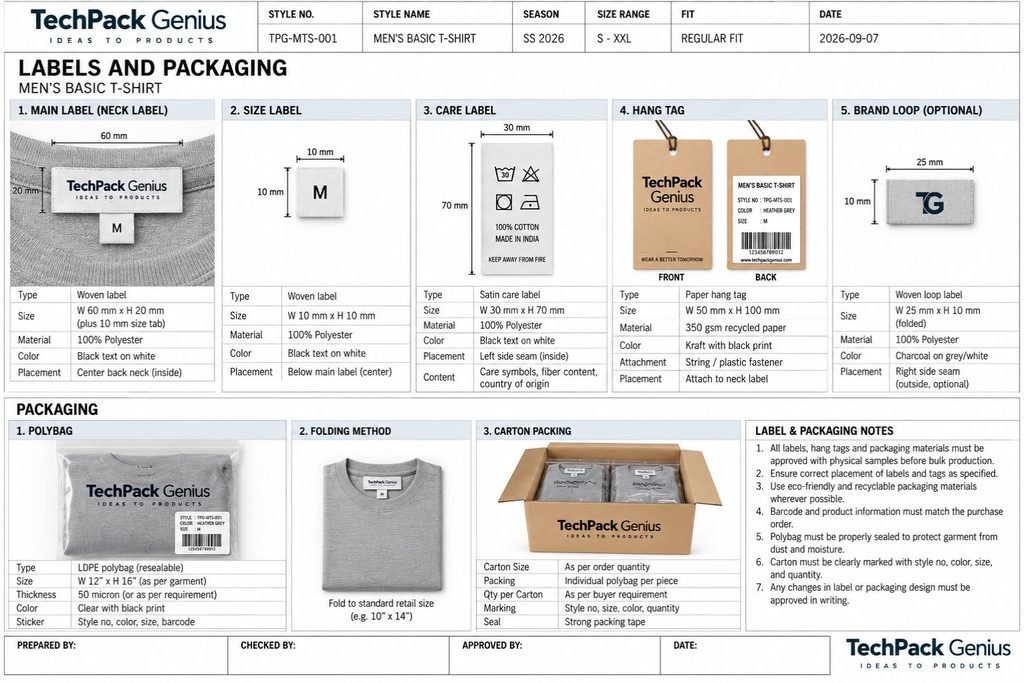
A production-ready tech pack may also contain labeling and packaging requirements.
These can include:
- Main brand label
- Size label
- Care label
- Country-of-origin label
- Composition information
- Hangtags
- Polybag requirements
- Folding instructions
- Carton specifications
Packaging requirements become particularly important when products are being shipped directly to warehouses, retailers, or customers.
Why Is a Tech Pack Important?
The biggest reason a tech pack matters is communication.
A fashion designer may visualize a garment one way while a manufacturer interprets the same design differently.
A detailed tech pack reduces this gap.
A good tech pack can help:
1. Reduce misunderstandings
Everyone works from the same documented specifications.
2. Improve sample accuracy
The manufacturer has measurable instructions to work from instead of relying only on sketches or verbal explanations.
3. Reduce unnecessary revisions
Clear specifications can reduce the number of back-and-forth changes during product development.
4. Improve production consistency
The approved specifications can be used as a reference during bulk production.
5. Make manufacturer communication easier
Instead of explaining every detail through emails and messages, the brand can provide a centralized production document.
6. Support quality control
Measurements, construction specifications, materials, and tolerances provide standards against which samples and production garments can be checked.
Current industry guides similarly describe tech packs as the bridge between design intent and manufacturing execution, particularly for measurements, materials, construction, and sampling.
Tech Pack vs. Fashion Sketch: What’s the Difference?
A common mistake among new fashion entrepreneurs is assuming that a fashion sketch is the same as a tech pack.
It isn’t.
| Fashion Sketch | Tech Pack |
|---|---|
| Communicates creative vision | Communicates production specifications |
| Focuses on appearance | Focuses on appearance + construction |
| May not contain measurements | Contains detailed measurements |
| Usually not production-ready | Designed for manufacturing |
| Shows the overall concept | Documents how the product should be made |
A fashion sketch answers:
“What should this garment look like?”
A tech pack answers:
“Exactly what should the manufacturer make, and how should it be made?”
Tech Pack vs. Spec Sheet
A spec sheet and a tech pack are related, but they are not necessarily the same thing.
A spec sheet generally focuses on the garment’s measurements and specifications.
A complete tech pack is broader and can include:
- Technical flats
- Measurement specifications
- BOM
- Construction details
- Fabric specifications
- Colorways
- Artwork
- Labels
- Trims
- Packaging
- Sample comments
- Revision information
In other words:
A spec sheet can be one component of a tech pack.
Industry sources also distinguish the complete tech pack from a measurement-only specification sheet.
Who Needs a Tech Pack?
A tech pack can be useful for almost anyone developing a custom physical fashion product.
Fashion Designers
Designers can use tech packs to translate creative concepts into production-ready specifications.
Clothing Brands
Startups and established fashion brands can use them to communicate product requirements to manufacturers.
Apparel Manufacturers
Factories use tech packs as production references for sampling and manufacturing.
Product Developers
Product development teams can use tech packs to manage specifications, revisions, samples, and approvals.
Fashion Startups
For new brands, a good tech pack can be especially valuable because founders may not have years of manufacturing experience.
When Do You Need a Tech Pack?
Ideally, you should create the tech pack before sending a garment to a manufacturer for sampling.
A typical workflow looks like this:
Idea → Design → Tech Pack → Manufacturer → Prototype/Sample → Fit Review → Revised Tech Pack → Final Sample → Bulk Production
The tech pack can evolve during product development.
For example, after receiving a first sample, the brand may discover that:
- The sleeve is too long.
- The chest measurement needs adjustment.
- The neckline needs to be wider.
- The pocket needs to move.
- The fabric needs to be heavier.
Those approved changes should be documented in the updated technical specifications.
How to Create a Tech Pack
Creating a professional fashion tech pack requires more than putting a sketch and measurements into a PDF.
A basic process is:
Step 1: Finalize the Design
Define what the product should look like and how it should function.
Step 2: Create Technical Flats
Develop accurate front and back technical drawings.
Step 3: Define Materials
Specify the main fabric, lining, trims, hardware, thread, labels, and other components.
Step 4: Create the BOM
List every component required to manufacture the product.
Step 5: Develop the Measurement Chart
Define the points of measure, finished measurements, size range, and tolerances.
Step 6: Document Construction
Specify seams, stitches, hems, pockets, closures, and other manufacturing details.
Step 7: Add Artwork and Branding
Document logo placement, prints, embroidery, labels, and other branding elements.
Step 8: Add Colorways
Specify approved colors and relevant color references.
Step 9: Add Packaging Requirements
Document folding, labeling, polybagging, carton, and other packaging instructions where required.
Step 10: Send It to the Manufacturer
The manufacturer can use the completed tech pack to review requirements, quote the product, develop samples, and prepare for production.
What Makes a Good Tech Pack?
Not every tech pack is production-ready.
A high-quality tech pack should be:
Accurate
Measurements, materials, artwork, and construction details should be correct.
Clear
Instructions should be easy for a manufacturer to understand.
Complete
Important specifications shouldn’t be left to assumptions.
Consistent
Measurements and instructions should not contradict each other.
Organized
Information should be structured so manufacturers can quickly locate what they need.
Version-Controlled
Changes should be tracked so the manufacturer knows which version is current.
The goal isn’t to create the longest possible document.
The goal is to create a document that leaves as little room for interpretation as possible.
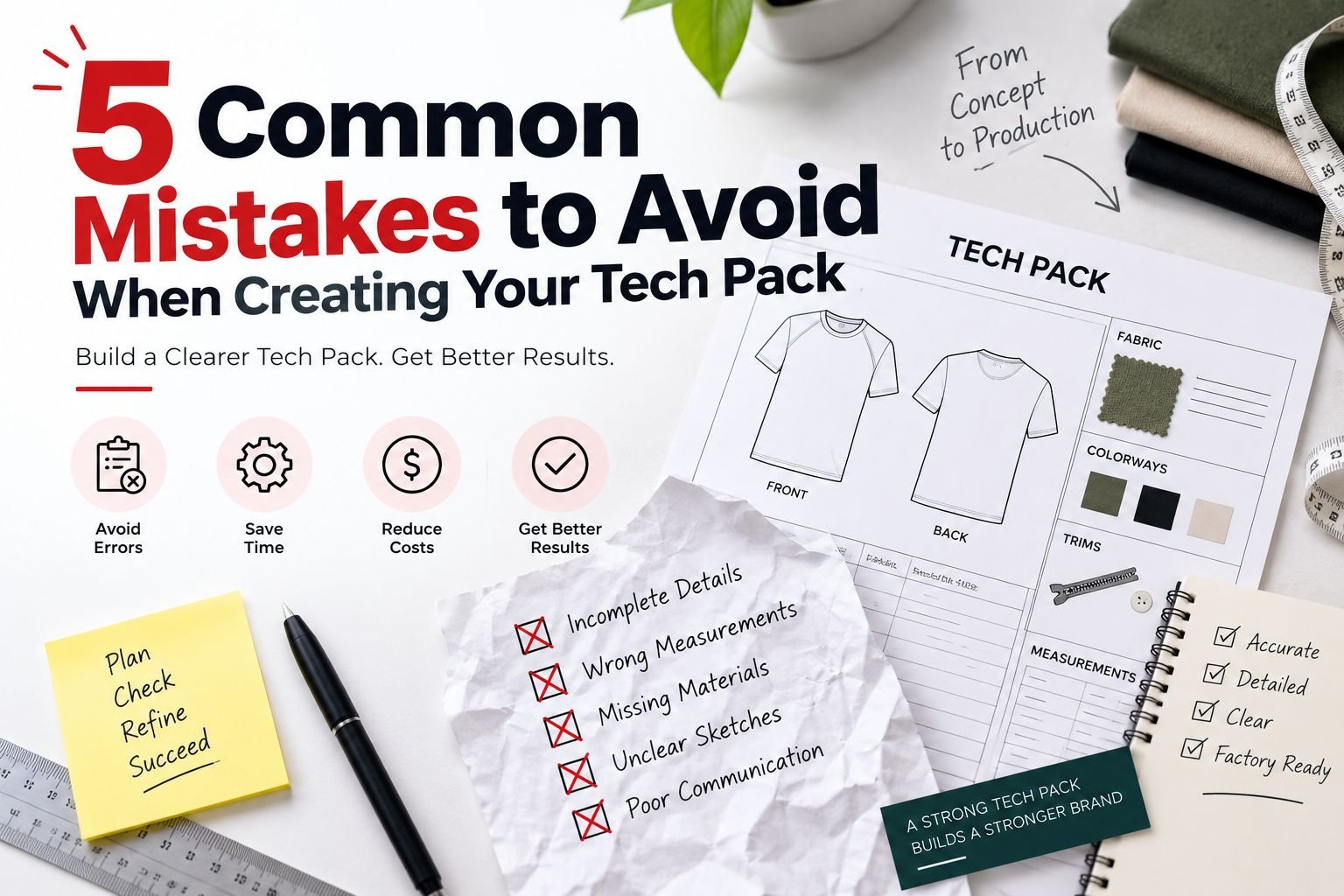
Common Tech Pack Mistakes
New fashion brands often make several mistakes when preparing their production documents.
1. Using Only a Fashion Sketch
A sketch communicates appearance but usually doesn’t provide enough manufacturing information.
2. Missing Measurements
A manufacturer cannot reliably reproduce a garment’s fit without clear measurement specifications.
3. Vague Material Descriptions
Writing “cotton fabric” is usually not enough. Relevant material characteristics should be specified.
4. No Measurement Tolerances
Production garments naturally have some variation. Acceptable tolerances should be clearly defined where appropriate.
5. Unclear Artwork Placement
“Logo on chest” is ambiguous. Exact placement and dimensions are much more useful.
6. Missing Construction Instructions
Important construction details should not be left entirely to the factory’s interpretation.
7. Outdated Versions
If a brand changes a measurement or material but sends an old version of the tech pack, production problems can occur.
What Does a Tech Pack Look Like?
A professional tech pack is usually a multi-page technical document, rather than a single sheet.
Depending on the garment, it may contain pages such as:
- Cover / Style Information
- Technical Flat
- Bill of Materials
- Measurement Specification
- Size Grading
- Construction Details
- Fabric Specifications
- Colorways
- Artwork & Print Placement
- Labels & Branding
- Packaging
- Sample Comments & Revision History
The exact structure varies depending on the product and the requirements of the brand and manufacturer.
How Much Does a Tech Pack Cost?
The cost of a tech pack varies significantly depending on:
- Product complexity
- Number of views and details
- Number of colorways
- Number of sizes
- Artwork requirements
- Construction complexity
- Number of revisions
- Designer or agency experience
- Whether pattern development is included
A simple T-shirt tech pack can require substantially less work than a complex jacket, technical garment, or multi-component product.
Instead of choosing a tech pack designer solely based on price, evaluate whether the final document is accurate, complete, manufacturer-friendly, and production-ready.
Can You Create a Tech Pack Yourself?
Yes.
A founder or designer can create a tech pack using tools such as:
- Adobe Illustrator
- Adobe InDesign
- Excel or Google Sheets
- Fashion design software
- Specialized tech pack software
- Other technical documentation tools
However, creating a professional tech pack requires knowledge of apparel construction, measurements, garment terminology, materials, grading, and manufacturing processes.
For brands without technical apparel expertise, working with an experienced tech pack designer can help reduce errors during development.
Do Manufacturers Need a Tech Pack?
For custom garment development, a detailed tech pack is highly useful because it gives the manufacturer a structured specification to work from.
Manufacturers need enough information to understand:
- What the product is
- What materials to use
- How it should be constructed
- What measurements it should have
- What colors and artwork are required
- What trims and labels are needed
- What quality requirements apply
A complete tech pack therefore becomes a common reference point between the brand and manufacturing team.
Frequently Asked Questions About Tech Packs
What is a tech pack in fashion?
A tech pack in fashion is a detailed technical document that communicates a garment’s measurements, materials, construction, colors, trims, artwork, labeling, and other production requirements to a manufacturer.
What is a tech pack used for?
A tech pack is used to communicate a garment’s exact production specifications to manufacturers during sampling and production. It helps reduce ambiguity and provides a reference for product development and quality control.
What does a tech pack include?
A typical tech pack includes technical flat sketches, a bill of materials, measurement specifications, size grading, fabric information, construction details, colorways, trims, artwork placement, labels, packaging, and revision information.
Is a tech pack the same as a spec sheet?
No. A spec sheet generally focuses on measurements and specifications, while a complete tech pack can contain the spec sheet plus technical drawings, BOM, construction information, materials, trims, artwork, labeling, and other production details.
Do I need a tech pack to manufacture clothing?
For custom clothing production, a detailed tech pack is strongly recommended. It gives the manufacturer clear specifications rather than requiring them to interpret the design from a sketch or verbal instructions.
Can a beginner create a tech pack?
Yes, but creating a production-ready tech pack requires more than basic design skills. Understanding garment construction, measurements, materials, grading, and manufacturing terminology is important.
What is the difference between a tech pack and a pattern?
A tech pack communicates product specifications and manufacturing requirements. A pattern is the actual template used to cut the garment pieces. They work together but serve different purposes.
What is a garment tech pack?
A garment tech pack is a technical package specifically prepared for a clothing product. It documents the garment’s design, measurements, materials, construction, trims, branding, and other manufacturing requirements.
Final Thoughts: Why Every Clothing Brand Should Understand Tech Packs
A great clothing design is only the beginning.
Turning that design into a consistent, manufacturable product requires precise communication between the brand and the factory.
That’s where a tech pack comes in.
A professional fashion tech pack transforms a creative concept into measurable production instructions. It gives manufacturers the information they need to develop samples and produce garments according to the brand’s specifications.
Whether you are launching your first clothing brand or developing products for an established fashion company, understanding what a tech pack is, what a tech pack includes, and how to create one can make the product development process significantly more organized.
In simple terms:
Your sketch shows the idea.
Your tech pack tells the factory how to build it.
And when the goal is to turn a fashion concept into a production-ready garment, that distinction matters.
Ready to Turn Your Design Into a Production-Ready Tech Pack?
If you have a clothing design, sketch, reference image, or product concept, the next step is transforming it into a professional, manufacturer-ready tech pack.
A properly structured tech pack can help your manufacturer understand the design, materials, measurements, construction, trims, branding, and quality requirements before sampling begins.
TechPack Genius helps fashion brands turn their clothing concepts into detailed technical packages designed for real-world apparel production.
Ready for Production?
Get a professional tech pack for your fashion design.
Table of Contents