Tech Pack Fundamentals
If you are starting a clothing brand, working with a garment manufacturer, or developing a new fashion product, you will eventually come across the term tech pack.
But what is a tech pack, and why is it so important in apparel manufacturing?
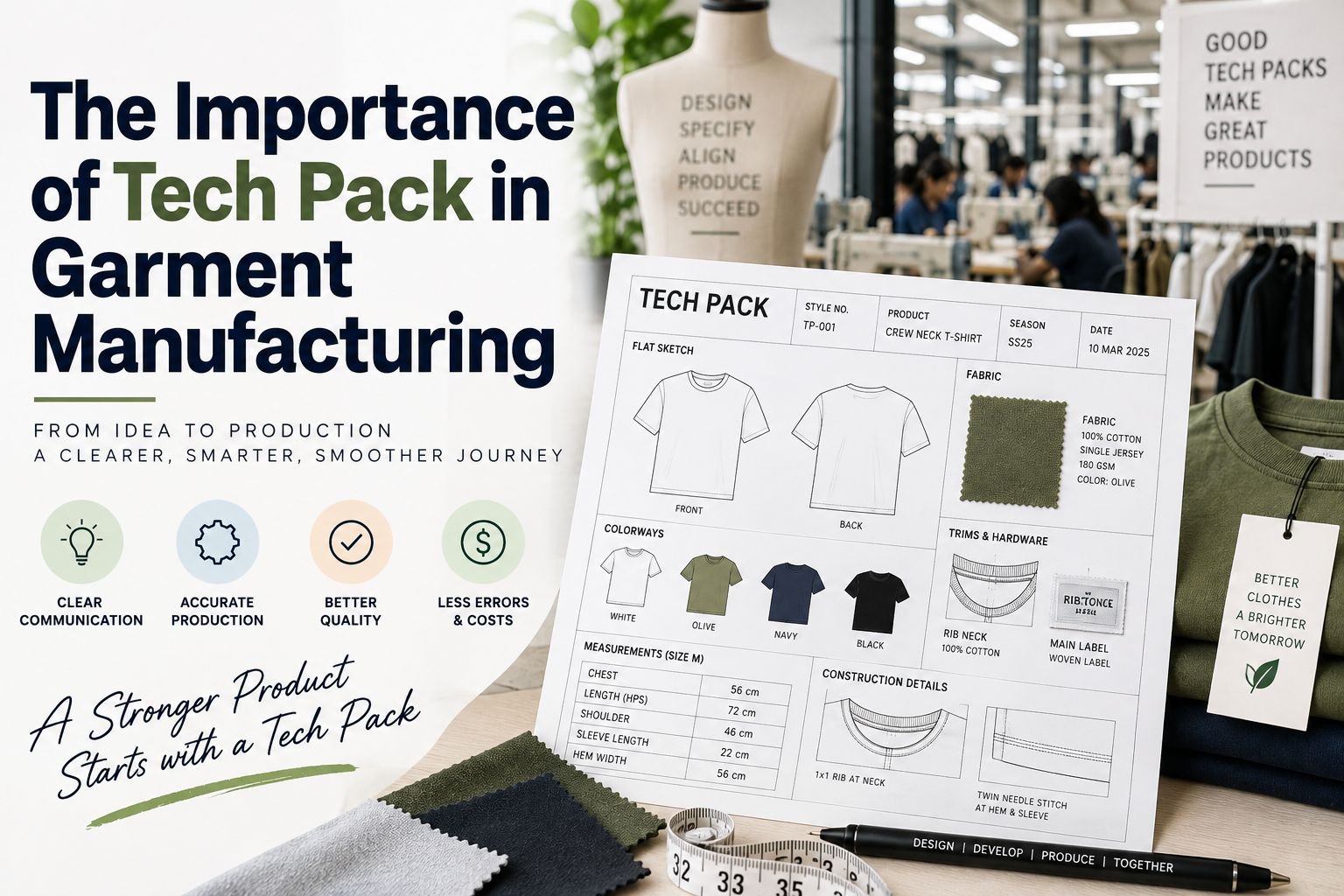
A tech pack is a detailed document that communicates the technical requirements of a garment to a manufacturer. It brings together the garment’s technical drawings, measurements, materials, construction details, trims, colors, labels, and other production instructions in one place.
In simple terms, a tech pack is the blueprint of a garment.
It takes your design idea and turns it into clear instructions that a pattern maker, sample maker, or clothing manufacturer can understand and use.
This guide explains the tech pack meaning, what a tech pack contains, why it is important, and how an apparel tech pack helps turn a fashion idea into a production-ready garment.
What Is a Tech Pack?
A tech pack, short for technical package, is a collection of technical specifications and production instructions used to manufacture a garment.
It tells a manufacturer what the product should look like, what materials should be used, how different parts should be constructed, and what measurements the finished garment should have.
A typical tech pack may include:
- Technical flat sketches
- Bill of Materials (BOM)
- Measurement specifications
- Points of Measure (POM)
- Size grading
- Construction details
- Stitching information
- Seam and hem specifications
- Fabric information
- Trims and accessories
- Color specifications
- Artwork and print placement
- Label specifications
- Packaging instructions
- Sample comments
- Revision history
The exact contents can vary depending on the product and the requirements of the manufacturer.
Tech Pack Meaning in Simple Words
The easiest way to understand the tech pack meaning is:
A tech pack is a set of instructions that tells a manufacturer exactly how a garment should be made.
Think about building a house.
An architect does not simply give a builder a photograph of a house and say, “Build this.”
The builder needs drawings, dimensions, materials, construction information, and other specifications.
A tech pack works in a similar way for clothing.
Your design may show what you want the garment to look like, but the tech pack explains how to manufacture it.
Why Is a Tech Pack Important?
A clothing design can communicate an idea, but a factory needs technical information to turn that idea into a physical product.
Without clear specifications, manufacturers have to make assumptions.
For example, if you show a factory a sketch of a T-shirt with a pocket but do not specify the pocket dimensions or exact placement, the manufacturer may interpret the design differently from what you intended.
A well-prepared tech pack reduces this uncertainty.
It creates a central reference that the designer, product developer, pattern maker, sample maker, and manufacturer can use during product development.
- Reduce misunderstandings
- Improve sample accuracy
- Communicate measurements clearly
- Specify the correct materials
- Standardize construction details
- Make factory communication easier
- Reduce unnecessary sample revisions
- Maintain consistency between production batches
- Communicate design changes
- Support quality control
The goal is simple: less guessing and more precise communication.
What Does a Tech Pack Include?
There is no single universal format that every brand must follow. Different products require different technical information.
However, a professional apparel tech pack commonly contains several important sections.
1. Technical Flat Sketches
Technical flats are clean, two-dimensional drawings of the garment.
Unlike fashion illustrations, technical flats focus on construction and product details rather than artistic presentation.
They commonly show:
- Front view
- Back view
- Side view when necessary
- Internal details
- Pockets
- Seams
- Panels
- Collars
- Cuffs
- Plackets
- Closures
- Stitching details
Callouts can be added to point out specific construction requirements.
Technical flats give the manufacturer a visual reference for the garment.
2. Bill of Materials
The Bill of Materials, commonly called a BOM, lists the materials and components required to make the garment.
Depending on the product, a BOM may include:
- Main fabric
- Lining
- Interlining
- Thread
- Buttons
- Zippers
- Snaps
- Elastic
- Labels
- Woven labels
- Hang tags
- Drawcords
- Hardware
- Packaging materials
For each component, the tech pack can specify details such as material type, color, size, supplier reference, placement, or other relevant requirements.
The BOM helps the manufacturer understand what components are required to make the product.
3. Measurement Specification
Measurements are one of the most important parts of a garment tech pack.
The measurement section defines the required dimensions of the finished garment.
It may include Points of Measure (POM), such as:
- Chest
- Body length
- Shoulder width
- Sleeve length
- Bottom opening
- Waist
- Hip
- Neck width
- Armhole
- Bicep
Each measurement can have a target value and an acceptable tolerance.
For example:
| Point of Measure | Size M | Tolerance |
|---|---|---|
| Chest | 56 cm | ±1 cm |
| Body Length | 72 cm | ±1 cm |
| Shoulder | 46 cm | ±0.5 cm |
| Sleeve Length | 62 cm | ±1 cm |
The actual measurements will depend on the garment and the brand’s fit requirements.
4. Size Grading
If a garment will be produced in multiple sizes, the tech pack can include grading information.
Grading explains how measurements change from one size to another.
For example:
XS → S → M → L → XL
Different measurements may increase or decrease by different amounts depending on the garment and the brand’s grading rules.
Proper grading helps maintain the intended fit across the entire size range.
5. Construction Details
A tech pack should communicate how the garment is constructed.
Construction information may include:
- Seam types
- Stitch types
- Seam allowance
- Hem construction
- Seam finishing
- Topstitching
- Pocket construction
- Collar construction
- Cuff construction
- Placket construction
- Reinforcement details
This information helps the manufacturer understand how different parts of the garment should be assembled.
6. Fabric Specifications
The fabric section identifies the materials that should be used.
Depending on the garment, specifications may include:
- Fiber composition
- Fabric type
- Fabric weight
- GSM
- Width
- Stretch
- Knit or woven construction
- Finish
- Fabric color
- Supplier reference
For example, instead of simply writing “cotton fabric,” a specification might identify a particular fabric construction, composition, weight, and approved color.
The more specific the requirement, the less room there is for interpretation.
7. Color and Colorway Information
A fashion tech pack may contain multiple colorways for the same style.
Color information can be documented for:
- Main fabric
- Contrast fabric
- Thread
- Labels
- Buttons
- Zippers
- Prints
- Embroidery
- Hardware
Pantone references or other approved color references may be used where appropriate.
8. Artwork, Print and Embroidery Details
If the garment contains artwork, graphics, prints, or embroidery, the tech pack should communicate their production requirements.
This may include:
- Artwork file reference
- Placement
- Width and height
- Distance from seams
- Print technique
- Embroidery dimensions
- Embroidery thread colors
- Print colors
- Artwork position
- Application method
For example, instead of simply saying “logo on chest,” the tech pack can specify the exact logo size and its distance from relevant garment reference points.
9. Label and Branding Information
Labels are another important part of a clothing tech pack.
A tech pack can specify:
- Main brand label
- Size label
- Care label
- Content label
- Country-of-origin label
- Label dimensions
- Label material
- Label placement
- Label attachment method
This makes it easier for the manufacturer to understand exactly where and how each label should be applied.
10. Packaging Requirements
Some tech packs also include packaging instructions.
These can cover:
- Folding method
- Polybag requirements
- Size stickers
- Hang tags
- Cartons
- Carton markings
- Quantity per carton
- Packaging dimensions
- Special packing instructions
Packaging requirements are particularly important when a brand has specific retail or fulfillment standards.
Tech Pack vs. Fashion Sketch
A fashion sketch and a tech pack serve different purposes.
A fashion sketch communicates the creative idea.
A tech pack communicates the technical requirements needed to manufacture that idea.
For example:
Fashion sketch:
“This is the silhouette and overall look I want.”
Tech pack:
“This is the exact fabric, measurement, construction, stitching, trim, color, artwork placement, and labeling required to produce it.”
A sketch is useful at the design stage.
A tech pack becomes especially important when the product moves toward sampling and manufacturing.
Tech Pack vs. Spec Sheet
A spec sheet and a tech pack are related, but they are not necessarily the same thing.
A spec sheet generally focuses on measurements and tolerances.
A tech pack is broader and can contain multiple sections covering the complete technical requirements of the product.
For example:
Spec sheet:
Measurements + tolerances
Tech pack:
Technical flats + BOM + measurements + grading + construction + fabric + trims + colorways + labels + artwork + packaging + other production information
Therefore, a spec sheet can be one part of a complete tech pack.
Tech Pack vs. Tech Pack Template
A tech pack template provides a structured starting point for creating a tech pack.
It may contain predefined sections such as:
- Style information
- Technical flats
- BOM
- Measurement chart
- Construction details
- Colorways
- Labels
- Packaging
- Revision history
A template can save time and help maintain consistency.
However, simply filling out a template does not automatically create a production-ready tech pack.
The information inside the document still needs to be accurate.
What Is an Apparel Tech Pack?
An apparel tech pack is a technical package specifically created for clothing products.
It translates an apparel design into production specifications that manufacturers can follow.
For example, an apparel tech pack for a T-shirt might include:
- Front and back technical flats
- Fabric specification
- Neck construction
- Sleeve construction
- Hem details
- Stitching requirements
- Measurement chart
- Size grading
- Print placement
- Label placement
- Colorways
- Packaging requirements
A jacket, dress, hoodie, trouser, or activewear product would require different technical information.
What Is a Clothing Tech Pack?
A clothing tech pack is essentially a detailed production document for a clothing style.
The purpose is to remove ambiguity between the brand and the manufacturer.
For example, a clothing brand may know that it wants a heavyweight oversized hoodie.
But “heavyweight oversized hoodie” is not enough information for a factory to manufacture the exact product.
The manufacturer still needs to know:
- Which fabric?
- What GSM?
- What measurements?
- What fit?
- Which rib?
- Which thread?
- What stitching?
- What pocket dimensions?
- Where should the logo go?
- What label should be used?
- What colors are required?
The clothing tech pack answers these questions.
What Is a Fashion Tech Pack?
A fashion tech pack is a technical document used to communicate the production requirements of a fashion product.
It connects the creative side of fashion design with the technical side of manufacturing.
A fashion designer may focus on:
Shape → Style → Color → Aesthetic
A technical designer focuses on:
Measurements → Materials → Construction → Fit → Production
The fashion tech pack brings these two sides together.
What Is a Garment Tech Pack?
A garment tech pack is a technical specification package for a specific garment style.
It provides the information needed to develop, sample, approve, and manufacture the garment.
A garment tech pack can be used by:
- Fashion designers
- Technical designers
- Product developers
- Pattern makers
- Garment manufacturers
- Sample makers
- Quality control teams
- Sourcing teams
It becomes a shared reference throughout the product development process.
Who Uses a Tech Pack?
A tech pack is not only for factories.
Several people can use it during product development.
Fashion Designers
Designers use the tech pack to communicate the intended design details.
Technical Designers
Technical designers create and manage measurements, construction specifications, and technical details.
Product Developers
Product developers use tech packs to coordinate product development and communicate with suppliers.
Pattern Makers
Pattern makers use technical specifications and measurements when developing patterns.
Manufacturers
Manufacturers use the tech pack to understand what needs to be produced.
Quality Control Teams
Quality teams can compare finished garments against the approved specifications.
When Do You Need a Tech Pack?
A tech pack is most useful when your design moves from an idea toward actual product development.
A typical workflow may look like this:
Idea → Design → Tech Pack → Pattern → Sample → Fit Review → Revision → Approval → Production
The exact process can vary between brands and manufacturers.
Creating technical documentation before sampling gives the manufacturer a clearer understanding of what you want them to make.
Can You Make a Tech Pack Yourself?
Yes.
A designer or brand founder can create a tech pack themselves if they understand the technical requirements of the product.
Common tools used to create tech packs include:
- Adobe Illustrator
- Adobe InDesign
- Excel or Google Sheets
- Specialized tech pack software
- PLM systems
- Canva
However, the software is not the most important part.
Accuracy is more important than the tool.
A beautiful document with incorrect measurements is still a poor tech pack.
A simple document containing accurate and complete production information can be much more useful.
What Makes a Good Tech Pack?
A good tech pack should be:
Clear
The manufacturer should understand the instructions without unnecessary interpretation.
Accurate
Measurements, materials, artwork, and construction information should be correct.
Complete
Important production information should not be missing.
Consistent
The information should agree across drawings, measurement charts, BOMs, and other sections.
Easy to Update
Product development involves changes. A good tech pack should allow revisions to be tracked.
Manufacturer-Friendly
The document should be organized in a way that makes it practical for the factory to use.
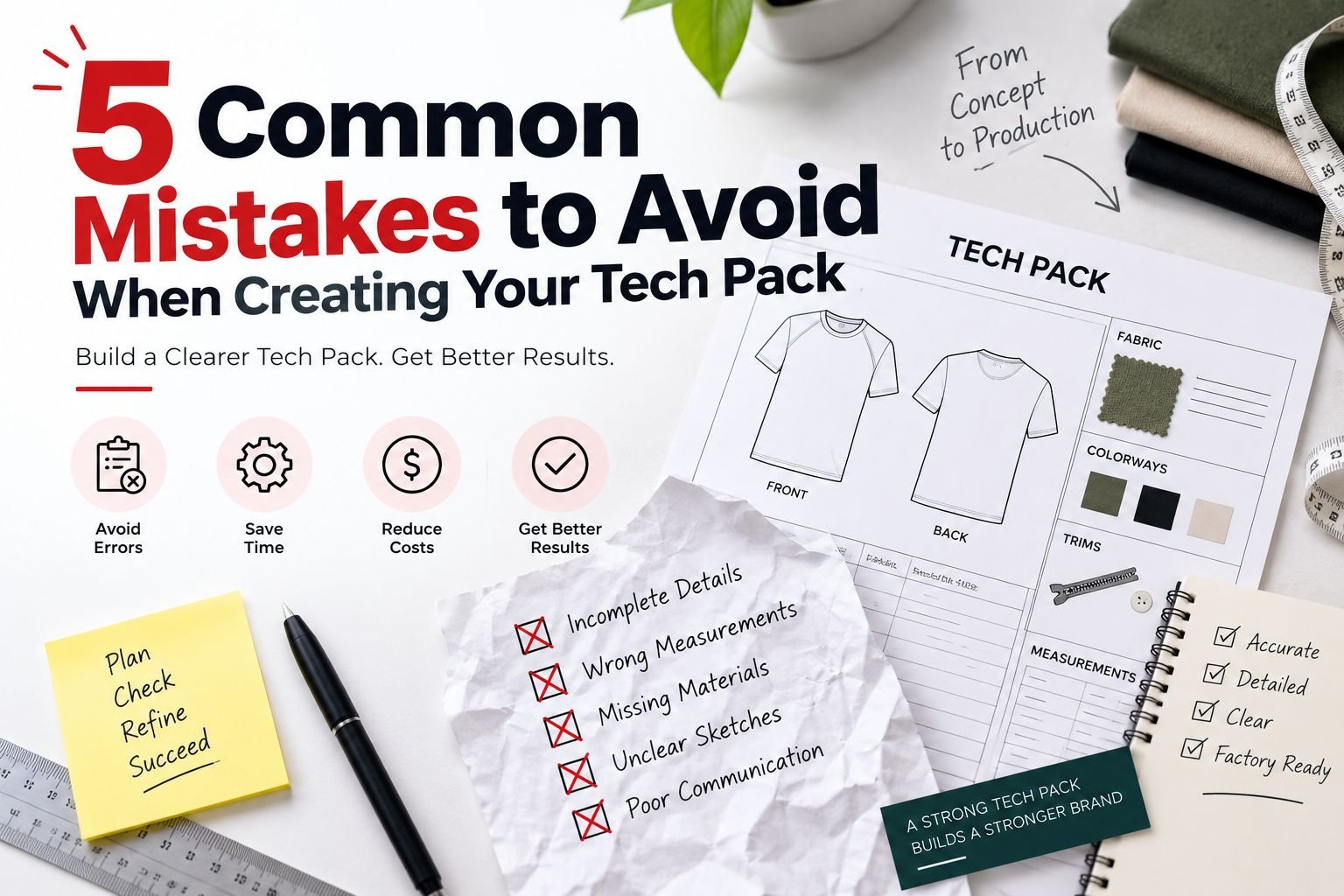
Common Tech Pack Mistakes
Even when a brand has a tech pack, problems can occur if the document is incomplete.
Common mistakes include:
- Missing measurements
- Incorrect measurements
- No tolerances
- Unclear technical drawings
- Missing construction details
- Incomplete BOM
- Vague fabric descriptions
- Missing color references
- Incorrect artwork placement
- Missing label information
- No size grading
- Conflicting information between pages
- Poor version control
The biggest problem is usually not the appearance of the document.
It is missing or inaccurate information.
Why Tech Packs Matter for New Fashion Brands
For an established fashion company, technical documentation is usually part of the product development process.
For a new fashion brand, the process may be less familiar.
A founder may have:
- A product idea
- A mood board
- A fashion illustration
- Reference images
- A sample garment
But the factory still needs technical instructions.
This is where a tech pack becomes extremely valuable.
It helps turn a creative concept into something that can be measured, sampled, reviewed, revised, and manufactured.
The Tech Pack as the Bridge Between Design and Manufacturing
The most important concept to understand is that a tech pack is a communication bridge.
On one side is the creative vision.
On the other side is manufacturing.
The designer thinks:
“This is what I want to create.”
The factory needs to know:
“This is exactly how I should make it.”
The tech pack connects these two statements.
That is why technical documentation is such an important part of apparel product development.
Tech Pack Fundamentals: Quick Checklist
Before sending a tech pack to a manufacturer, check that it contains the relevant information for your product.
Design
- Technical flats
- Detail drawings
- Design callouts
- Artwork references
Materials
- Main fabric
- Lining
- Trims
- Hardware
- Thread
- Labels
Measurements
- Points of Measure
- Base size
- Measurement specifications
- Tolerances
- Size grading
Construction
- Seam details
- Stitch types
- Hem details
- Finishing requirements
- Special construction instructions
Branding
- Logo placement
- Print specifications
- Embroidery specifications
- Label placement
- Care label requirements
Production
- Colorways
- Packaging requirements
- Sample comments
- Revision history
- Approval information
Not every product needs every item on this checklist. The required information depends on the garment.
Frequently Asked Questions About Tech Packs
What is a tech pack?
A tech pack is a technical document that communicates the specifications and production requirements of a garment to a manufacturer. It can include technical drawings, measurements, materials, construction details, colorways, labels, artwork, packaging, and other product information.
What does tech pack mean?
Tech pack is short for technical package. It refers to a collection of technical specifications and production instructions used to communicate how a product should be manufactured.
What is an apparel tech pack?
An apparel tech pack is a technical package created for a clothing product. It provides information such as technical flats, measurements, materials, construction details, grading, trims, labels, and artwork specifications.
What is a clothing tech pack?
A clothing tech pack is a detailed set of technical instructions used to communicate the requirements for producing a specific clothing style.
What is a fashion tech pack?
A fashion tech pack translates a fashion design into technical specifications that a manufacturer can use to develop and produce the garment.
What is a garment tech pack?
A garment tech pack is a production specification document containing the technical information required to develop and manufacture a particular garment.
Is a tech pack the same as a pattern?
No.
A tech pack communicates the product specifications and manufacturing requirements. A pattern is a physical or digital template used to cut the garment pieces.
They are different parts of the product development process.
Is a tech pack the same as a spec sheet?
Not necessarily.
A spec sheet generally focuses on garment measurements and tolerances, while a complete tech pack can contain many additional sections covering materials, construction, artwork, labeling, and other production requirements.
Do manufacturers need a tech pack?
Manufacturers generally need clear technical specifications to develop and produce a garment accurately. The exact documentation requirements vary by manufacturer and product, but a well-prepared tech pack provides a practical central reference for production.
Final Thoughts
A tech pack is much more than a collection of drawings and measurement tables.
It is the technical communication system that connects a fashion brand’s design idea with the manufacturing process.
A strong apparel tech pack, clothing tech pack, fashion tech pack, or garment tech pack gives manufacturers the information they need to understand the product and reduces unnecessary guesswork.
The basic idea is simple:
Your design shows what you want.
Your tech pack explains how to make it.
If you are serious about turning fashion ideas into production-ready garments, understanding the fundamentals of tech packs is one of the most important steps in the product development process.
Ready for Production?
Get a professional tech pack for your fashion design.
Table of Contents