Do I Need Separate Tech Packs for Different Sizes? Here’s the Truth Nobody Tells New Brands
Picture this: you finally get your first bulk order back from the factory. You rip open the box, buzzing with excitement — and your Small looks like a Medium, your Large fits like an XL, and your whole size run is a mess.
You didn’t mess up the design. You messed up the paperwork behind it.
This is one of the most common (and most expensive) mistakes new clothing brand founders make. And it almost always comes down to one question: do you need separate tech packs for every single size, or can one document cover them all?
Let’s clear this up completely, once and for all.
First, What Exactly Is a Tech Pack?
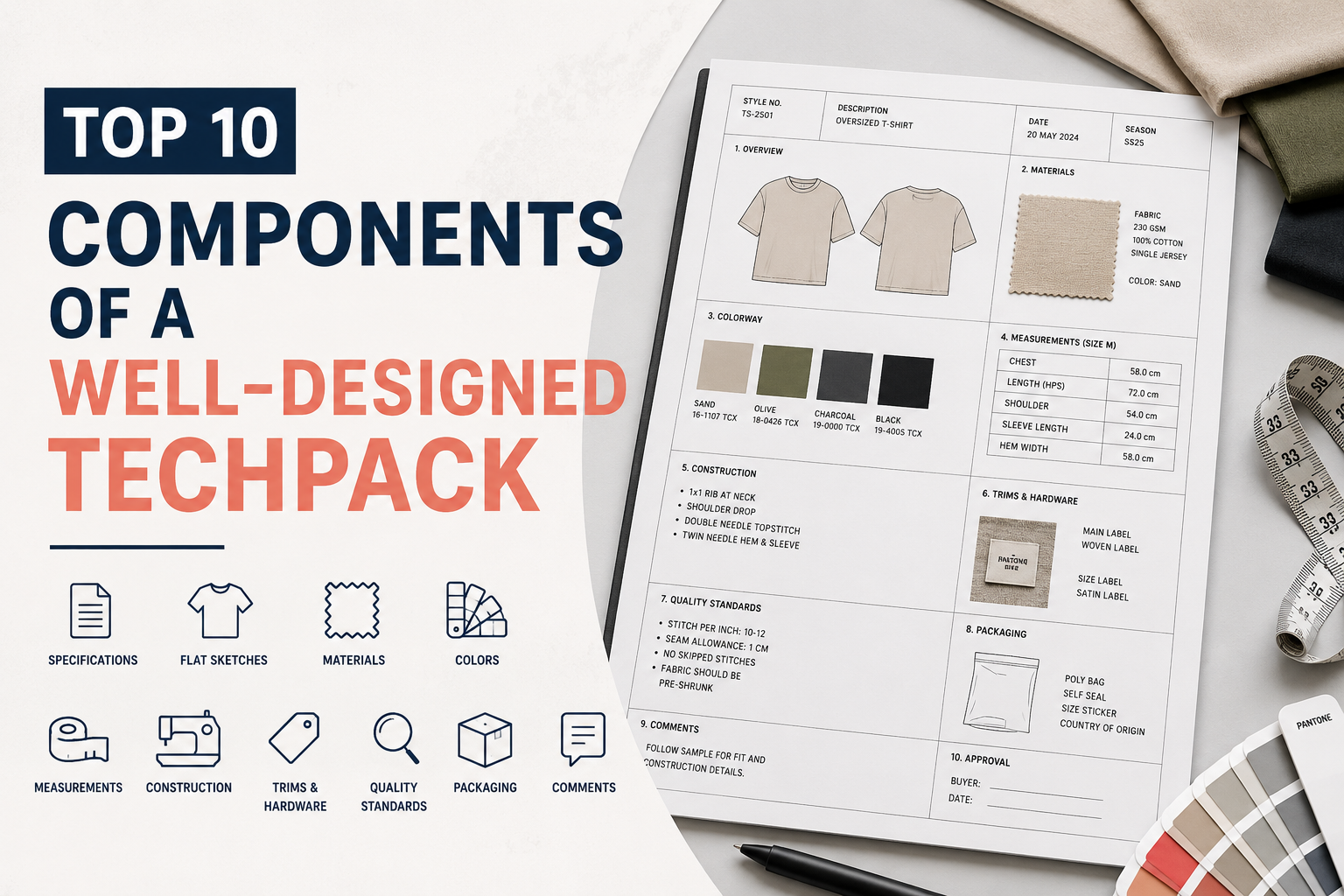
If you’re new to this, a tech pack (short for “technical package”) is basically the instruction manual you hand to your factory. It tells them exactly how to build your garment — the measurements, materials, stitching details, colors, and trims.
Think of it like an architect’s blueprint. A builder can’t guess how many floors your house should have. A factory can’t guess how your hoodie should fit either.
Without a proper tech pack, you’re not manufacturing — you’re gambling.
So, Do You Need a Separate Tech Pack for Every Size?
Here’s the short answer: No, you don’t need a completely separate tech pack for each size. But you absolutely need a proper size grading system inside your one tech pack.
That’s the part most beginners get wrong. They think “one size = one tech pack,” so either they:
- Make one tech pack with only one size (usually Medium) and hope the factory “figures out” the rest, or
- Try to create 5–6 totally separate documents for XS through XL, which becomes messy and inconsistent.
Neither approach works well. The real professional method is called size grading, and it lives inside one single, well-organized tech pack.
What Is Size Grading? (Explained Simply)
Size grading is the process of increasing or decreasing your base measurements by a fixed amount, size by size, to create a full and consistent size range.
Let’s say you design your T-shirt starting with a Medium as your base size (also called the “sample size” or “fit size”). From there:
- A Small is graded down from the Medium.
- A Large is graded up from the Medium.
- Every size follows the same logic in equal, predictable steps.
For example, if your chest width grows by 2 inches from Small to Medium, it should also grow by roughly 2 inches from Medium to Large, and so on — unless your brand intentionally uses a different grading rule for a specific size range (which some brands do for plus-size or petite lines).
This is why one tech pack, containing a full graded size chart, is far more reliable than five random, disconnected files.
Why One Graded Tech Pack Beats Multiple Separate Ones
Let’s talk about why fashion factories, technical designers, and experienced brands almost always prefer one master tech pack with a size chart — not five separate files.
1. Consistency Across Sizes
When every size sits in one chart, it’s easy to visually check that growth between sizes is even. Separate files hide inconsistencies until the samples arrive — and by then, it’s too late and costly to fix.
2. Fewer Costly Mistakes
Factories cross-reference measurements constantly while cutting and sewing. If your data is scattered across six different files, something will get missed. One clear document reduces human error dramatically.
3. Easier for Factories to Quote and Produce
Manufacturers price and plan production based on your full size run. A single tech pack with a clean grading chart lets them see your entire order at a glance — which usually means faster quotes and fewer confused emails back and forth.
4. Saves You Money and Time
Every time a factory has to stop and ask “wait, which file has the Large measurements?”, you lose days. Multiply that across every size and every style, and you can see how quickly delays add up.
This is exactly the kind of structural gap we fix every day at TechPackGenius — turning scattered size notes and half-finished specs into one clean, factory-ready document your manufacturer can act on immediately.
What a Properly Graded Tech Pack Should Include
If you’re building this yourself, here’s what your size section needs, at minimum:
- Base size (Sample size): The size your first sample and fit approval are built around — usually S or M.
- Points of Measure (POM): Every measurement point on the garment — chest, waist, hip, sleeve length, shoulder width, and so on.
- Grade rules: The exact amount added or subtracted between each size, per measurement point.
- Full size range chart: Every size (XS to XXL, or whatever your range is) laid out side-by-side in one table.
- Tolerance levels: The acceptable +/- variance factories are allowed (usually ±0.5 cm to ±1 cm), since fabric and machines are never 100% perfect.
If any one of these is missing, your factory is left guessing — and guessing is exactly how sizing disasters happen.
A Real-World Example: How This Plays Out
Let’s say you’re a startup brand launching a unisex hoodie, similar to how many DTC streetwear labels have scaled out of the US, UK, and Australia.
You send your factory a tech pack with only a Medium sample and a note that says “please make in S, M, L, XL, following the same style.”
Sounds simple, right? But “following the same style” isn’t a measurement. Different factories may interpret that instruction differently — one might grade sizes by 1 inch, another by 1.5 inches. The result? Inconsistent fits across your very first collection, and unhappy customers posting size complaints on Instagram.
Now compare that to a brand that sends one clear tech pack with a graded size chart for all five sizes, clearly labeled POM by POM. The factory has zero guesswork. Production runs smoother, samples come back closer to accurate on the first try, and reorders become far easier because the specs are already locked in.
That difference — one clear document versus vague instructions — is often the line between a smooth launch and a costly reprint.
What About Plus-Size, Petite, or Extended Size Ranges?
This is where things get slightly more nuanced. Standard grading (equal jumps between every size) doesn’t always work perfectly for extended ranges.
Many established brands use split grading, where:
- Regular sizes (XS–XL) follow one consistent grade rule.
- Extended sizes (2XL–5XL, for example) follow a slightly larger or adjusted grade rule, because body proportions don’t scale in a perfectly straight line at larger sizes.
If your brand plans to offer an extended size range, it’s worth deciding this early and building it into your tech pack from day one — rather than trying to bolt it on later after your standard sizes are already locked.
Common Mistakes Founders Make With Size Tech Packs
Let’s go through the sizing mistakes we see most often from first-time clothing brand founders:
1. Sending only one size and assuming the factory will “just scale it.” Factories will grade based on their own default rules if you don’t specify yours — and their default may not match your brand’s intended fit at all.
2. Copying a size chart from a random template online. Generic templates from the internet are rarely built around your specific garment, fabric type, or target market’s body measurements.
3. Mixing inches and centimeters inconsistently. This single mistake alone causes major production errors, especially when working with overseas factories.
4. Not including tolerance levels. Without tolerance ranges, a factory technically has no defined limit for how far off a garment can be before it’s considered a defect.
5. Ignoring finished garment measurements vs. body measurements. Your size chart for customers (body measurements) and your factory’s cut specs (finished garment measurements, which include ease) are two different things — and mixing them up leads to garments that don’t match your published size guide.
Quick Checklist: Is Your Size Chart Factory-Ready?
Before sending your tech pack to production, run through this checklist:
- Base/sample size is clearly marked
- All Points of Measure are listed for every size
- Grade rules are specified between each size jump
- Tolerance levels are included
- Units (cm or inches) are consistent throughout
- Finished garment measurements are used, not just body measurements
- Extended sizes (if any) use appropriate split grading
If you can check every box, your tech pack is in solid shape. If not, that’s usually a sign it needs a professional pass before it reaches your manufacturer.
How TechPackGenius Helps With This
This is genuinely one of the most common fixes we make for founders who come to us with a “half-finished” tech pack — usually a nice flat sketch with only one size’s measurements and a vague note like “grade as needed.”
At TechPackGenius, every tech pack we build includes a complete, properly graded size chart with clear POMs, grade rules, and tolerance levels — built specifically around your garment, not copy-pasted from a template. That’s part of what makes a tech pack genuinely factory-ready, instead of just good-looking.
Whether you’re a solo founder prepping your first small-batch run or an established label scaling into a new size range, getting this right the first time saves you real money in samples, reprints, and returns.
Final Thoughts: One Tech Pack, Done Right
You don’t need five, six, or ten separate tech packs for every size you offer. What you need is one well-structured tech pack with a properly graded, complete size chart — built by someone who understands how factories actually read and use this information.
Get this piece right, and your factory will produce consistent, accurate sizing across your entire range — the first time, not after three rounds of costly sample corrections.
If your current tech pack only has one size filled in, or your grading feels like a guess rather than a system, don’t wait for a bulk order to expose the gap. Fix it before production, not after.
Ready to get a complete, factory-ready tech pack with accurate size grading built in? [Get your tech pack built by TechPackGenius today.]
Frequently Asked Questions (FAQs)
1. Do I need a different tech pack for every size I sell? No. You need one tech pack that includes a complete, properly graded size chart covering all your sizes — not separate documents for each size.
2. What is a “base size” in a tech pack? The base size (or sample size) is the size your first prototype is built and fit-tested on, usually Small or Medium. All other sizes are graded up or down from it.
3. What’s the difference between body measurements and garment measurements? Body measurements describe the actual human body. Garment measurements describe the finished product, including extra room (ease) for comfort and movement. Factories cut based on garment measurements, not body measurements.
4. What is a grade rule? A grade rule is the fixed amount added or subtracted at each measurement point when moving from one size to the next, like adding 2 cm to the chest width for every size up.
5. Do plus-size or extended ranges need different grading? Often yes. Many brands use split grading, applying a different (usually larger) grade rule for extended sizes like 2XL–5XL, since proportions don’t scale evenly at larger sizes.
6. What happens if my tech pack doesn’t include tolerance levels? Without tolerance levels, factories have no clear standard for how much variance is acceptable, which can lead to disputes over whether a garment is defective or within normal production variation.
7. Can I fix a tech pack that only has one size filled in? Yes. A technical designer can build out a full graded size chart based on your existing sample measurements — this is one of the most common fixes requested by early-stage brands.
Table of Contents