Tech Pack Mistakes That Cost Me Money (And How to Avoid Them)
I still remember the invoice. $2,400. Gone. Not because the factory scammed me — because my tech pack had a mistake on page 4 that nobody caught until 300 units were already cut.
That one line item taught me more about running a clothing brand than any course ever did.
If you’re building a fashion brand right now, I want to save you that $2,400 lesson. Because tech pack mistakes don’t just cost money — they cost time, trust with your factory, and sometimes your entire production run.
What Exactly Is a Tech Pack (In Plain English)
Before we get into the mistakes, let’s make sure we’re on the same page.
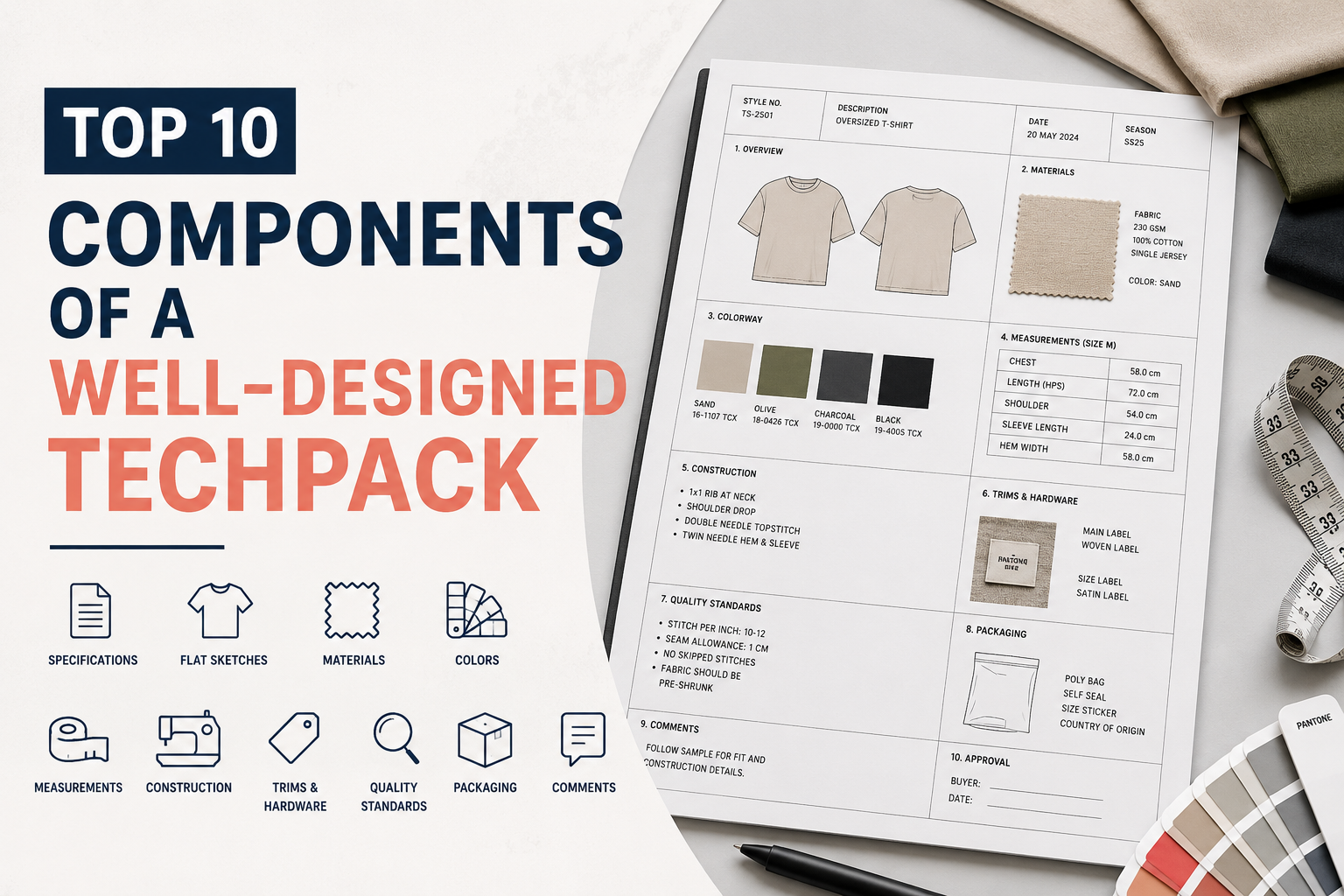
A tech pack (technical package) is basically the instruction manual you hand to a garment factory. It tells them exactly how to build your product — measurements, materials, colors, stitching details, labels, packaging — everything.
Think of it like a blueprint for a house. You wouldn’t tell a contractor “build me a nice house” and walk away. You’d give them drawings, dimensions, and material specs. A tech pack does the same job for clothing.
No tech pack, or a bad one, means the factory has to guess. And factories don’t guess in your favor — they guess in the way that’s fastest and cheapest for them.
Why Tech Pack Mistakes Are So Expensive
Here’s the part most new founders don’t realize until it’s too late.
A mistake in your tech pack doesn’t cost you once. It costs you at every single stage:
- Sampling stage — you pay for a sample that’s wrong, then pay again for the corrected one.
- Bulk production stage — if the mistake slips through, you’re now paying for hundreds of wrong units.
- Shipping stage — wrong products still get shipped, and returns eat your margin twice.
- Time stage — every round of “wait, this isn’t right” adds 1–3 weeks to your timeline.
One small error on paper can multiply into thousands of dollars by the time it reaches your customer’s doorstep. That’s exactly what happened with my $2,400 lesson — a single missing measurement tolerance turned into a full re-cut of fabric.
Let’s go through the mistakes that actually cause this, one by one.
Mistake #1: Missing or Vague Measurements
This is the single biggest money-killer I’ve seen — in my own brand and in the 100+ tech packs I’ve reviewed for clients.
Founders often write measurements like “medium fit” or “true to size.” That means absolutely nothing to a factory in Bangladesh, Vietnam, or China. Every factory has a different idea of “medium.”
What happens instead: the factory picks their own standard block pattern, and your “medium” comes out sized completely differently from what you imagined.
The fix:
- Always give a full measurement spec sheet — chest, waist, hip, sleeve length, shoulder width, hem, etc. in both cm and inches.
- Include tolerance levels (example: chest ± 1 cm). This tells the factory how much variation is acceptable.
- Use a size grading chart if you’re making multiple sizes, not just one sample size.
A real example: A POD (print-on-demand) hoodie brand I worked with was getting complaints that their “unisex L” ran huge in the US but tiny when a different factory produced it for their EU customers. The tech pack had no exact measurements — just “standard L.” Fixing that one gap solved 80% of their return requests.
Mistake #2: Skipping the Bill of Materials (BOM)
The BOM (Bill of Materials) is the full list of every material used to make your product — fabric, thread, zippers, labels, buttons, trims, packaging.
A lot of first-time founders skip this or leave it vague, thinking “the factory will just use good quality stuff.”
They won’t. Factories work off written instructions, not assumptions.
What a proper BOM should include:
- Fabric type, GSM (fabric weight), and composition (e.g., 100% cotton, 240 GSM)
- Trim details — zipper brand/type, button size, drawstring material
- Label and tag specifications
- Packaging material (poly bags, boxes, hang tags)
Real scenario: A streetwear founder ordered 500 hoodies expecting heavyweight 320 GSM fleece. His tech pack just said “cotton fleece.” The factory sent 220 GSM — noticeably thinner. He had to eat the cost of the entire batch because, on paper, they technically fulfilled the order.
Always write exact numbers. GSM, thread count, fabric composition percentages — these are not “nice to have.” They’re the difference between a premium product and a flimsy one.
Mistake #3: No Clear Callouts or Construction Details
A callout is a small note pointing to a specific part of the garment explaining exactly how it should be built — like “topstitch 1/4 inch from edge” or “double-needle stitch on hem.”
Many founders send beautiful flat sketches with zero construction notes. It looks like a design file, not a manufacturing document.
Without callouts, the factory’s sample-maker fills in the blanks using their own default methods — which may not match your brand’s intended quality or style.
What to add instead:
- Stitch type and placement (single needle, double needle, overlock, etc.)
- Seam allowance measurements
- Special construction notes (reinforced stress points, French seams, topstitching width)
Example: A denim brand wanted raised, visible topstitching as a signature design detail. Their tech pack only showed a flat sketch with no callout. The sample came back with standard hidden stitching — the exact opposite of their brand identity. That round of samples cost them three weeks and a re-order fee.
Mistake #4: Inconsistent or Missing Colorway Information
Color mistakes are sneaky because they often don’t show up until the fabric is already dyed.
If your tech pack says “navy blue” without a Pantone code, you’re leaving color interpretation completely up to the factory’s dye lab — and every lab interprets “navy” differently.
The fix:
- Always include Pantone (PMS) codes for every color used.
- If Pantone isn’t available, provide a physical fabric swatch or a hex code as backup reference, though Pantone is always the industry standard.
- List every colorway (color variation) separately with its own code — don’t assume the factory will “figure out” your color story from one image.
Real example: An activewear brand wanted a specific sage green. The tech pack described it only as “sage green, earthy tone.” The factory’s dye batch came out more olive than sage. Because there was no Pantone reference, there was no way to dispute the mismatch — the factory technically matched the vague description they were given.
Mistake #5: No Revision History or Version Control
This mistake is invisible until it isn’t — and then it’s a disaster.
When you’re going back and forth with a factory across multiple sample rounds (Proto, PP, SMS, TOP), it’s incredibly easy to lose track of which version is the “final” one.
I’ve seen founders accidentally approve bulk production based on an outdated tech pack version because there was no clear labeling of what changed and when.
The fix:
- Add a simple version history table at the top or bottom of your tech pack: Version 1.0, 1.1, 1.2, with dates and a one-line note on what changed.
- Clearly mark the final approved version before bulk production begins.
- Never rely on email chains to track changes — put it in the document itself.
This one habit alone prevents one of the most expensive mistakes in the entire production process: approving the wrong version for mass production.
Mistake #6: Ignoring Sample Rounds and Factory Feedback
A tech pack isn’t a “send it once and forget it” document. It should evolve through the sampling process.
Founders who ignore factory feedback during the Proto Sample or PP (Pre-Production) Sample stage often end up with problems baked into the final bulk order.
Common sample stages you should know:
- Proto Sample — first rough version to check fit and construction
- PP Sample (Pre-Production Sample) — refined version, closer to final
- SMS (Sales Sample/Shipment Sample) — used for selling or marketing before bulk ships
- TOP (Top of Production Sample) — pulled from the actual bulk run to confirm consistency
If a factory flags an issue — say, a zipper that keeps jamming, or a fabric that shrinks more than expected — and you don’t update the tech pack to address it, that same issue will repeat across the entire bulk order.
Practical tip: Treat every sample round as a chance to tighten your tech pack, not just approve or reject the garment. Update the document itself every time something changes.
Mistake #7: Using Vague Language Instead of Precise Specs
This is a subtle one, but it costs founders constantly.
Words like “soft fabric,” “nice finish,” “good stitching,” or “premium feel” sound fine in a pitch deck — but they’re meaningless to a factory that needs exact numbers.
Replace vague language with specifics:
| Vague Term | Specific Replacement |
|---|---|
| “Soft fabric” | “180 GSM combed cotton, 30s single jersey” |
| “Good stitching” | “Single needle topstitch, 1/8 inch from seam” |
| “Nice fit” | Full measurement spec sheet with tolerances |
| “Durable zipper” | “YKK #5 metal zipper, antique brass finish” |
Precision protects you. Vague language gives the factory room to interpret things in whatever way is cheapest or fastest for them — which is rarely what you had in mind.
Mistake #8: Skipping Labeling and Packaging Details
This mistake usually shows up right at the finish line — when your product looks perfect, except the label is stitched in the wrong place, or the poly bag is the wrong size.
Labeling and packaging are often treated as an afterthought in tech packs, added as a quick note instead of a full spec.
What your tech pack should specify:
- Label size, placement, and stitching method (woven label, printed label, heat transfer)
- Care label content — required for many countries by law
- Hang tag placement and attachment method
- Packaging type — poly bag size, folding method, box specifications for shipping
For global brands selling in multiple countries, care labels are especially important. The US, EU, and other regions often have different labeling requirements, and getting this wrong can create compliance headaches beyond just aesthetics.
Mistake #9: Not Accounting for MOQ and Fabric Cuts
MOQ (Minimum Order Quantity) mistakes usually happen because founders design a tech pack without fully understanding how it affects fabric usage and factory cutting efficiency.
If your tech pack specifies unusual cuts, multiple fabric types in one garment, or complex trims, factories often need higher MOQs to make it worth their setup cost.
Practical tip: When designing your tech pack, ask your factory contact early: “Does this construction affect my MOQ or cost?” Small design tweaks — like simplifying a seam or switching to a more common trim size — can sometimes cut your MOQ requirement significantly without changing your product’s look.
Mistake #10: DIY-ing a Tech Pack With Zero Industry Experience
I get why this happens. Hiring a professional tech pack service feels like an extra cost when you’re bootstrapping a brand. So founders use a template found online, or worse, sketch it themselves in Canva.
The problem isn’t ambition — it’s that a tech pack is a technical manufacturing document, not a design mockup. One missing spec can undo the savings of doing it yourself many times over.
A simple gut-check before going the DIY route:
- Do you know exact GSM and fabric composition for every material?
- Can you specify tolerances for every measurement point?
- Do you know construction terminology well enough to write clear callouts?
- Have you built size grading charts before?
If the honest answer is “no” to most of these, it’s worth getting a professional tech pack made — even once — just to see what a complete, factory-ready document actually looks like. Many founders use that first professional tech pack as a template for future styles.
Quick Checklist: Before You Send Your Tech Pack to a Factory
Before hitting send, run through this list:
- Full measurement spec sheet with tolerances (in cm and inches)
- Complete Bill of Materials with GSM, composition, and trims
- Construction callouts for every seam and stitch type
- Pantone codes for every color and colorway
- Version history clearly labeled
- Label and packaging specifications
- Size grading chart (if multiple sizes)
- Care label content confirmed for your target market
- Sample feedback incorporated into the latest version
If you can tick every box, you’re in a strong position to avoid the mistakes that quietly drain founders’ budgets every single day.
Final Thoughts: Your Tech Pack Is Your Insurance Policy
A tech pack isn’t paperwork you rush through to “get to the fun part” of building your brand. It’s the single document standing between your vision and what actually shows up at your customer’s door.
Every mistake on this list is fixable — and every fix is far cheaper than the mistake itself. The founders who protect their margins long-term are the ones who treat their tech pack as seriously as their factory does.
If you’re about to send your product idea into production, take one more look at your tech pack first. That extra hour of review could save you the kind of money I lost on page 4 of mine.
Frequently Asked Questions
1. What is the most common tech pack mistake new brands make? Missing or vague measurements. Terms like “medium fit” without exact numbers and tolerances lead to sizing inconsistencies across production batches.
2. Do I need a tech pack for a small batch or POD order? Yes. Even small or print-on-demand orders benefit from a tech pack, since it prevents costly reprints and ensures consistent quality across every unit.
3. What’s the difference between a tech pack and a spec sheet? A spec sheet usually covers measurements only, while a tech pack is the complete document — measurements, BOM, callouts, colors, labeling, and packaging all in one.
4. How much does a professional tech pack usually cost? Pricing varies by complexity, but many services charge per style, often in the range of $75–$350 depending on detail level and revisions included.
5. Can I edit my tech pack after sending it to the factory? Yes, and you should if issues come up during sampling. Just make sure every revision is version-labeled so the factory always works from the latest approved copy.
6. What software do people use to make tech packs? Common tools include Adobe Illustrator, CLO3D, and specialized tech pack software, though many founders now outsource this to professional tech pack services for faster turnaround.
7. How do I know if my tech pack is factory-ready? If it includes full measurements with tolerances, a complete BOM, construction callouts, Pantone colors, and packaging specs, it’s generally considered factory-ready.
Table of Contents