Did you know Why Clothing Manufacturers Need Tech Packs?
The $4,000 Mistake That Never Had To Happen

A first-time founder in Los Angeles once sent her Clothing Manufacturers in Vietnam a single reference photo, a rough sketch, and a WhatsApp message that said “make it like this, but nicer.”
Six weeks later, 500 hoodies arrived. Wrong hood shape. Wrong drawstring. Fabric that felt nothing like the mock-up she had dreamed about for months.
She lost close to $4,000, three months of runway, and almost her entire launch collection — all because of one missing document: a tech pack.
If that story makes your stomach drop a little, good. Because this happens every single day, in every corner of the world, to founders who are smart, passionate, and completely unaware that one file could have saved them.
So, What Exactly Is a Tech Pack?
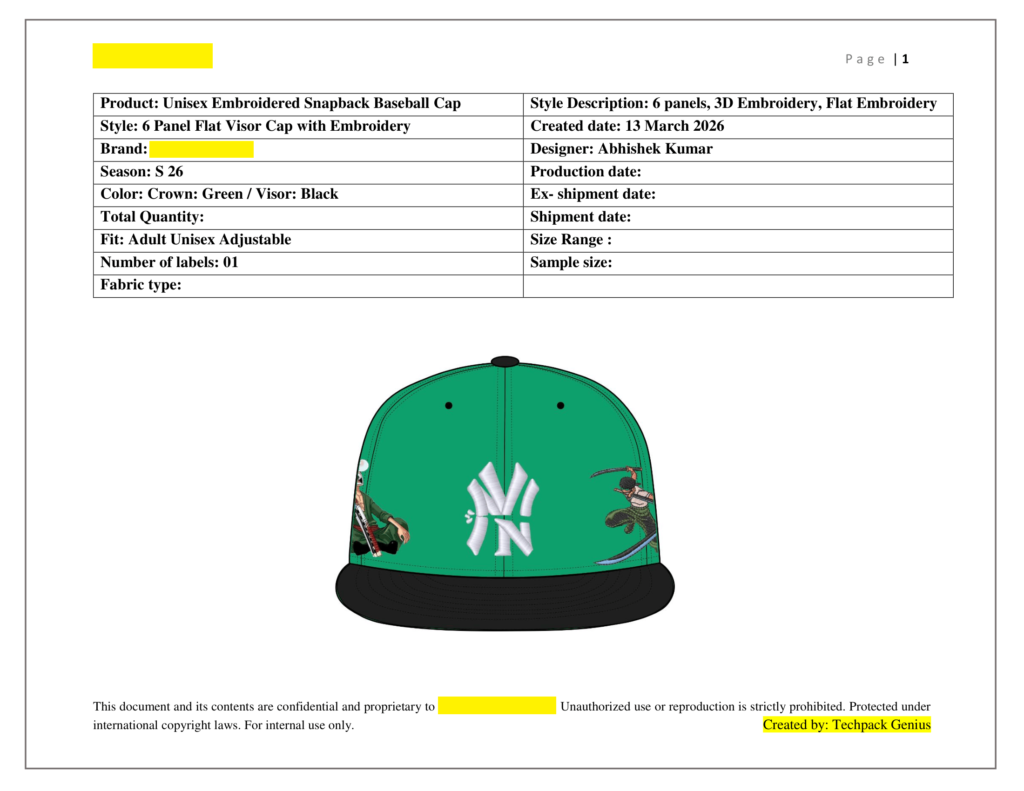
Think of a tech pack as the “instruction manual” for your garment — except instead of building furniture, your factory is building your brand.
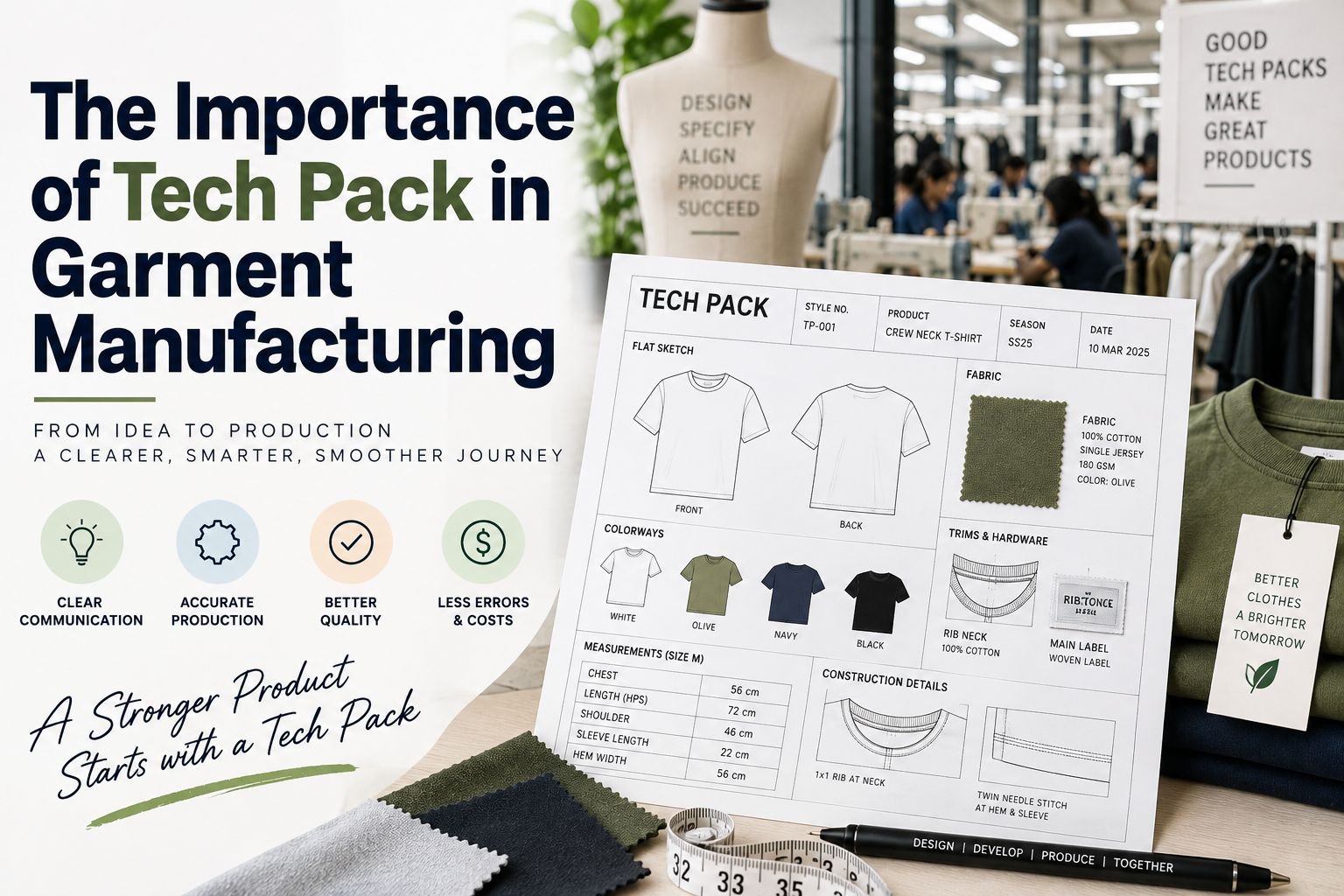
A tech pack is a detailed document that tells a manufacturer exactly how to construct a garment: the measurements, materials, colors, stitching, trims, labels, and packaging — all in one place, with zero guesswork.
It’s not a moodboard. It’s not a sketch on a napkin. It’s a technical blueprint that speaks the same language a production manager, pattern maker, and sewing line operator all understand.
Here’s the simple truth: factories don’t build your vision — they build your instructions. If your instructions are vague, your product will be vague too.
Why Clothing Manufacturers Actually Need This Document (Not Just Want It)
Founders sometimes assume tech packs are a “nice to have” for polished, big-budget brands. In reality, factories depend on them to function properly — and here’s why.
1. Factories Run on Precision, Not Imagination
A factory floor isn’t a creative studio. It’s a precision operation with dozens of workers each doing one repetitive task — cutting, stitching, finishing — often without ever seeing the full picture of your design.
Without exact specs, every worker fills the gaps with their own assumptions. And when ten people guess differently, you get ten different results stitched into one inconsistent batch.
A tech pack removes the guesswork by giving every station the same reference point.
2. It Prevents Costly Miscommunication Across Language and Culture
Most apparel founders don’t manufacture in their own country. Your factory might be in China, Bangladesh, Turkey, Portugal, or India — while you’re sitting in the US, UK, Australia, or UAE.
Even with a shared language, fashion terminology varies wildly by region. A “raglan sleeve” or “French seam” might mean something slightly different depending on who’s reading it.
A tech pack uses universal technical language, diagrams, and measurements — the one format that translates cleanly across borders, accents, and time zones.
3. It Protects You From Sample After Sample After Sample
Every sample round costs money and time — often 2 to 4 weeks per round, plus shipping and sample fees.
Founders without tech packs often go through 4, 5, even 8 rounds of samples before getting it right. Founders with a solid tech pack? Usually 1 to 3 rounds, because the factory had clarity from day one.
That difference alone can save you months of launch delays.
4. It Becomes Your Legal and Quality Safety Net
If a factory delivers garments that don’t match agreed specs, a tech pack is your proof.
Without one, you have no documented standard to hold them accountable to — and disputes become a “he said, she said” situation that almost always favors the manufacturer.
With one, quality control becomes measurable: right or wrong, matched or not matched.
What Actually Goes Inside a Tech Pack?
A complete tech pack usually includes these core sections:
- Flat sketches (front & back) — technical line drawings, not artistic illustrations
- Measurement spec sheet — exact measurements in a size grade (XS–XXL or numeric sizing)
- Bill of Materials (BOM) — every fabric, trim, zipper, button, and label used
- Colorways — Pantone codes so colors are consistent across production runs
- Stitch and construction details — seam types, stitch per inch (SPI), topstitching width
- Labeling and packaging instructions — care labels, hang tags, poly bag specs
- Grading rules — how measurements scale up/down across sizes
- Artwork placement — exact positioning for prints, embroidery, or patches
Each of these isn’t decoration — it’s a direct answer to a question your factory would otherwise have to guess.
Beginner-Friendly Breakdown: Confusing Terms, Explained Simply
If you’re new to this world, some of these words can feel like a foreign language. Here’s the plain-English version:
- BOM (Bill of Materials): A shopping list of every material used to make your garment.
- GSM: Grams per square meter — basically how heavy or thick a fabric is. Higher GSM = heavier fabric.
- MOQ: Minimum Order Quantity — the smallest number of units a factory will produce per style or color.
- CMT (Cut, Make, Trim): A manufacturing model where you supply the fabric and the factory just cuts, sews, and finishes.
- Grading: Scaling one sample size up or down to create a full size range.
- SPI (Stitches Per Inch): How tightly a seam is stitched — affects durability and finish quality.
Once you know these terms, factory conversations stop feeling intimidating and start feeling like a normal business discussion.
Real Scenarios From Around the Fashion World
Scenario 1 — The Streetwear Founder in the UK A London-based streetwear brand wanted oversized, boxy hoodies. Without exact body measurements and grading rules, their factory in Portugal produced hoodies that fit like regular fit — completely missing the “oversized” identity that defined the brand.
Scenario 2 — The POD Creator in Australia A print-on-demand entrepreneur sent artwork files but no placement guide. The factory centered the design too low, and half the print got cut off at the seams. A single placement diagram in a tech pack would have prevented the entire reprint.
Scenario 3 — The Sustainable Brand in Canada A founder wanted GOTS-certified organic cotton at a specific GSM for breathability. Without listing the exact GSM and fiber content in a BOM, the factory sourced a similar-looking but heavier, non-certified fabric — breaking both the brand promise and the sustainability claim.
Each of these stories shares one root cause: information that existed only in the founder’s head, never made it onto paper.
Practical Tips You Can Apply Right Now
- Never rely on verbal or chat instructions alone. WhatsApp messages get lost, forgotten, or misread — a tech pack doesn’t.
- Always include exact measurements in centimeters and inches. Different regions default to different units; give both to avoid confusion.
- Attach real fabric swatches or Pantone codes, not just “navy blue” or “olive green” — color names mean different things to different people.
- Specify tolerance levels (example: bust ±1cm) so minor manufacturing variance doesn’t become a rejection dispute.
- Update your tech pack after every sample round. Treat it as a living document, not a one-time file.
- Keep one master tech pack per style, and version it (V1, V2, V3) so nothing gets mixed up across seasons.
Who Benefits Most From a Strong Tech Pack?
- New clothing brand founders launching their first collection who can’t afford costly sample mistakes.
- Ecommerce apparel sellers scaling into private label manufacturing for the first time.
- Print-on-demand creators moving from platforms like Printful into their own bulk manufacturing.
- Established designers expanding into new categories (say, moving from tees into outerwear) where construction complexity jumps significantly.
- Sustainable and ethical brands that need documented proof of materials and sourcing standards.
If you fall into any of these categories, a tech pack isn’t optional polish — it’s the foundation your entire production process stands on.
The Bigger Picture: Tech Packs Build Trust, Not Just Products
Here’s something most founders don’t realize until they’ve been burned once: manufacturers actually prefer working with brands that send professional tech packs.
It signals seriousness. It reduces back-and-forth emails. It shows the factory you understand the process, which often earns you better pricing, faster turnaround, and priority production slots — because you’ve made their job easier, not harder.
In an industry where factories juggle dozens of clients at once, being the “easy, clear” client is a genuine competitive advantage.
Final Thoughts: Don’t Let a Missing Document Cost You Your Launch
Fashion is an emotional business — you’re not just making garments, you’re building a story people want to wear. But that story only survives the trip from your imagination to a factory floor if it’s translated into a language manufacturers can execute perfectly.
A tech pack is that translation. It’s the difference between hoping your factory understands you, and knowing they can’t misunderstand you.
Before you send your next design to production, ask yourself honestly: if I disappeared right now, could a stranger in a factory build this exact garment using only what I’ve given them?
If the answer is no, it’s time to build a real tech pack — before your next sample round becomes your next expensive lesson.
Frequently Asked Questions
1. What happens if I send a factory a design without a tech pack?
The factory will fill in missing details with assumptions, which usually leads to sizing errors, wrong materials, or construction mistakes — often requiring costly reproduction.
2. Do small or POD brands really need a full tech pack?
Yes. Even a single-style POD launch benefits from a basic tech pack covering measurements, artwork placement, and material specs — it prevents misprints and fit issues.
3. How is a tech pack different from a mood board?
A mood board shows inspiration and aesthetic direction; a tech pack gives exact technical instructions a factory can physically build from. You typically need both, but only one gets your garment made correctly.
4. Can I create a tech pack myself without design software experience?
Basic tech packs can be built in tools like Illustrator, Canva, or Google Sheets, though professional tech packs (with accurate flats, grading, and specs) are usually created by trained tech pack designers for accuracy.
5. How many pages should a tech pack have?
It varies by garment complexity — a simple t-shirt might need 3–5 pages, while a structured jacket with multiple components could need 10–15 pages.
6. Will a tech pack guarantee zero sample mistakes?
No document guarantees perfection, but a detailed tech pack drastically reduces errors and sample rounds compared to relying on verbal instructions or reference images alone.
7. Do factories charge extra for working from a tech pack?
No — most factories actually prefer tech packs because they reduce their own back-and-forth communication and rework, often leading to smoother pricing and faster quotes.
Ready for Production?
Get a professional tech pack for your fashion design.
Table of Contents