How Detailed Should My Tech Pack Specifications Be?
Picture this. You’ve spent three months designing your dream hoodie. You send your “tech pack” (really just a sketch and a few notes) to a factory in Vietnam. Six weeks later, a sample arrives — and it’s wrong. Wrong sleeve length, wrong fabric weight, wrong stitch on the hood. You just lost six weeks and $400, and you still don’t have a wearable sample.
This happens every single day to first-time apparel founders. Not because they lack good taste. Because their tech pack didn’t tell the factory enough.
So let’s answer the question properly: how detailed does a tech pack actually need to be? Too little detail, and the factory guesses. Too much irrelevant detail, and important specs get buried. There’s a sweet spot — and this guide will show you exactly where it is.
First, What Exactly Is a Tech Pack?
A tech pack is the instruction manual for your garment. It’s the document a factory uses to cut, sew, and finish your product without ever needing to ask you “what did you mean by this?”
Think of it like a blueprint for a house. A contractor doesn’t guess where the walls go — they follow measurements. A factory shouldn’t guess your armhole depth either — it should be written down in centimeters.
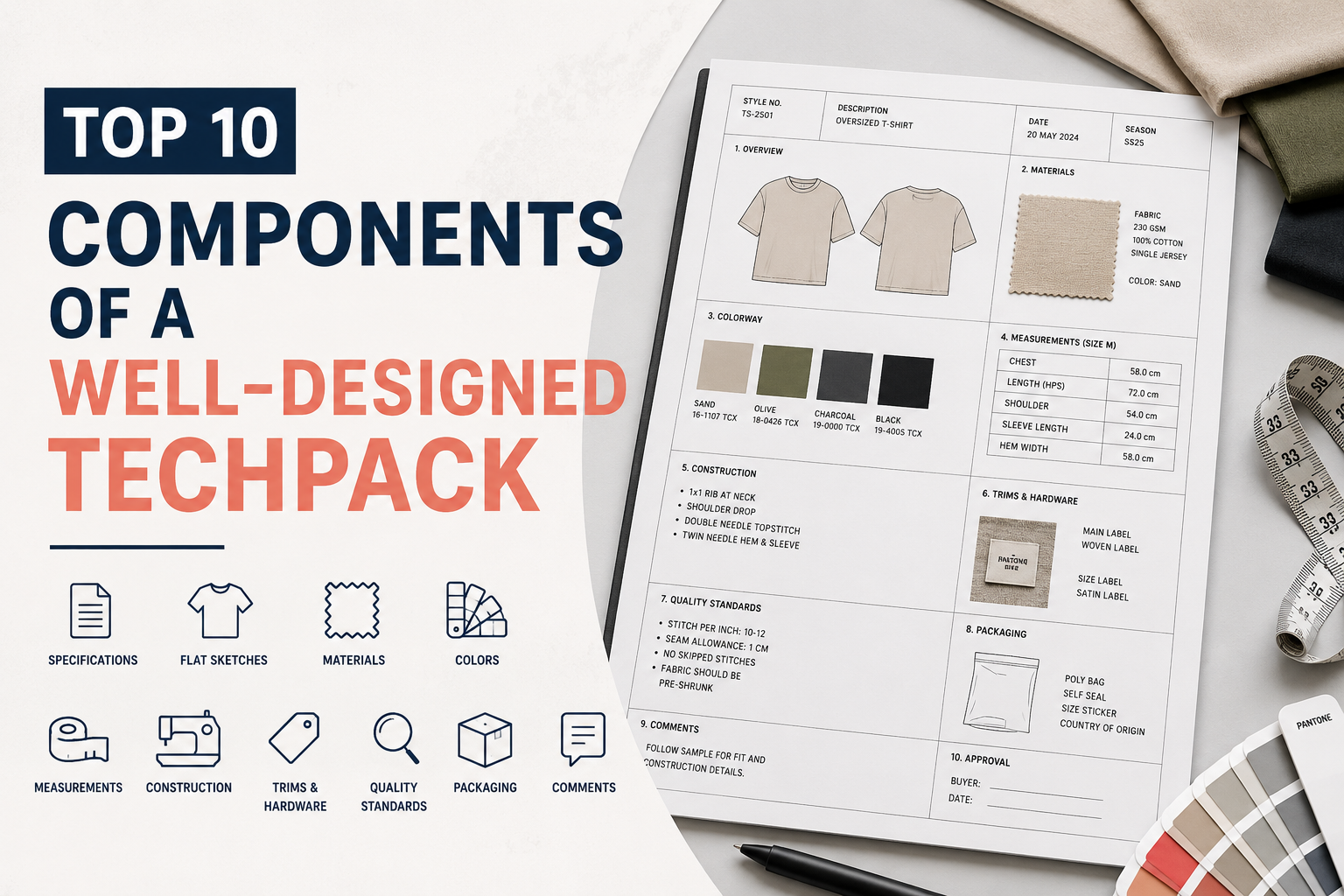
A tech pack usually includes:
- Flat sketches (front, back, and close-up details)
- A measurement chart (called a POM — Point of Measure — chart)
- Fabric and trim details
- Construction and stitching notes
- Colorways and labeling instructions
- Grading rules for different sizes
If any of these pieces are missing or vague, your factory fills the gap with assumptions. And assumptions are where quality control problems are born.
Why “Detail Level” Is the Single Biggest Reason Samples Come Back Wrong
Here’s something most new founders don’t realize: factories are not trying to interpret your creative vision. They are trying to follow instructions as literally as possible, as fast as possible.
If your tech pack says “sleeve should look cool and slightly oversized,” the factory has to guess what “cool” means. If it says “sleeve opening: 18 cm, sleeve length from shoulder point: 62 cm,” there is zero room for guessing.
The rule of thumb: the more subjective a word is, the more likely it will be misread. Words like “loose,” “premium,” “soft,” or “trendy” mean nothing to a pattern maker. Numbers, references, and named standards mean everything.
The Real Answer: How Much Detail Is “Enough”?
There’s no single word count or page count that makes a tech pack “detailed enough.” The right benchmark is this:
A tech pack is detailed enough when a factory you’ve never spoken to could produce your exact garment with zero follow-up questions.
That’s the test. If a stranger reading your document would still need to message you to ask about fabric weight, stitch type, or size grading — it’s not done yet.
Let’s break this down section by section, because different parts of a tech pack need different levels of detail.
1. Measurements (POM Chart) — This Needs to Be 100% Precise
This is the least forgiving section in the entire document. A half-centimeter error in a chest measurement can make a “medium” fit like a “small” for your customer.
Your POM chart should include:
- Every measurable point (chest, waist, hip, sleeve length, neck opening, hem width, etc.)
- Measurements in centimeters (the global manufacturing standard, even for US brands)
- Tolerance range (example: chest ± 1 cm) — this tells the factory how much natural variation is acceptable
- A full size run (XS to XL, or whatever range you’re launching with), not just one sample size
Example: A streetwear brand in Los Angeles wanted an “oversized boxy tee.” Instead of writing “oversized,” they specified: chest width 58 cm (size M), body length 71 cm, drop shoulder 8 cm. The factory nailed the fit on the first sample — because there was nothing left to interpret.
2. Fabric Specifications — Be Specific, Not Just Descriptive
“Soft cotton” is not a fabric spec. It’s marketing language. A factory needs:
- Fiber content (100% cotton, 95% cotton / 5% elastane, etc.)
- GSM — Grams per Square Meter, which tells the factory how heavy or light the fabric should feel. A t-shirt is usually 160–220 GSM. A heavyweight hoodie can be 320–400 GSM.
- Fabric structure (jersey, French terry, ribbed, twill, etc.)
- Stretch direction, if relevant (2-way stretch, 4-way stretch)
- Finish (brushed, enzyme washed, peached, etc.)
If you don’t know your exact GSM yet, it’s okay to give a range and ask the factory to recommend based on comparable existing fabrics — but say so clearly, don’t leave it blank.
3. Construction Details — This Is Where Most Tech Packs Fall Short
This section explains how the garment is physically built. It’s often the most skipped section, and also the most important for quality.
Include:
- Seam types (flatlock, overlock, coverstitch) and where each is used
- Stitches per inch (SPI) — higher SPI usually means a cleaner, more durable finish
- Topstitching width (example: 0.3 cm from edge)
- Reinforcement points (bartacks at stress points like pocket corners)
- Closures (zipper type, button type, drawstring width)
Real scenario: A Melbourne-based activewear brand once specified “flatlock stitching throughout.” Their factory used flatlock on the side seams but regular overlock on the inseam because it wasn’t clearly separated by construction area. The resulting leggings chafed during workouts, and the entire batch had to be reworked. One missing sentence cost them the full production run.
4. Trims, Labels, and Packaging — Small Details, Big Brand Impact
This section is often treated as an afterthought, but it directly affects how premium your product feels when it arrives.
Specify:
- Zipper brand/type (YKK is a common global standard reference)
- Button material and size (in millimeters)
- Label placement (measured from the center back neck, in cm)
- Care label content (fabric composition, wash instructions, country of origin)
- Hangtag and poly bag specifications, if applicable
Skipping this doesn’t make your sample “wrong” — but it often means round two of revisions just to fix branding details that could have been locked in from the start.
5. Colorways and Artwork — Give Exact References, Not Just Visual Descriptions
“Navy blue” can mean five different shades depending on who’s reading it. Always include:
- Pantone TCX or TPX codes for solid colors
- Print file specifications (resolution, placement measurements, color mode — CMYK vs RGB)
- Embroidery thread codes, if applicable
- Placement measurements for logos/prints (example: 10 cm from center front neck, sized 8 cm wide)
How Much Is Too Much Detail?
Yes, over-detailing is also a real problem — just a much smaller one than under-detailing.
Signs your tech pack has too much unnecessary content:
- Long paragraphs of brand story or mission statement inside technical pages
- Repeating the same measurement in multiple places with slightly different numbers (creates confusion about which is correct)
- Vague “inspiration” mood boards mixed into the construction pages without clear separation
Simple fix: Keep inspiration and brand storytelling on a separate page or moodboard section. Keep the technical pages purely functional — numbers, diagrams, and clear labels only.
A Quick Detail-Level Checklist You Can Use Today
Before sending your next tech pack to a factory, run through this:
- Every measurement point has a number in centimeters, not a description
- Tolerance ranges are included for at least the 5 key measurements
- Fabric has fiber content + GSM + structure written down
- Every seam type is specified and matched to a specific garment area
- Trims have exact size, material, or brand reference
- All colors have Pantone codes, not just names
- Labels and packaging placement are measured, not just described
- A person outside your company could read it without asking you anything
If you can tick every box, your tech pack is ready for production-grade communication.
What Happens When Founders Skip This Step (Real Consequences)
We’ve seen this pattern repeat across markets — from a small activewear label in Toronto to a print-on-demand streetwear seller in the UK:
- Sample delays: Vague tech packs mean back-and-forth emails, and each round can add 1–2 weeks.
- Extra sample costs: Every wrong sample often means paying for another round of fabric, cutting, and labor.
- Sizing inconsistency: Without a locked POM chart with tolerances, sizes can shift between production batches, leading to returns and unhappy customers.
- Damaged factory relationships: Factories start to see a brand as “difficult” or “unclear” when tech packs are consistently incomplete, which can affect priority and pricing over time.
The good news? None of this requires you to become a technical designer overnight. It just requires a document that removes guesswork.
Beginner-Friendly Glossary (Because These Terms Matter)
- POM (Point of Measure): The specific spots on a garment that get measured, like chest width or sleeve length.
- GSM (Grams per Square Meter): A number that tells you how heavy or light a fabric is.
- Tolerance: The acceptable amount a measurement can vary from the exact number (example: ± 1 cm).
- SPI (Stitches Per Inch): How tight or loose the stitching is — higher usually means stronger and cleaner.
- Grading: The process of scaling your sample size measurements up or down to create a full size range.
- BOM (Bill of Materials): A complete list of every fabric, trim, and component used to build the garment.
Final Thoughts: Detail Is a Form of Respect (For Your Factory and Your Customer)
A detailed tech pack isn’t about being controlling or overly technical. It’s about respecting the time of the people making your product, and respecting the customer who will eventually wear it.
Every number you lock in now is one less misunderstanding later. Every vague word you replace with a measurement is one less delayed sample. Think of your tech pack as the one conversation you get to have perfectly — before the factory ever touches your fabric.
If you’re not confident building this level of detail yourself, that’s completely normal — most first-time founders aren’t fashion technologists, and they shouldn’t have to be. What matters is making sure the final document speaks the language factories actually understand.
Ready to stop guessing and start getting factory-ready samples on the first try? A properly detailed tech pack is the cheapest insurance policy you’ll ever buy in this industry — it costs far less than a single failed sample run.
Frequently Asked Questions
1. Do I need a tech pack even for a small batch order (50–100 pieces)? Yes. Factories don’t reduce detail requirements for smaller orders — if anything, small-batch and low-MOQ factories rely on tech packs even more since they run tighter production schedules.
2. What if I don’t know the exact GSM or fabric details yet? Give a target range and ask the factory to suggest matching fabrics from their existing stock. Just make sure this is written clearly as “TBD — factory to recommend,” not left blank.
3. Should measurements be in inches or centimeters? Always use centimeters, even if you’re a US-based brand. Centimeters are the global manufacturing standard, and using them avoids rounding errors during conversion.
4. How many pages should a tech pack be? There’s no fixed page count. A simple t-shirt might need 3–4 pages, while a technical jacket with multiple panels could need 10+. The goal is completeness, not length.
5. Can I reuse one tech pack for multiple factories? Yes, and you should. A well-detailed tech pack is factory-agnostic — it should work whether you’re sourcing from Vietnam, Bangladesh, Portugal, or Turkey, as long as the specs are precise.
6. What’s the biggest mistake founders make with tech pack detail? Using descriptive, emotional language (“premium feel,” “relaxed fit”) instead of measurable specs. Factories need numbers, not adjectives.
7. Do print-on-demand (POD) sellers need detailed tech packs too? If you’re customizing base garments (like adding your own prints or labels) through a manufacturer rather than a POD platform, yes — placement measurements, print resolution, and label specs still need to be locked down clearly.
Table of Contents