Can a Tech Pack Designer Help Me With Plus-Size Clothing? Here’s the Truth Most Startups Learn Too Late
You’ve designed a beautiful piece. The sample in size Medium looks perfect on the mannequin. Then the size 2XL comes back from the factory — and the sleeve pulls, the waistband digs in, the proportions look “stretched” instead of designed.
You didn’t fail as a designer. You failed at grading. And that’s a completely fixable problem, if you know who to bring in and when.
If you’re building a clothing brand that promises “inclusive sizing,” “size-inclusive fits,” or “made for every body,” this article is for you. Let’s talk about what a tech pack designer actually does for plus-size clothing — and why skipping this step is one of the most expensive mistakes a new apparel brand can make.
Why This Question Matters Right Now
Plus-size and extended-size apparel isn’t a side category anymore. It’s one of the fastest-growing segments in global fashion, with market researchers tracking hundreds of billions of dollars in worldwide demand and steady annual growth as more shoppers actively seek brands that fit them properly instead of settling for whatever’s available.
Brands like Universal Standard, Torrid, and Eloquii built entire businesses on this promise. Even mainstream players like H&M, Nike, and Ashley Graham’s JCPenney collection have expanded into extended sizing because customers are done being an afterthought.
But here’s the part nobody tells new founders: you can’t “scale up” a small-size pattern and call it plus-size. That approach is exactly why so many extended-size launches fail — with baggy armholes, boxy silhouettes, and returns that eat your margin alive.
This is where a tech pack designer with real grading knowledge becomes the difference between a brand that earns trust in the plus-size community and one that gets called out for it on social media.
First, What Exactly Is a Tech Pack?
If you’re new to manufacturing, let’s clear this up simply.
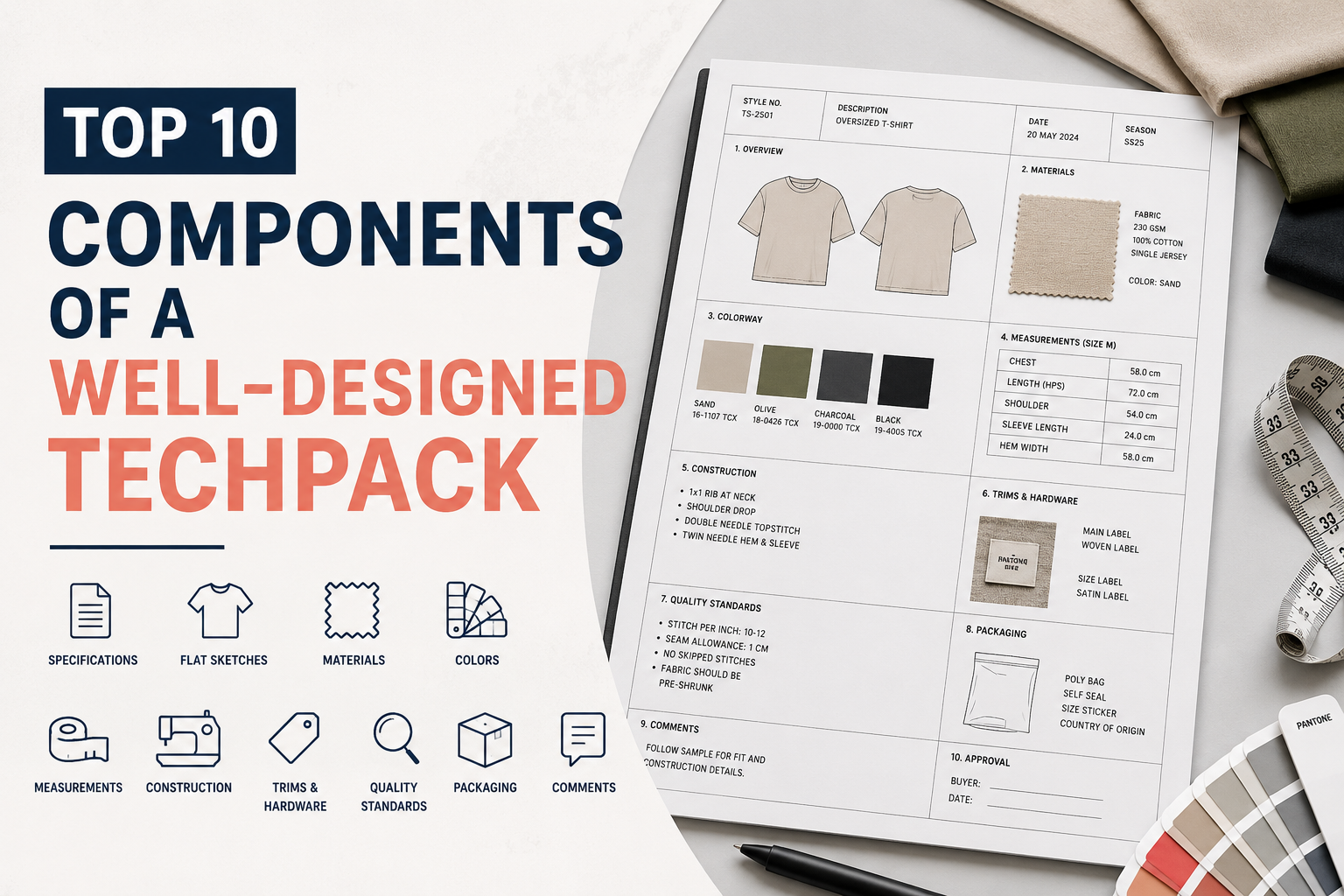
A tech pack (short for “technical package”) is the instruction document you send to a factory so they can produce your garment exactly as you imagined it. Think of it as the blueprint of your clothing — the same way an architect hands over blueprints to a construction crew, not just a sketch.
A complete tech pack typically includes:
- Flat sketches (front, back, and sometimes side views)
- Measurement specs (“spec sheet”) for every size in your range
- Grading rules — how measurements change from size to size
- Fabric and trim details — weight, stretch, composition, sourcing notes
- Construction notes — seam types, stitch counts, finishing details
- Labeling and packaging instructions
- Color ways (colorways) — the different color options for the style
Without this document, you’re relying on a factory to “guess” your vision. And factories don’t guess well — they follow specs. No specs, no consistency.
So Where Does Plus-Size Fit Into This?
This is the part that trips up almost every new founder: plus-size isn’t just “bigger numbers.” It’s a different body shape philosophy entirely.
A well-made plus-size garment accounts for:
- Different waist-to-hip ratios compared to straight sizes
- More generous bust and underarm room without adding bulk
- Longer torso and rise measurements in most cases
- Fabric behavior — some stretch fabrics that look fine at size Small can pull or pill at 2XL
- Proportional details — pocket placement, collar width, and button spacing that don’t look “stretched”
A tech pack designer who understands plus-size grading builds all of this directly into your spec sheet and grading rules, before a single sample is cut. That’s the entire value: catching fit problems on paper, not after 200 units are sewn wrong.
The “Grading” Word You’ll Hear a Lot
Grading, in simple terms, is the process of increasing or decreasing a pattern proportionally to create your full size range — from XS all the way to 4XL or beyond.
Here’s the mistake almost every new brand makes: they design a perfect sample in one size (usually Medium), then ask the factory to “just make it bigger” for plus sizes using the same grade rules as the smaller sizes.
That’s like photocopying a photograph and stretching it wider — the proportions distort. A properly graded plus-size tech pack uses separate grade rules for extended sizes because bodies don’t grow in a straight mathematical line as sizes go up.
Real Example
Imagine a t-shirt brand grading from size Small to size 3XL using one flat grade rule (say, adding 2 inches to the chest per size). By 3XL, the shoulder seam may have drifted so far out that it sits on the upper arm instead of the shoulder point — while the length barely increased at all. The shirt looks “boxy” instead of intentional.
A tech pack designer with plus-size experience adjusts the grade rule specifically for extended sizes — often widening the torso more generously while keeping shoulder and armhole placement proportionate. That single adjustment is the difference between a shirt that “fits” and one that flatters.
What a Tech Pack Designer Actually Does for Your Plus-Size Line
Let’s break this into the practical, step-by-step deliverables you should expect.
1. Size Range Planning
Before any sketch happens, a good tech pack designer will ask: what’s your size range — S–XL, S–3XL, or S–6XL? Extended sizing (4XL and up) often needs different fabric allowances and construction methods, so this decision shapes everything downstream.
2. Fit-Specific Spec Sheets
Instead of one generic size chart, you get a detailed measurement spec for every single size, including:
- Chest/bust
- Waist
- Hip
- Shoulder width
- Sleeve length
- Front and back rise (for bottoms)
- Inseam
3. Custom Grading Rules for Plus Sizes
As covered above, this is the technical core of plus-size tech packs — separate, body-aware grading logic instead of a flat one-size-fits-all formula.
4. Fabric Recommendations
Some fabrics that drape beautifully in small sizes behave completely differently at scale. A tech pack designer with manufacturing experience will flag fabric weight, stretch percentage (like 2-way vs. 4-way stretch), and recovery — so your 3XL doesn’t sag by the end of the day.
5. Construction Notes for Durability
Plus-size garments carry more stress at seams — especially underarms, crotch seams, and waistbands. A knowledgeable tech pack designer specifies reinforced stitching (like double-needle or bar-tack stitching) in exactly those stress points.
6. Communication With the Factory
The tech pack becomes your translator. Instead of back-and-forth emails trying to explain fit issues, the factory has a single reference document showing exactly what “correct” looks like for every size.
A Real-World Scenario
Picture Maria, a founder launching a size-inclusive activewear line from her home studio in the Philippines, selling into the US and Australian markets.
She designed leggings that fit perfectly in size Medium. Thrilled, she sent the same pattern specs to her factory with a note: “please make sizes up to 3XL using the same shape.”
The factory did exactly what she asked — extended the pattern mathematically. The result? The 3XL leggings had a waistband that rolled down, thigh fabric that pulled thin under stretch, and a crotch seam that sat too low.
Maria’s return rate on plus sizes hit nearly 30%, while her small-to-large sizes sat under 5%. That gap wasn’t a fabric problem — it was a grading and spec problem that a proper plus-size tech pack would have caught before production even started.
After rebuilding her tech pack with separate plus-size grading rules, reinforced waistband construction, and fabric with higher recovery percentage for the extended sizes specifically, her plus-size return rate dropped to single digits within two production cycles.
This is the real, measurable value of getting your tech pack right — it’s not a “nice to have,” it’s a direct line to your profit margin.
Common Technical Terms Explained Simply
If you’re new to this world, here’s a quick glossary so nothing in your next factory call sounds like a foreign language.
- Spec sheet — the exact measurements for each size of your garment
- Grading — scaling a pattern up or down across your size range
- Ease — the extra room built into a garment beyond exact body measurements, for comfort and movement
- POM (Point of Measure) — the exact spot on a garment where a measurement is taken (like “across chest, 1 inch below armhole”)
- Colorway — a specific color combination offered for one style
- MOQ (Minimum Order Quantity) — the smallest number of units a factory will produce per style/color
- Sample yardage — fabric ordered specifically to make prototype samples before bulk production
- Fit sample — the sample garment made specifically to test and approve fit before mass production
- Bar-tack stitch — a reinforced stitch used at stress points like pocket corners or waistbands
How to Brief Your Tech Pack Designer for Plus-Size Success
If you’re about to start this process, here’s exactly what to prepare:
- Your full target size range (be specific — “S to 5XL” not just “inclusive sizing”)
- Reference garments that already fit your target customer well, even from other brands
- Your target fabric type and any known stretch/recovery requirements
- Photos or measurements from real fit models in plus sizes, if you have access to them
- Your manufacturing country, since grading standards and factory capabilities vary by region
- Any past return-rate data, if you’re relaunching or fixing an existing style
The more specific and honest you are about your current fit problems, the faster your tech pack designer can fix the actual root cause instead of guessing.
Mistakes to Avoid When Building a Plus-Size Line
- Designing only in a sample size and assuming grading will “just work.” It won’t, without dedicated plus-size grade rules.
- Using one fit model for your entire size range. Plus-size bodies aren’t a scaled-up version of straight sizes — get separate fit feedback for extended sizes specifically.
- Ignoring fabric recovery. A fabric with poor stretch recovery will bag out at the knees and seat far faster in bigger sizes.
- Skipping wear-testing on real plus-size bodies. A sample that looks fine on a form isn’t the same as one that’s been sat in, walked in, and washed a few times.
- Assuming all plus-size customers want the same silhouette. Just like straight sizing, your plus-size customer wants variety — fitted, relaxed, structured, and flowy options, not one generic “plus-size cut.”
Why This Is a Smart Investment, Not Just a Cost
Founders sometimes hesitate at the cost of a professional tech pack, especially early on. But compare the numbers:
- A basic tech pack investment is typically a few hundred dollars per style.
- A poorly graded plus-size run that gets returned at scale can cost thousands in return shipping, restocking, and lost customer trust — and that’s before you factor in the reputational damage of being called out publicly for “sizing that doesn’t fit.”
Getting the tech pack right the first time isn’t an extra step. It’s the cheapest insurance policy in your entire production process.
Final Thoughts: Build Trust Through Fit
Plus-size customers have spent years being an afterthought in fashion. Every ill-fitting garment reinforces that feeling — and every well-fitted one builds real, lasting brand loyalty.
If you’re serious about building a brand that genuinely serves plus-size customers — not just markets to them — start with the tech pack. It’s where fit, comfort, and trust actually get built, long before a single unit reaches production.
Ready to get your plus-size or size-inclusive line factory-ready without guesswork? A properly built tech pack — with real grading, fabric guidance, and construction notes — is the fastest way to launch a size range your customers will actually trust and keep coming back to.
Frequently Asked Questions
1. Do I need a separate tech pack for plus sizes, or can I use the same one as my regular sizes? You can use one master tech pack, but it needs separate grading rules for plus/extended sizes built into it. A single flat grade rule across your whole range usually causes fit problems in the larger sizes.
2. What size range counts as “plus-size” for tech pack purposes? This varies by region and brand, but plus-size typically starts around size 14–16 (US women’s) or 1X, extending through 6X and beyond. Always define your exact range clearly in your tech pack brief.
3. Can a tech pack designer help me if I already have a plus-size line with fit complaints? Yes — this is actually one of the most common requests. A designer can audit your existing spec sheet and grading rules to identify exactly where the fit is breaking down, then rebuild the affected sizes.
4. Does plus-size clothing need different fabric specifications in the tech pack? Often, yes. Fabric weight, stretch percentage, and recovery matter more at larger sizes because more fabric is under more tension. Your tech pack should specify these details clearly for the factory.
5. How much does a plus-size tech pack typically cost? Pricing depends on complexity and how many sizes you’re grading, but professional tech pack services often start in the range of $100–$300 per style, which is far cheaper than the cost of a failed production run.
6. Will a good tech pack guarantee a perfect fit on the first sample? It significantly increases your odds, but the first sample is still a starting point. Expect one or two rounds of fit sample revisions even with an excellent tech pack — that’s normal and part of the process.
7. Can POD (print-on-demand) creators use plus-size tech packs too? Yes, especially if you’re moving from generic POD blanks to your own manufactured designs. A tech pack ensures your custom cut-and-sew pieces fit consistently across your full size range instead of relying on a supplier’s generic block pattern.
Table of Contents