What Makes a Tech Pack Good Enough for Manufacturers? (The Real Checklist Factories Actually Use)
Imagine: you’ve spent three weeks designing your dream hoodie. You send your file to a factory in Vietnam, feeling proud. Two days later, you get a one-line reply: “Please send proper tech pack, this is not enough.”
Your stomach drops. Your launch date suddenly feels further away than ever.
This happens to thousands of brand founders every single month — not because their designs are bad, but because their tech packs weren’t built the way manufacturers actually need them.
Let’s fix that, once and for all.
First, What Exactly Is a Tech Pack?
A tech pack (short for “technical package”) is the instruction manual for your garment. It’s not a mood board. It’s not a sketch on your phone. It’s a document that tells a factory everything they need to cut, sew, and finish your product without guessing.
Think of it like a recipe for a chef. A vague recipe says “add some sugar.” A great recipe says “add 45g of caster sugar, sifted.” Factories work the same way — they need exact numbers, not vague vibes.
If your tech pack leaves room for interpretation, the factory will interpret it their way. And their way is rarely what you imagined.
Why “Good Enough” Actually Matters (More Than You Think)
A weak tech pack doesn’t just cause delays. It quietly costs you money in ways most new brand owners never see coming:
- Extra sample rounds — each round can cost $50–$300 and add 1–3 weeks
- Wrong fit — sizes that don’t match your size chart, leading to returns
- Wrong fabric weight — a “cozy hoodie” that feels thin and cheap
- Miscommunication fees — some factories charge for “unclear spec” clarifications
- Damaged relationships — factories quietly deprioritize clients who send messy files
One founder we worked with in Australia had already burned through 4 sample rounds with a Chinese manufacturer before coming to us. Her tech pack was missing seam allowances and had no callouts for stitching type. Once we rebuilt it properly, she approved her sample on the very first try.
That’s the real value of a factory-ready tech pack — it’s not about looking professional, it’s about saving real time and real money.
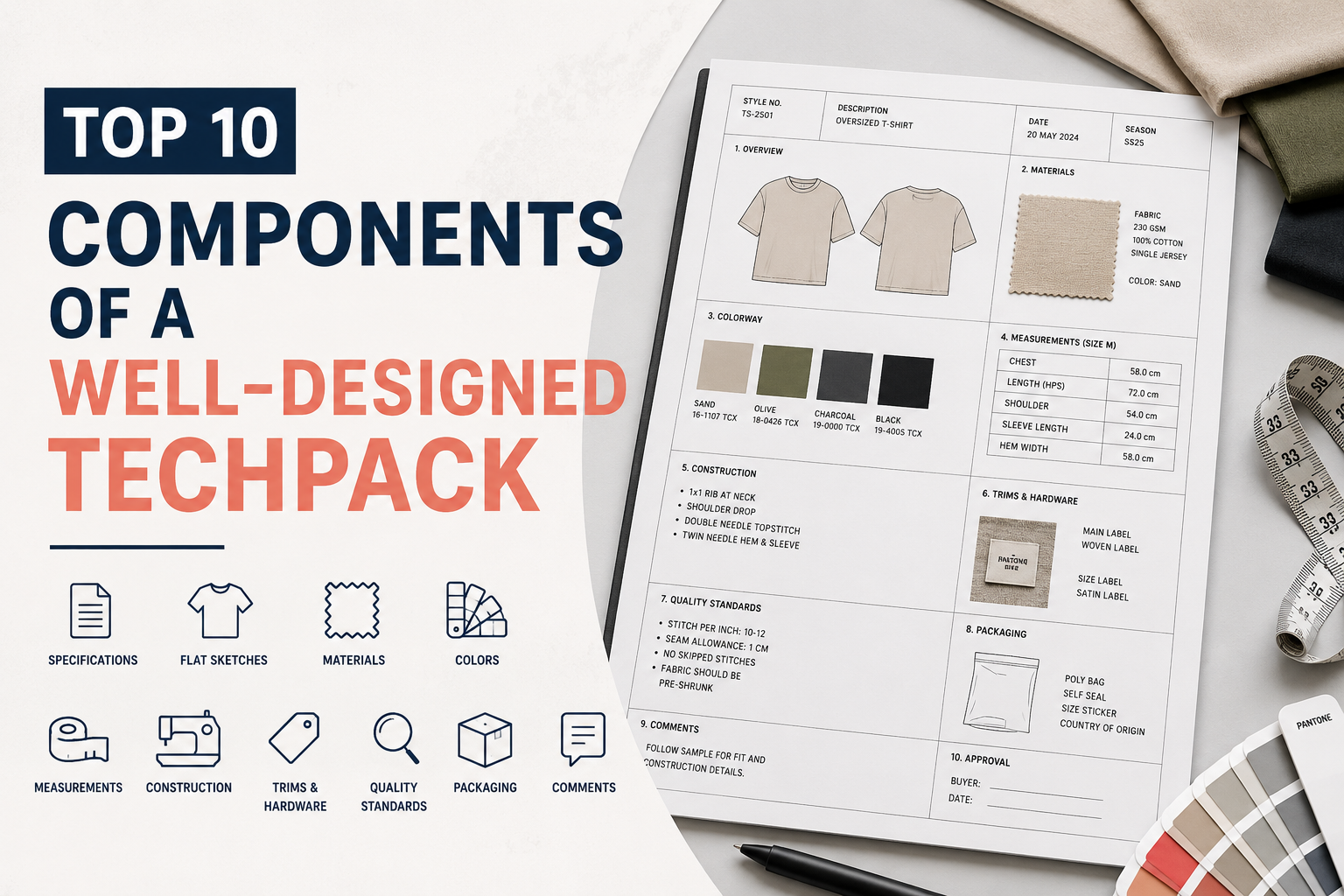
The Core Elements Every Manufacturer Expects
Let’s break down exactly what a manufacturer scans for in the first 60 seconds of opening your file. If these elements are missing or vague, expect delays.
1. Flat Sketches (Front, Back, and Details)
Your tech pack needs clean, proportionate flat sketches — not fashion illustrations, not photos of your prototype.
- Front view
- Back view
- Any zoomed-in details (pockets, plackets, trims)
Beginner tip: A “flat sketch” is a simple 2D line drawing of your garment, shown as if it’s laid flat on a table — no body, no styling, just the shape and construction lines.
2. Accurate Measurement Specs (Spec Sheet)
This is the single most important part of your entire tech pack. A spec sheet (short for “specification sheet”) lists every key measurement of the garment — chest width, body length, sleeve length, hem width — usually across multiple sizes (XS to XXL).
Manufacturers need:
- Point of Measure (POM) codes for each measurement
- Measurements in both cm and inches
- Tolerance range (e.g., ± 0.5 cm) — this tells the factory how much variation is acceptable
Without tolerances, factories either guess (bad) or ask you (delay).
3. Fabric Details (GSM, Composition, and Construction)
Saying “soft cotton” is not a fabric spec. Manufacturers need:
- GSM (grams per square meter) — this tells them exact fabric weight/thickness. A 180 GSM tee feels very different from a 240 GSM tee.
- Fabric composition — e.g., 100% cotton, or 80% cotton/20% polyester
- Fabric construction — knit, woven, jersey, French terry, ribbed, etc.
- Stretch direction, if relevant (2-way or 4-way stretch)
Beginner tip: GSM is like the “thickness score” of fabric. Higher GSM usually means heavier, more premium-feeling fabric — but also higher cost.
4. Color Details and Pantone Codes
“Navy blue” means something different to everyone. One person’s navy is another person’s midnight black.
Always include:
- Pantone TCX codes for every colorway
- Placement of colors if the design is multi-colored
- Colorway names matched to your product listing names
This single fix — using Pantone codes instead of color names — eliminates one of the most common causes of rejected samples.
5. Trims and Accessories List
This is your BOM — Bill of Materials. It’s simply a full list of every extra component that goes into the garment, beyond the main fabric.
Include for each trim:
- Type (zipper, button, drawcord, label, elastic)
- Size and material
- Placement
- Supplier reference, if you already have one
Skipping trims is one of the fastest ways to get a sample that looks “almost right but not quite.”
6. Construction and Stitching Details
This section tells the factory how to actually build the garment — which seams to use where, and how things should be finished.
- Seam types (flatlock, overlock, coverstitch)
- Stitch per inch (SPI), if quality control matters to you
- Special construction notes (double-stitched hems, reinforced stress points)
Many new founders skip this section entirely — and it’s exactly why finished garments come back with weak seams or messy hems.
7. Grading Rules (For Size Ranges)
If you’re producing more than one size, you need grading — the process of scaling your base pattern up or down across your size range.
A good tech pack either includes a grading rule table or clearly states: “Grade per [standard] — e.g., ASTM D6192 US Misses” so the factory follows a known standard.
Without this, sizes across your range often come out inconsistent — an XL that barely fits differently from a Large.
8. Labeling, Packaging, and Care Instructions
Small detail, big impact on your unboxing experience and compliance.
- Main label placement and content
- Care label wording (wash, dry, iron instructions)
- Country of origin requirement, if applicable
- Poly bag or folding instructions for packaging
9. Clear Callouts and Annotations
Every measurement, trim, and construction note should be visually linked to the sketch using numbered callouts or arrows. A manufacturer shouldn’t have to guess which line refers to which part of the garment.
This is often the difference between an “amateur” looking tech pack and one that reads like it came from an experienced production team.
A Quick Real-World Example
Let’s say you’re launching an oversized streetwear tee for the US market, manufactured in Bangladesh.
A weak tech pack might say: “Oversized tee, 100% cotton, black color, size S–XL.”
A manufacturer-ready tech pack says: “Oversized boxy tee, 220 GSM 100% combed ring-spun cotton, Pantone 19-4006 TCX black, drop shoulder construction, body length 74cm (size M) with ±1cm tolerance, side seam vent 8cm, main label center back neck, care label at side seam, grading per ASTM standard.”
Which one do you think gets approved on the first sample?
Common Mistakes That Make Tech Packs Fail
Here are the mistakes we see most often when brand founders come to us after a failed sample round:
- Using inches only (or cm only) — international factories expect both
- No tolerance range — leads to inconsistent sample fit
- Missing back view sketch — factories can’t see back construction details
- Copy-pasted specs from another product — sizes don’t match the new design
- No fabric weight (GSM) — leads to a completely different fabric feel than expected
- Vague trims section — “zipper” instead of “YKK #5 metal zipper, antique brass, 22cm”
- No revision history — factory doesn’t know which version is current
Even fixing just 3 of these can dramatically improve your first-sample approval rate.
A Simple Pre-Send Checklist
Before you send your tech pack to any factory, run through this quick list:
- Front and back flat sketches included
- Spec sheet with POM codes and tolerances
- Fabric GSM, composition, and construction listed
- Pantone codes for every color
- Full trims/BOM list
- Construction and stitching notes added
- Grading standard specified (if multi-size)
- Labeling and packaging instructions included
- All measurements shown in cm and inches
- Callouts numbered and matched to sketch
If you can tick every box here, your tech pack is genuinely factory-ready — not just “good enough,” but built the way experienced production teams build them.
For Print-on-Demand and Small Batch Creators
If you’re working with POD platforms or small-batch manufacturers, you might think tech packs don’t apply to you. They still do — just in a lighter form.
Even a simplified one-page spec sheet with fabric type, print placement measurements, and color codes will save you from misaligned prints and inconsistent colors across batches.
Final Thoughts: Your Tech Pack Is Your Business Card to Factories
Manufacturers work with dozens of brands at once. The founders who send clear, complete, professional tech packs get faster replies, fewer questions, and better production priority.
A strong tech pack isn’t extra paperwork — it’s the fastest, cheapest way to protect your time, your money, and your brand’s reputation before a single unit is cut.
If building all of this from scratch feels overwhelming, that’s exactly why TechPackGenius exists — we turn your idea into a factory-ready tech pack in 72 hours, so you can go straight from design to production without the guesswork.
Frequently Asked Questions
1. What is the most important part of a tech pack for manufacturers? The spec sheet with accurate measurements and tolerances is the most critical section — it directly determines fit accuracy and sample approval speed.
2. Do I need a tech pack for a small batch or POD order? Yes, even a simplified version helps avoid print misalignment, wrong fabric weight, and inconsistent colors across production runs.
3. What does GSM mean in a tech pack? GSM stands for grams per square meter and tells the factory the exact weight and thickness of your fabric.
4. Can I just send reference photos instead of a tech pack? Reference photos help with inspiration, but factories still need exact measurements, fabric specs, and construction details to produce accurately.
5. How many sample rounds does a good tech pack usually save? A complete, accurate tech pack typically reduces sample rounds from 3–5 down to just 1–2, saving both time and sampling costs.
6. What software is used to create tech packs? Common tools include Adobe Illustrator, CLO3D, and specialized tech pack software, though many brands also use well-structured templates in PDF or spreadsheet form.
7. Do factories reject tech packs without Pantone codes? Many factories will proceed but often guess the closest match, which frequently results in incorrect colors on the first sample.
Table of Contents