Kidswear Tech Pack Guide for Beginners: How to Get Your Children’s Clothing Line Factory-Ready
Imagine this. You’ve designed the cutest little dinosaur romper you’ve ever seen. You can already picture toddlers running around in it at birthday parties. You send your sketch to a factory in China, feeling proud and excited.
Three weeks later, a sample arrives. The dinosaur print is upside down. The snap buttons are in the wrong place. And somehow, the “small” size would barely fit a newborn.
This happens to new kidswear brand founders every single day. Not because their designs are bad, but because a sketch alone can never tell a factory everything it needs to know. What they needed wasn’t a prettier drawing. They needed a tech pack.
What Exactly Is a Tech Pack
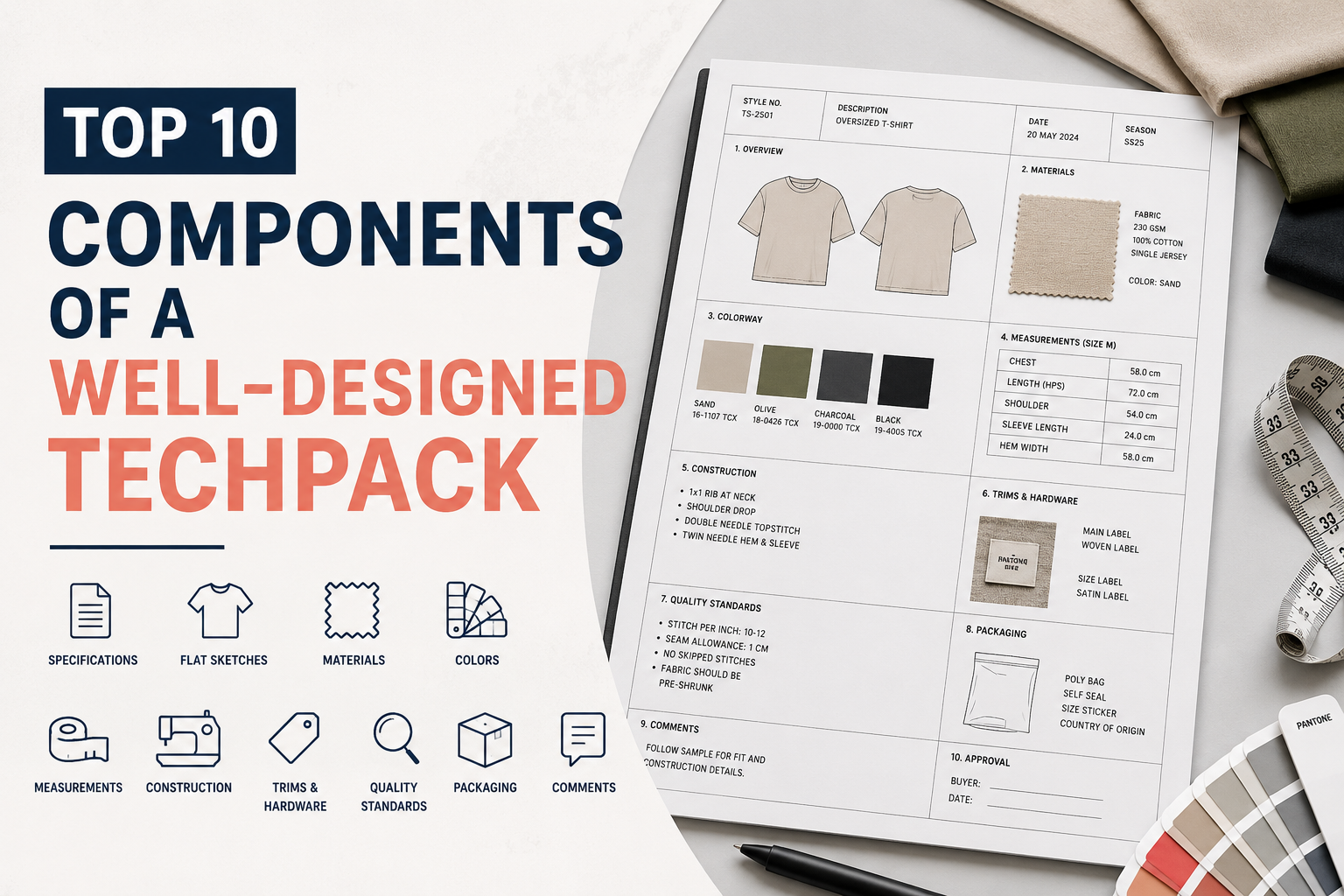
Think of a tech pack as an instruction manual for your garment, written in a language factories understand.
It’s not a mood board. It’s not a pretty design deck for investors. It’s a technical document that tells the factory exactly how to cut, sew, measure, and finish your product, down to the millimeter.
A good tech pack usually includes:
- Flat sketches (front and back) showing every design detail
- A size chart with exact measurements for every size
- Fabric and trim details (what material, what weight, what color code)
- Construction notes (how seams should be sewn, what stitch type to use)
- Labeling and packaging instructions
- A bill of materials (BOM) listing every component used
For adult clothing, missing a detail is annoying. For kidswear, missing a detail can mean a safety issue, a failed compliance test, or a very upset parent writing a one-star review.
Why Kidswear Tech Packs Are a Different Game
A lot of new founders assume that a kids’ tech pack is just a smaller version of an adult one. It isn’t. Kidswear has its own rulebook, and factories expect you to know it.
Here’s what makes kidswear tech packs unique:
1. Safety comes before style. Small buttons, loose drawstrings, and long cords near the neck can be genuine choking or strangulation hazards. Regulations like CPSIA (USA) and EN 14682 (Europe) exist specifically to prevent this. Your tech pack needs to call out safety compliance clearly, not leave it as an assumption.
2. Sizing is far more detailed. Adult sizing usually has 4–6 size breaks. Kidswear often needs size charts covering newborn to 14 years, sometimes in 3-month or 6-month increments for babies. A one-centimeter error at this stage can mean a garment that simply doesn’t fit the age group it’s meant for.
3. Growth and comfort matter more than fit. Kids grow fast, wiggle a lot, and can’t tell you if something feels itchy. Tech packs for kidswear often specify stretchy waistbands, tagless labels, and soft, breathable fabrics as standard requirements, not extras.
4. Fabric testing requirements are stricter. Many countries require testing for lead content, phthalates, and flammability in children’s clothing. Your tech pack should note which certifications the fabric and trims must meet before the factory even sources materials.
If you’re building a kidswear brand and skip these details, you’re not just risking a bad sample. You’re risking your product getting stuck at customs or, worse, recalled after it’s already sold.
The Core Sections Every Kidswear Tech Pack Needs
Let’s break this down section by section, the way a factory would actually read your document.
1. Cover Page and Style Summary
This is your garment’s ID card. It should include:
- Style name and style number
- Season and collection name (e.g., “Spring 2027 – Playful Jungle”)
- Garment category (romper, onesie, dress, joggers, etc.)
- Age group and size range
- Date and revision number
A small tip here: always add a revision number. When you make changes after the first sample, you’ll thank yourself for tracking version 1, 2, and 3 instead of five files all named “final_final_v2.”
2. Technical Flat Sketches
These are clean, black-and-white line drawings showing your garment from the front and back, sometimes with a side view for structured pieces like jackets.
Unlike a fashion illustration, a flat sketch shows:
- Exact seam placement
- Stitch lines
- Zipper, snap, and button positions
- Pocket size and placement
- Any prints, embroidery, or appliqué location
For example, if you’re designing a baby romper with snap closures for easy diaper changes, your flat sketch needs to show exactly how many snaps, where they start, and where they end. “A few snaps down the front” is not a specification. “5 snaps, starting 2cm below neckline, spaced 6cm apart” is.
3. Size Chart and Grading
This is where kidswear tech packs demand the most attention.
Your size chart should list every measurement point (chest, waist, length, sleeve, inseam) for every size you plan to produce. If you’re launching sizes 2T through 6T, you need clear numbers for each one, not just the base size with a note saying “grade accordingly.”
A practical tip: work with body measurement charts from your target market. A US 2T and a UK 2-3 years size are not identical. If you’re selling globally, decide early which sizing standard you’re building around, and say so clearly in the tech pack.
Beginner tip: “Grading” simply means increasing or decreasing measurements consistently across sizes, like a ladder where each step is a slightly bigger or smaller version of the one before it.
4. Fabric and Trim Details (Bill of Materials)
List every material used in the garment, including:
- Fabric type (e.g., 100% organic cotton, 220 GSM)
- Color with Pantone code
- Trims (buttons, zippers, elastic, drawstrings, labels)
- Any required certifications (OEKO-TEX, GOTS, CPSIA compliance)
For kidswear specifically, always note if fabric needs to be flame-retardant tested, especially for sleepwear. This single detail can be the difference between a smooth customs clearance and a shipment held up for weeks.
5. Construction Details
This section tells the factory how to actually build the garment. It includes:
- Seam types (e.g., flatlock seams reduce irritation against sensitive baby skin)
- Stitch per inch (SPI) requirements
- Reinforcement points (like double-stitching at the crotch seam of leggings, since that’s where kids put the most stress)
- Closure types and placement
A useful real-world example: many baby clothing brands specify flatlock or overlock seams instead of standard seams because they lie flatter against the skin and reduce rashes. If your tech pack doesn’t mention this, the factory will likely default to whatever seam is cheapest and fastest for them, not what’s best for a baby’s skin.
6. Labeling and Packaging Instructions
Kidswear has extra labeling requirements most adult clothing doesn’t need, such as:
- Age and size labeling in multiple languages if selling internationally
- Care instructions (many parents wash kids’ clothes far more often)
- Country of origin
- Choking hazard warnings if small parts are used (like buttons or bows)
- Safety certification marks where required by law
Also include packaging specifics: poly bag thickness (important for child safety, since bags need suffocation warnings and sometimes ventilation holes), hangtag placement, and folding method.
7. Fit Comments and Special Notes
This is your space to call out anything unusual: “waistband must stretch to accommodate diapers,” “avoid any exposed metal parts,” “print must not crack after 20 washes.” Factories appreciate specificity here because it prevents guesswork.
A Real-World Example: From Sketch to Tech Pack
Let’s say you’re designing a unisex toddler tracksuit for a POD (print-on-demand) or small-batch apparel brand.
Without a tech pack, you might send the factory a Canva mockup and a one-line description: “Cozy tracksuit with a fun print, sizes 2T-5T.”
With a proper tech pack, you’d specify:
- Fabric: 280 GSM French terry, 95% cotton, 5% spandex
- Fit: relaxed, elastic waistband with drawstring cover (no exposed drawstring ends, per CPSIA)
- Print: DTG print, placement centered on chest, 15cm x 15cm, wash-fastness tested
- Sizing: exact chest, waist, and length measurements for 2T, 3T, 4T, 5T
- Seams: flatlock throughout for skin comfort
- Labeling: tagless printed care label, size label sewn into side seam
See the difference? The factory now has zero room for guessing, which means fewer sample rounds, faster turnaround, and a final product that actually matches your vision.
Common Mistakes First-Time Kidswear Founders Make
After working with dozens of early-stage apparel founders, a few mistakes come up again and again:
Skipping safety specifications because “the factory will know.” Factories manufacture for many clients across many markets. They won’t automatically apply US or EU safety standards unless you tell them which ones apply to you.
Using adult size grading logic for kids. Kids’ bodies don’t scale the same way adult bodies do. A baby’s head-to-body ratio is different at every age, which affects neckline and armhole sizing especially.
Forgetting to specify wash and shrinkage tolerance. Parents wash kids’ clothes constantly. If your tech pack doesn’t specify maximum shrinkage percentage after washing, you might get gorgeous samples that shrink two sizes down after the first laundry cycle.
Not testing for choking hazards early. Small decorative elements like buttons, bows, or beads look adorable in a sketch but can trigger compliance failures. It’s far cheaper to catch this in the tech pack stage than after 5,000 units are already produced.
Overcomplicating the first collection. Many new kidswear brands try to launch with 15 styles and 6 sizes each right away. Starting smaller, maybe 3-4 hero styles with fewer size breaks, makes your first tech pack round easier to manage and correct.
Quick Checklist: Is Your Kidswear Tech Pack Ready?
Before sending your tech pack to a factory, run through this list:
- [ ] Cover page with style number, season, and age group
- [ ] Front and back flat sketches with clear callouts
- [ ] Complete size chart with all measurement points
- [ ] Fabric details including GSM, composition, and color codes
- [ ] Trim details with certification requirements noted
- [ ] Construction and seam specifications
- [ ] Safety compliance notes (CPSIA, EN 14682, or your target market’s standard)
- [ ] Labeling and packaging instructions
- [ ] Any special fit or performance notes
If you can check every box, you’re in a strong position to get accurate samples on the first or second try, instead of the fifth.
Why Getting This Right Early Saves You Real Money
A vague tech pack doesn’t just cause frustration. It costs money in very direct ways:
- Extra sample rounds (each round can take 2-4 weeks and cost real production fees)
- Air freight charges when a fix needs to happen fast
- Compliance failures that block shipments at customs
- Returns and refunds from parents unhappy with fit or safety issues
Founders often think a tech pack is an extra step that slows things down. In reality, it’s the step that speeds everything up, because it removes the back-and-forth guessing between you and your factory.
Final Thoughts: Your Tech Pack Is Your Brand’s First Promise
Every parent who buys your kidswear is trusting you with something precious: their child’s comfort and safety. A tech pack is where that trust actually starts, long before the garment ever reaches a store shelf or online cart.
Getting your kidswear tech pack right isn’t about perfection on the first try. It’s about giving your factory a clear, complete, professional document so the samples that come back actually reflect the vision in your head, not a guess based on a sketch and a hope.
If building this document yourself feels overwhelming while you’re also managing sourcing, branding, and everything else that comes with launching a kidswear line, that’s exactly the kind of groundwork a tech pack specialist can help you nail down quickly and correctly.
FAQs: Kidswear Tech Packs for Beginners
1. Do I really need a tech pack if I’m only making a small batch?
Yes. Even small batches benefit from a tech pack because it reduces sample errors, and factories often treat clearer documentation as a sign of a serious, professional client, which can improve your pricing and priority.
2. What’s the difference between a spec sheet and a tech pack?
A spec sheet is usually just the measurements and basic details for one garment. A tech pack is the full package, including sketches, materials, construction notes, and compliance details, everything a factory needs in one place.
3. Which safety standards should I include for kidswear?
It depends on where you’re selling. CPSIA applies in the US, EN 14682 covers cords and drawstrings in the EU, and many countries have their own flammability and chemical testing rules. Always check your specific target market’s requirements.
4. Can I make a tech pack without design software like Illustrator?
Yes, though it takes more manual effort. Some founders start with simple tools or templates and refine sketches later. What matters most to factories is clarity, not the software used to create it.
5. How detailed should my size chart be for baby clothing?
Very detailed. Babies grow fast, so many brands use 3-month size increments (0-3M, 3-6M, 6-9M) with exact measurements for chest, length, and sleeve at each size.
6. What happens if I skip compliance details in my tech pack?
The factory may use their default materials and construction methods, which might not meet your target market’s legal requirements. This can lead to shipments being held at customs or products being pulled from marketplaces.
7. How many sample rounds does a good tech pack typically save?
While it varies by factory and complexity, a clear, complete tech pack often reduces sample rounds from 4-5 down to 1-2, saving weeks of back-and-forth and real production costs.
Ready to turn your kidswear designs into factory-ready tech packs without the guesswork? TechPackGenius helps apparel founders build professional, compliance-ready tech packs so your samples come back right the first time.
Table of Contents