Fashion Startup Toolkit: 15 Must-Have Tools Every New Clothing Brand Needs in 202
You have a vision. A brand in your head that feels real — the colors, the vibe, the customer you’re designing for. But the moment you sit down to actually build it, you realize something nobody tells you: launching a fashion brand is less about creativity and more about systems.
The brands that survive their first year don’t just have great designs. They have the right tools. And the ones that fail? They’re usually drowning in chaos — wrong suppliers, missing tech packs, no systems, no process.
This guide is your shortcut. Whether you’re in Lagos, London, New York, or Manila, here are the exact tools that help new fashion brands go from “great idea” to “real business” — fast.
Why Your Fashion Startup Needs a Toolkit (Not Just Talent)
Passion gets you started. Tools get you paid.
Think of any successful fashion brand — Gymshark started in a garage in Birmingham, UK. Cider launched out of Guangzhou and became a global Gen Z brand. What they had in common wasn’t just good products. They had workflows, tools, and repeatable systems.
Without the right toolkit, you’re redesigning your size chart every time you email a new manufacturer. You’re losing track of samples. You’re creating the same product sheet five different ways.
Let’s fix that.
Category 1: Design & Tech Pack Tools
1. TechPackGenius — Your Production-Ready Tech Pack Builder
If you’re sending designs to a manufacturer without a tech pack, you’re setting yourself up for expensive mistakes.
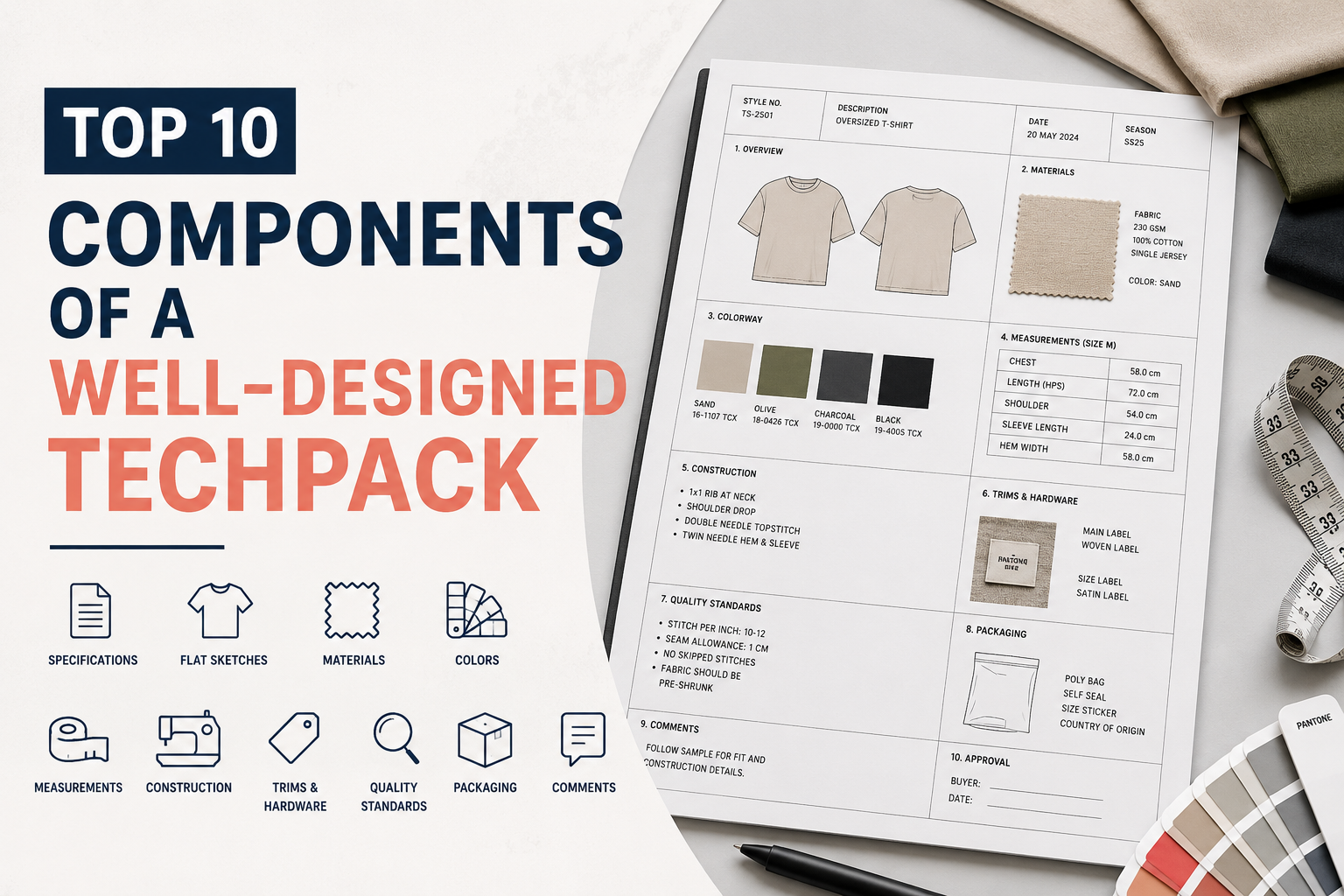
A tech pack is a detailed document that tells your manufacturer exactly how to make your garment — measurements, materials, trims, stitching details, colorways. Think of it as the blueprint for your product.
TechPackGenius.com is built specifically for fashion founders who don’t have a full design team. You can create professional, production-ready tech packs without needing to know how to use Adobe Illustrator or hire an expensive technical designer.
Why it matters: Manufacturers in Bangladesh, China, Portugal, and Turkey all work from tech packs. A clean, clear tech pack reduces sample errors, saves rounds of back-and-forth, and builds your credibility as a buyer.
2. Adobe Illustrator — For Technical Flat Sketches
For those ready to go deeper into design, Adobe Illustrator is the industry standard for creating flat sketches — the top-down, technical drawings of your garments.
It’s a learning curve, but once you know it, you can create precise design files that feed directly into your tech packs.
Beginner tip: YouTube has hundreds of free Illustrator tutorials specifically for fashion design. Search “Adobe Illustrator flat sketch tutorial” and you’ll find hours of guidance.
3. CLO 3D — Virtual Sampling
Physical samples are expensive. A single sample from an overseas factory can cost $200–$800, not counting shipping.
CLO 3D is a 3D garment simulation tool that lets you see how your design actually drapes, fits, and moves on a virtual body before you produce anything physical. Brands like Tommy Hilfiger and fast-growing DTC brands use it to cut sampling costs by 40–60%.
It’s more of an investment (subscription-based), but for brands building multiple styles per season, it pays for itself quickly.
Category 2: Sourcing & Supplier Management Tools
4. Alibaba / Global Sources — Manufacturer Discovery
Finding the right factory is one of the hardest parts of starting a clothing brand. Alibaba and Global Sources are two of the world’s largest B2B sourcing platforms.
On these platforms, you can:
- Search for manufacturers by product type (e.g., “cut and sew knit manufacturer”)
- Filter by minimum order quantity (MOQ)
- Request quotes and samples
- Check supplier ratings and certifications
Pro tip: Always ask for a factory’s certifications (OEKO-TEX, GOTS, WRAP, etc.) and request a video call before placing any order. A 15-minute call can tell you more than 100 emails.
5. NuOrder / Faire — For B2B Wholesale Buyers
If you’re planning to sell wholesale — to boutiques, department stores, or multi-brand retailers — NuOrder and Faire are the platforms buyers actually use to discover and order from new brands.
Getting listed on Faire can open doors to thousands of independent retailers across the US, UK, and Europe without you having to do cold outreach.
Category 3: Ecommerce & Sales Tools
6. Shopify — Your Online Storefront
For most new fashion brands, Shopify is the best place to build your ecommerce store. It’s beginner-friendly, globally supported, and has thousands of fashion-specific themes and apps.
Key reasons fashion brands love Shopify:
- Easy product variant management (sizes, colors)
- Integrates with print-on-demand services like Printful and Printify
- Built-in abandoned cart recovery
- Works with global payment gateways
7. Printful / Printify — For Print-on-Demand Brands
If you’re starting with print-on-demand (POD) — meaning you design the products but only produce them when someone orders — these two platforms are your engine.
Printful connects directly to Shopify, Etsy, WooCommerce, and more. You upload your designs, they handle printing, packing, and shipping worldwide. No inventory. No upfront costs.
Great for: Testing new designs, running limited drops, and scaling without warehouse risk.
Category 4: Brand & Marketing Tools
8. Canva — Brand Identity on a Budget
Not everyone can afford a branding agency. Canva is a drag-and-drop design platform that lets you create logos, brand style guides, lookbook layouts, social media posts, email headers, and packaging mockups — even if you have zero design experience.
How real brands use it: A sustainable swimwear founder from Brazil used Canva to build her entire brand identity — logo, brand colors, social templates — in a weekend before her first launch. Her brand looked polished enough to get into three boutiques in her first month.
9. Later / Planoly — Social Media Scheduling
Fashion is visual. Instagram, TikTok, and Pinterest are your runways.
Later and Planoly are social media scheduling tools that let you plan and auto-post your content calendar. You can see your Instagram grid visually before posting, drag-and-drop content, and schedule weeks in advance.
This saves you from the daily scramble of “what do I post today?” — which is real, and it kills momentum for small brands.
Category 5: Operations & Business Tools
10. Trello / Notion — Project Management
Launching a collection involves dozens of moving parts — design sign-off, tech pack completion, supplier quotes, sample orders, photography, pre-launch marketing, and more.
Trello (visual boards) and Notion (docs + databases) are both popular among fashion founders for keeping every task, deadline, and document in one place.
Real-world example: A streetwear brand founder in Nairobi uses a Notion database to track every SKU — with columns for design status, tech pack version, supplier, sample stage, and launch date. Nothing falls through the cracks.
11. QuickBooks / Wave — Accounting for Founders
Cash flow kills more fashion brands than bad designs.
QuickBooks is the go-to accounting tool for small businesses, with good support for inventory, tax tracking, and invoicing. If you’re on a tight budget, Wave is free and handles basic bookkeeping well for early-stage brands.
Knowing your numbers — cost of goods, margins, returns rate — is what separates brands that scale from brands that stay stuck.
12. Google Workspace — Communication & Files
Simple but essential. Google Workspace (Gmail, Drive, Docs, Sheets) gives you a professional email address, shared file storage, and collaboration tools.
Having yourname@yourbrand.com instead of a Gmail address immediately signals that you’re a real business. Manufacturers and buyers notice this.
Category 6: Trend Research & Customer Insight Tools
13. WGSN / Trendalytics — Trend Forecasting
Making the right product at the right time is everything in fashion.
WGSN is the global leader in trend forecasting — used by major brands to predict colors, silhouettes, and consumer behavior 12–24 months ahead. It’s an investment, but it pays back when you’re not stuck with 500 units of a style that’s already peaked.
Budget alternative: Follow trend reports on Pinterest Trends, Google Trends, and TikTok’s Creative Center — all free.
14. Hotjar / Microsoft Clarity — Website Behavior Analytics
Once your Shopify store is live, you need to understand how customers move through it. Are they dropping off at checkout? Ignoring your size guide? Clicking the wrong buttons?
Hotjar and Microsoft Clarity (free) give you heatmaps and session recordings so you can see exactly where customers get confused — and fix it.
Bonus: The Tool That Ties It All Together
15. TechPackGenius Templates — From Idea to Production Document
You can have all the tools above, but if your tech pack is unclear, none of it matters. Your factory won’t build what you imagined. Your samples will come back wrong. Your production will be delayed.
That’s why a solid tech pack workflow — ideally using purpose-built templates from TechPackGenius.com — is the single tool that connects your creative vision to real-world production.
It’s not glamorous. But it’s what makes products actually happen.
The Simple Stack for a Brand-New Fashion Startup
If you’re just starting out and budget is tight, here’s the lean toolkit to get moving:
| Tool | Purpose | Cost |
|---|---|---|
| TechPackGenius | Tech pack creation | Affordable subscription |
| Canva | Branding & marketing visuals | Free / Pro |
| Shopify | Ecommerce store | From $39/mo |
| Printful | Print-on-demand production | Free (per order) |
| Notion | Project management | Free |
| Wave | Accounting | Free |
| Google Workspace | Email & files | From $6/mo |
Start here. Add more tools as you grow.
Conclusion: Build Your System, Then Scale Your Brand
The fashion industry is not just about what you create — it’s about how reliably you can create it, deliver it, and sell it again and again.
The founders who build lasting brands treat their toolkit as seriously as their design process. They invest in the right systems early, so that when demand comes, they’re ready.
Start with your tech packs. Get your production process clean. Build your store. Then grow.
Head over to TechPackGenius.com to explore tech pack templates built for exactly where you are right now — and build your brand the right way from day one.
Frequently Asked Questions (FAQs)
Q1: What is a tech pack and why do I need one? A tech pack is a detailed document that tells your manufacturer how to produce your garment — including measurements, materials, construction details, and labels. Without one, you risk receiving samples that look nothing like your design, wasting time and money.
Q2: Do I need all these tools to start a fashion brand? No. Start with the essentials: a tech pack tool, a design tool, and a sales channel (like Shopify or Etsy). Add more tools as your brand and budget grow. Complexity before revenue is a common beginner mistake.
Q3: What’s the best ecommerce platform for a new clothing brand? Shopify is the most popular choice for fashion brands worldwide due to its ease of use, strong app ecosystem, and global payment support. WooCommerce is a good free alternative if you’re already on WordPress.
Q4: Can I start a fashion brand without a factory if I’m on a small budget? Yes. Print-on-demand platforms like Printful or Printify allow you to launch with zero inventory and no factory relationship. You design the product; they handle printing, packing, and shipping when an order comes in.
Q5: How do I find reliable clothing manufacturers? Start with Alibaba or Global Sources for overseas factories. Always verify suppliers — request certifications, ask for samples before bulk orders, and do a video call. For local production, search industry directories or attend trade shows in your region.
Q6: Is 3D sampling software like CLO 3D worth it for small brands? If you’re launching multiple styles per season and sampling costs are adding up, yes. Otherwise, start with physical sampling and invest in CLO 3D once your volumes justify it. Many freelance technical designers also offer CLO 3D services if you need it occasionally.
Q7: How important is branding for a new fashion startup? Extremely important. Your brand identity — logo, colors, tone of voice, visual style — is what makes a customer choose you over someone else selling a similar product. Tools like Canva make professional branding accessible even on a tight budget.
Table of Contents