
Grey Fabric Inspection: The Hidden Step That Can Make or Break Your Clothing Brand
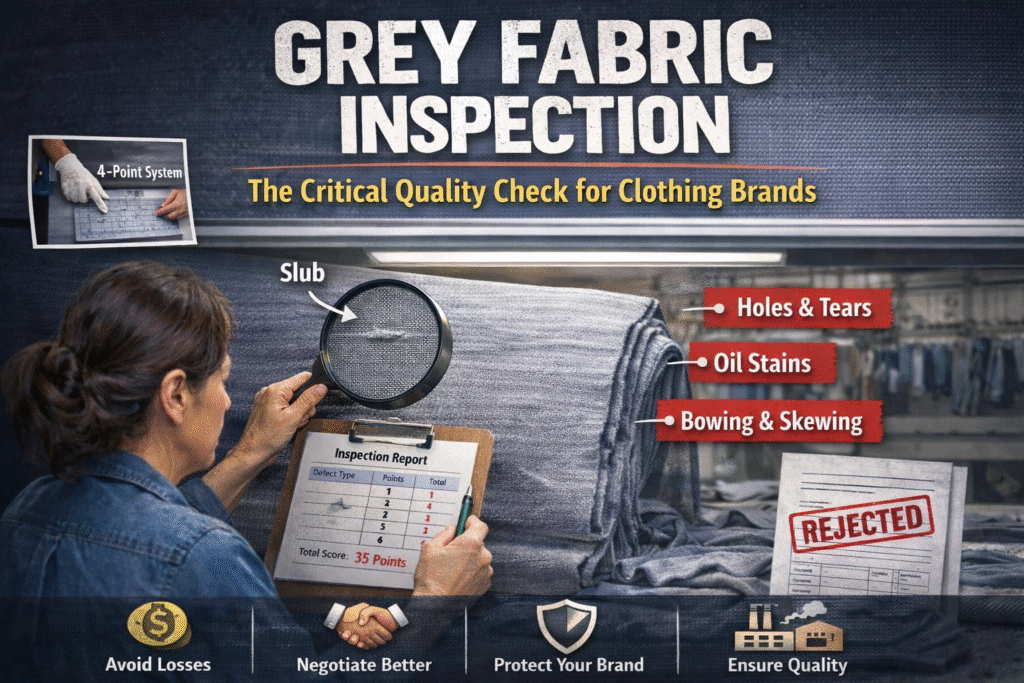
One bad fabric roll can quietly destroy months of design work.
Your patterns might be perfect.
Your tech pack might be flawless.
Your marketing campaign might already be booked.
But if defective fabric slips into production, everything collapses—returns rise, factories blame suppliers, timelines explode, and profits vanish.
That is why grey fabric inspection—a step most new founders underestimate—is one of the most powerful quality-control tools in global apparel manufacturing.
Let’s break it down clearly, practically, and commercially—so you can use it like a seasoned sourcing manager, not a nervous first-time buyer.
What Is Grey Fabric Inspection? (Simple Explanation)
Grey fabric (also called greige fabric) is fabric in its raw, unfinished state—before dyeing, printing, washing, or finishing.
Grey fabric inspection means:
Checking the fabric for defects before any expensive processes are added.
This inspection usually happens:
- After weaving or knitting
- Before dyeing or finishing
- Before cutting garments
Think of it like checking raw ingredients before cooking a huge meal.
If the rice is spoiled, no amount of seasoning will save it.
Why Grey Fabric Inspection Is Critical for Clothing Brands
Many startups only inspect fabric after dyeing.
That’s risky.
By then, you have already paid for:
- Dyeing
- Finishing
- Transportation
- Time delays
Catching defects early helps you:
- ✅ Reject faulty rolls before value is added
- ✅ Negotiate claims with mills
- ✅ Protect your brand reputation
- ✅ Avoid production stoppages
- ✅ Maintain consistent quality across batches
For ecommerce brands and POD creators, consistency is everything. One bad batch can trigger negative reviews that stay online forever.
The Two Sides of Grey Fabric Inspection
Technical + Commercial
Grey fabric inspection is not just a quality check.
It has two powerful purposes:
- Technical inspection – Can this fabric physically perform?
- Commercial inspection – Should we accept and pay for this lot?
Let’s explore both in depth.
Part 1: Technical Grey Fabric Inspection
Technical inspection focuses on physical defects, construction quality, and performance risks.
This is what factories and quality teams examine roll by roll.
Common Defects Checked in Grey Fabric
During inspection, teams look for:
- Holes & tears – Broken yarns or mechanical damage
- Slubs – Thick yarn lumps
- Thin places – Weak zones likely to tear
- Missing ends or picks – Gaps in weave
- Oil stains – Machine lubricant marks
- Barre effect – Stripe-like shade variations from yarn differences
- Bow & skew – Fabric distortion
- Contamination – Foreign fibers mixed in
- Knots – Yarn joins visible on surface
These may sound small.
But after dyeing, they often become more visible—not less.
How Grey Fabric Is Inspected: The 4-Point System (Beginner-Friendly)
Most factories use something called the 4-Point Fabric Inspection System.
Here’s how it works:
- Fabric is unrolled on an inspection machine under proper lighting.
- Every defect is marked.
- Each defect gets points depending on size.
Typical scoring:
- Defect up to 3 inches → 1 point
- 3–6 inches → 2 points
- 6–9 inches → 3 points
- Over 9 inches → 4 points
At the end:
Total points ÷ total yards = defect score per 100 yards
Brands usually accept fabric only if it falls below a set limit (for example, 40 points per 100 yards).
GSM, Width & Construction Checks
Besides surface defects, inspectors also verify:
📏 Fabric Width
- Is usable width matching order?
- Will marker planning still work?
⚖️ GSM (Grams per Square Meter)
- Confirms fabric weight.
- Affects drape, cost, and shipping.
🧵 Construction
- Ends per inch (EPI)
- Picks per inch (PPI)
- Stitch density (for knits)
- Yarn count and ply
Even small variations here can change:
- Shrinkage
- Hand feel
- Garment fit
Shrinkage & Skew Testing (Early Warning Signs)
Although full tests come after finishing, quick grey-stage checks can signal danger.
Technicians may:
- Steam small swatches
- Wash-test samples
- Check yarn relaxation
If fabric twists badly or shrinks too much now, it will likely get worse later.
Real-Life Scenario: A UK Streetwear Brand
A London-based streetwear startup once ordered 6,000 meters of cotton jersey.
Grey inspection revealed:
- Uneven loop structure
- High barre effect
They rejected the lot.
The mill replaced it—saving the brand from producing 3,000 hoodies that would have looked striped after dyeing.
That single inspection saved roughly $18,000 in production losses.
Part 2: Commercial Grey Fabric Inspection
Now comes the part founders rarely think about.
Grey fabric inspection is also a commercial weapon.
Why Inspection Protects Your Money
Commercially, inspection helps you decide:
- Should we accept this fabric?
- Can we demand replacement?
- Should price be reduced?
- Should delivery dates shift?
Inspection reports become legal evidence in sourcing discussions.
Without them, arguments turn emotional.
With them, negotiations stay professional.
Acceptance Criteria & Contracts
Smart brands define inspection standards before placing orders.
In your fabric PO or sourcing contract, include:
- Inspection system used (e.g., 4-point)
- Maximum defect points allowed
- Minimum usable width
- GSM tolerance (±5%, for example)
- Shade-barre limits
- Replacement or refund rules
This protects you when something goes wrong.
Claim Management: How Brands Recover Costs
If inspection fails, brands may:
- ❌ Reject the lot completely
- 🔁 Ask for re-supply
- 💰 Request price reduction
- 📉 Downgrade fabric for secondary styles
Big brands do this daily.
Small brands should too—just with documentation.
Global Market Reality: Why This Matters Everywhere
Grey inspection is critical in:
- 🇧🇩 Bangladesh & Vietnam – mass knitwear programs
- 🇹🇷 Turkey – fast-fashion woven sourcing
- 🇮🇳 India – cotton & sustainable fabrics
- 🇨🇳 China – performance synthetics
- 🇵🇹 Portugal – premium jersey production
No matter the country, raw fabric quality decides final garment success.
POD & DTC Brands: Yes, You Need This Too
Print-on-demand founders often skip fabric checks because suppliers “handle it.”
Dangerous assumption.
You should still ask:
- Do you inspect grey fabric?
- What system do you use?
- Can you share reports?
- What is your rejection threshold?
If they hesitate—dig deeper.
Practical Tips: How to Apply Grey Fabric Inspection in Your Business Today
Here’s how you can implement this immediately:
✅ Add It to Your Tech Packs
Mention:
- Grey-stage inspection required
- Inspection system
- Acceptance limits
✅ Request Inspection Reports
Before dyeing approval:
- Roll numbers
- Meterage
- Defect map
- Total score
✅ Use Third-Party Inspectors
If sourcing overseas, hire independent QC agencies.
✅ Train Your Eye
Visit mills. Watch inspections. Ask questions.
✅ Keep a Fabric History File
Track:
- Supplier
- Yarn source
- Defect patterns
- Claims history
Over time, this becomes sourcing gold.
Beginner Glossary: Simple Definitions
Grey Fabric / Greige Fabric
Raw textile before finishing.
GSM
Weight of fabric per square meter.
Barre Effect
Striped appearance from yarn variation.
EPI / PPI
Threads per inch in warp and weft.
Skew / Bow
Fabric distortion causing twisting garments.
4-Point System
Industry method to score fabric defects.
How Tech Packs Should Reference Grey Fabric Inspection
Professional tech packs include:
- Fabric specification sheet
- Yarn details
- Construction
- GSM & width tolerance
- Grey-stage inspection clause
- Rejection criteria
At TechPackGenius.com, this is exactly how we structure sourcing-ready documentation—so factories know expectations before production starts.
The Strategic Mindset Shift
Beginner brands focus on garments.
Experienced brands focus on materials first.
Grey fabric inspection is not extra cost.
It is cheap insurance against disasters.
When margins are thin and reviews move fast, prevention beats apology every time.
Conclusion: Inspect Early, Sleep Better
If you remember one thing from this article, make it this:
Never let fabric move to dyeing without inspection.
Grey fabric inspection protects:
- Your cash
- Your timelines
- Your reputation
- Your future reorders
Treat it as a non-negotiable step—not a luxury.
Your factory will respect you more.
Your customers will never know why your garments feel consistent.
And that’s exactly the point.
Frequently Asked Questions (FAQs)
1. Is grey fabric inspection mandatory?
Not legally, but commercially it is best practice for serious apparel brands.
2. Who usually performs grey fabric inspection?
Mills, garment factories, or third-party quality agencies.
3. What is an acceptable defect score?
Many brands use 30–40 points per 100 yards, depending on product type.
4. Can defective grey fabric be repaired?
Minor flaws sometimes, but structural issues usually require replacement.
5. Does POD production involve grey fabric?
Yes—fabric quality still matters even if printing happens later.
6. Should startups insist on this step?
Absolutely. It prevents expensive mistakes early in your journey.
7. Can grey inspection delay timelines?
Slightly—but it saves far more time than fixing problems later.