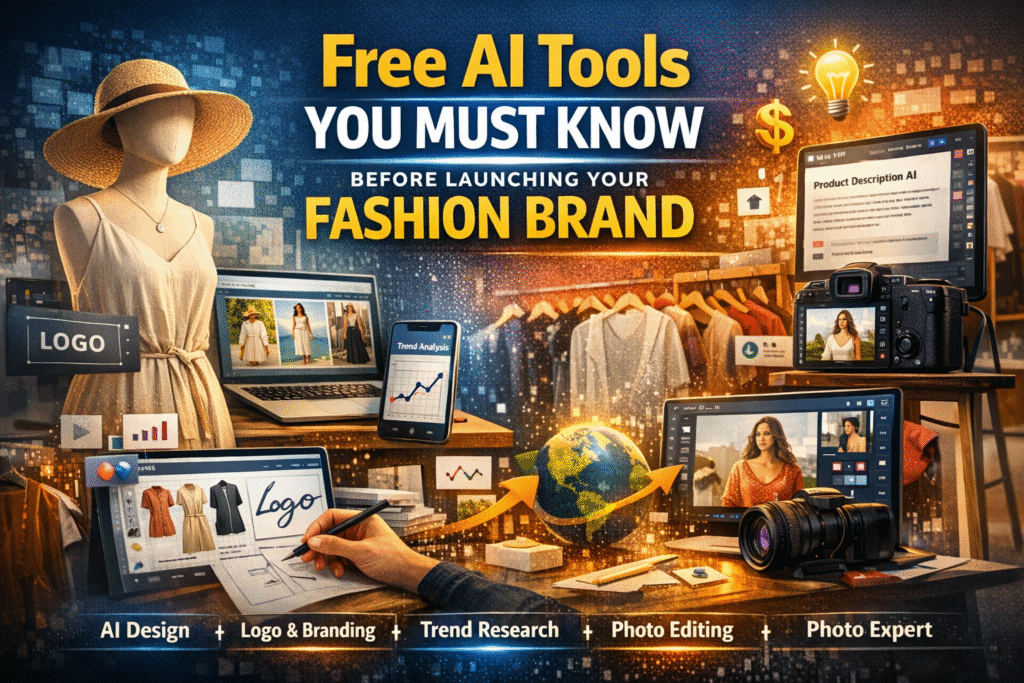
Free AI Tools You Must Know Before Launching Your Fashion Brand (2026 Edition)
Launching a fashion brand is thrilling… and terrifying.
You’ve got ideas scribbled in notebooks, mood boards on your phone, and designs living rent-free in your head at 3 a.m. But then reality hits—costing, suppliers, branding, marketing, tech packs, photoshoots, content creation.
It feels like you need a team of 20 before you even sell one piece.
Here’s the good news: AI has quietly become the smartest co-founder you never hired.
If you know which free tools to use—and how to use them—you can move faster, look more professional, and avoid beginner mistakes that destroy early-stage brands.
Let’s break it all down.
What Are AI Tools in Fashion (In Simple Words)?
AI tools are software platforms that use machine learning to:
- Generate images and mockups
- Write product descriptions and ads
- Analyze trends
- Create branding assets
- Edit photos
- Plan content calendars
- Predict demand
Think of them as junior designers, marketers, merchandisers, and copywriters—working 24/7 for free or low cost.
For first-time founders, ecommerce sellers, POD creators, and boutique labels, this is pure leverage.
Why Smart Fashion Startups Use AI From Day One
Before we jump into tools, let’s talk strategy.
Global fashion markets—from the US and Europe to India and Southeast Asia—are brutal for beginners. Margins are tight. Sampling is expensive. Marketing burns cash fast.
AI helps you:
- Validate ideas before production
- Create visuals without shoots
- Launch faster
- Reduce early marketing spend
- Look like a premium brand on a startup budget
That’s not hype. That’s survival.
1) AI for Design Inspiration & Concept Development
Best Free Tools:
- Canva AI
- Bing Image Creator / similar AI image platforms
- Adobe Express AI
- Playground-style generators
How Fashion Founders Use Them:
Imagine this:
You’re planning a resortwear collection for summer in Australia or beachwear for Dubai.
Instead of guessing what works, you type prompts like:
“Minimal linen co-ord set for women, neutral tones, resort luxury vibe, studio lighting.”
Within seconds, you get mood visuals.
You’re not copying designs—you’re exploring silhouettes, color stories, trims, and styling directions.
Practical Tips:
- Generate multiple versions of one idea
- Test fabrics visually (linen vs satin vs cotton poplin)
- Save winning looks for your tech pack mood boards
- Show them to manufacturers for reference—not final production
2) AI for Logo, Branding & Packaging Mockups
Your logo is not just decoration.
It signals price point, audience, and positioning in two seconds flat.
Free Branding Tools:
- Canva Logo Generator
- Looka (limited free previews)
- Hatchful
- Brandmark demos
What You Can Create:
- Logo drafts
- Swing tag layouts
- Polybag designs
- Box packaging
- Thank-you cards
- Hang labels
Real-World Scenario:
You’re launching a streetwear label for Gen-Z buyers in Germany.
Instead of paying ₹30,000+ upfront to a designer, you test 10 logo directions in Canva:
- Bold typography
- Gothic lettering
- Minimal sans-serif
- Icon-based mark
You show these to friends, retailers, or Instagram followers and see what resonates before finalizing.
3) AI for Writing Product Descriptions That Sell
Let’s be honest—most early fashion sites have terrible product copy.
“Premium fabric. Stylish look. Comfortable fit.”
That sells nothing.
Free Writing Tools:
- Chat-style AI platforms
- Copy.ai free plans
- Writesonic demos
- Rytr
How to Use Them Properly:
Don’t say:
“Write product description.”
Say:
“Write a persuasive product description for a women’s cotton summer dress for US ecommerce buyers, casual brunch wear, breathable fabric, mid-range price.”
What You Can Generate:
- Product descriptions
- Size-guide explanations
- Care instructions
- About-Us stories
- Sustainability messaging
- Email campaigns
4) AI for Trend Research & Market Validation
This is where most new brands fail.
They produce what they like—not what the market wants.
Free Trend Tools:
- Google Trends
- Pinterest Trends
- TikTok Creative Center
- Trend-tracking newsletters
- Marketplace bestseller lists
What to Look For:
- Rising keywords (like “quiet luxury top” or “cargo maxi skirt”)
- Seasonal spikes
- Regional demand
- Color preferences
- Fabric searches
Global Market Example:
In the US, “athleisure dresses” might trend upward.
In India, “cotton kurta set summer” spikes.
In the Middle East, “modest co-ord sets” gain traction.
AI-powered analytics platforms reveal this before you invest in inventory.
5) AI for Social Media Content & Ads
Marketing eats budgets faster than sampling mistakes.
AI helps you show up consistently without burning out.
Free Social Tools:
- Canva Magic Write
- CapCut AI
- Descript
- Meta Ad copy generators
- InVideo AI trials
What You Can Create:
- Instagram captions
- Reel scripts
- TikTok hooks
- Ad headlines
- Product launch posts
- Founder stories
Instant Tip:
Ask AI to generate 5 hooks for the same product:
- Emotional
- Problem-focused
- Luxury angle
- Sustainability angle
- Price-value angle
Test all five.
Let the market decide.
6) AI for Photo Editing & Virtual Shoots
Professional photoshoots cost thousands.
Before your first big campaign, AI editing tools can get you surprisingly far.
Free or Trial Tools:
- Remove.bg
- PhotoRoom
- Pixlr AI
- Fotor
- Lightroom mobile AI
Use Cases:
- Clean white backgrounds
- Marketplace-ready images
- Lifestyle composites
- Model swaps
- Shadow effects
POD Brand Example:
You sell print-on-demand hoodies globally.
Instead of shooting each design, you:
- Upload flat images
- Use AI to place them on models
- Generate lifestyle scenes
- Create marketplace thumbnails
That’s speed.
7) AI for Demand Forecasting & Pricing Research
Advanced forecasting tools are often paid—but free versions still help.
What AI-Powered Systems Can Do:
- Compare competitor prices
- Track bestseller rankings
- Suggest price ranges
- Analyze seasonality
How Founders Use This:
Before launching a $60 linen shirt, you check:
- Average market price
- Fabric weight comparisons
- Competitor positioning
- Review complaints
This prevents overpricing—or racing to the bottom.
8) AI + Tech Packs: The Smartest Combination
Here’s where serious brands separate themselves.
AI can generate visuals and descriptions—but manufacturers don’t cut fabric from inspiration images.
They need technical drawings, measurement charts, construction notes, BOM sheets, stitch details, tolerances.
That’s what a professional tech pack delivers.
Smart founders use AI to:
- Develop ideas
- Test silhouettes
- Build branding
- Create marketing
…and then translate those concepts into production-ready documentation with expert tech pack systems and specialists.
This hybrid approach saves months.
How to Build an AI-Powered Fashion Launch Workflow
Here’s a simple sequence you can steal:
- Trend Scan – Google Trends + Pinterest
- Design Concepts – AI image generators
- Brand Identity – Canva
- Market Copy – AI writers
- Product Visuals – PhotoRoom
- Pricing Research – marketplace analysis
- Tech Pack Creation – professional production files
- Launch Ads – CapCut + AI captions
That’s a real startup system.
Not theory.
Beginner Glossary (Simple Definitions)
Tech Pack:
A technical blueprint for manufacturers showing measurements, fabrics, stitching, trims, and construction.
BOM (Bill of Materials):
A list of everything used in the garment—fabric, thread, buttons, labels, zippers.
Tolerance:
How much a measurement can vary during production (for example ±0.5 cm).
POD (Print on Demand):
Products printed only after customers order—no inventory risk.
Forecasting:
Predicting demand before producing stock.
Mistakes to Avoid When Using AI in Fashion
AI is powerful—but not magic.
Avoid these traps:
- Copying designs directly
- Skipping sampling
- Trusting measurements generated by AI
- Ignoring fit testing
- Over-automating brand voice
- Using generic prompts
Use AI to assist, not replace expertise.
Final Thoughts: AI Won’t Replace Designers—But It Will Replace Slow Brands
The future belongs to founders who move fast, test ideas cheaply, and document production professionally.
Free AI tools give you:
- Speed
- Confidence
- Creative freedom
- Lower launch risk
Combine them with strong technical execution, and you’re no longer guessing.
You’re building like a modern fashion company from day one.
FAQs: Free AI Tools for Fashion Startups
1) Can I launch a fashion brand using only free AI tools?
You can validate ideas and market using free tools, but production still requires professional tech packs and sampling.
2) Are AI-generated designs legal to manufacture?
Use them as inspiration and reference—not final copyrighted designs.
3) Which AI tool is best for beginners?
Canva is the easiest all-rounder for visuals, branding, and social posts.
4) Do manufacturers accept AI sketches?
They prefer technical flats and specification sheets, not raw AI images.
5) Can AI predict fashion trends accurately?
It helps spot patterns early, but human judgment is still crucial.
6) Is AI useful for POD brands too?
Absolutely—especially for mockups, ads, and listing optimization.
7) Should luxury brands use AI?
Yes—behind the scenes for research, forecasting, and development.