Do Manufacturers Really Need 3D Prototypes
You’ve spent three weeks perfecting your design on Clo3D. It looks incredible — the fabric drapes just right, the colorway pops, the fit looks flawless on the digital model. You send it to five factories, feeling like you’ve already done the hard part.
Then the replies start coming in. “Can you send the tech pack?” “We need measurements and construction details, not just the render.” One factory doesn’t reply at all.
If this sounds familiar, you’re not alone. Thousands of independent designers and startup founders fall into the same trap every year — they confuse a beautiful 3D visual with the technical document a factory actually needs to build a garment.
The Real Question: What Are 3D Prototypes and Tech Packs, Actually?
Let’s clear this up in plain language, because the confusion here costs founders real time and money.
A 3D prototype (also called a digital sample or virtual sample) is a computer-generated image or video of your garment. Software like Clo3D, Browzwear, or Style3D lets you see how a design might look and drape on a virtual body, without sewing a single stitch.
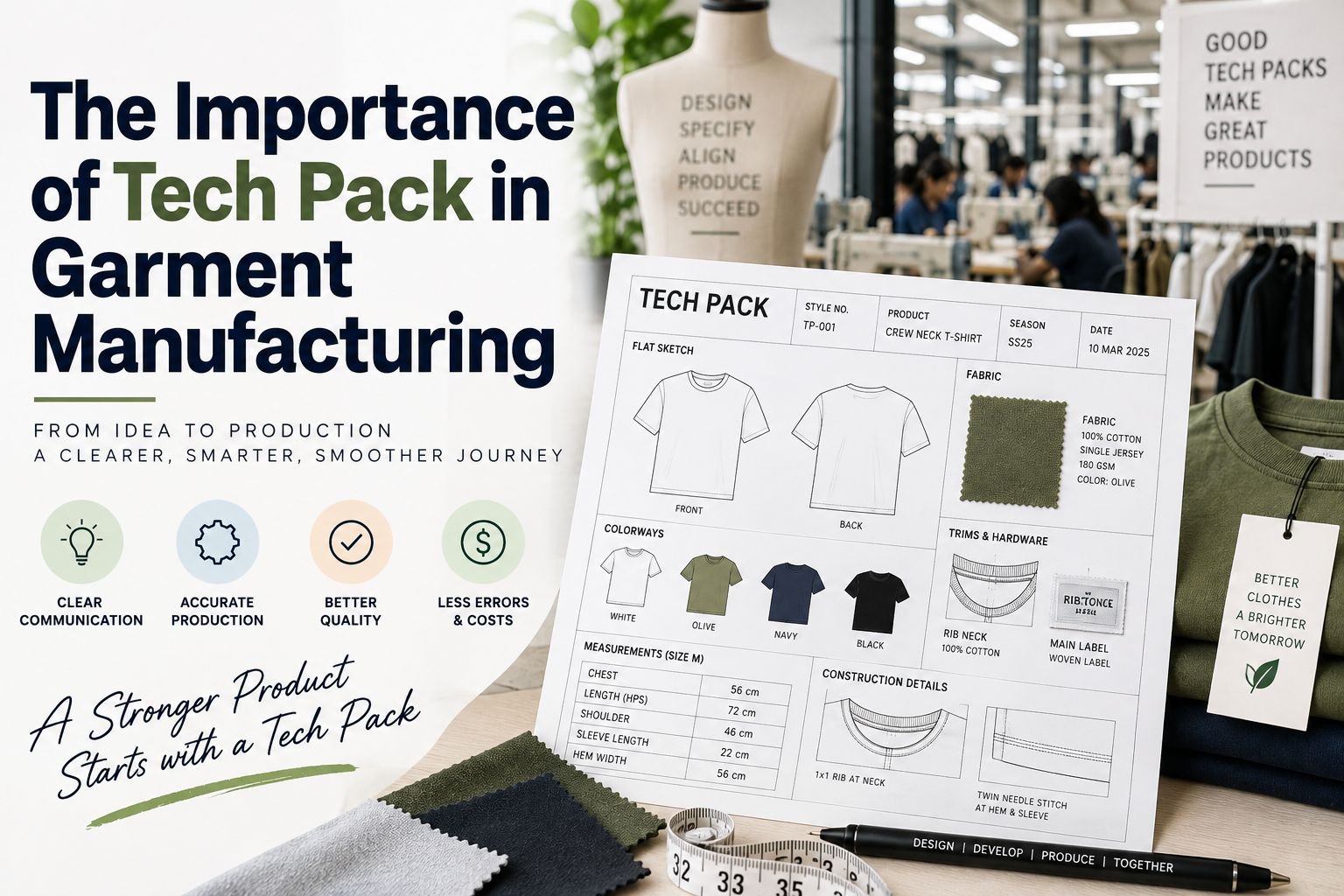
A tech pack is a technical instruction manual for your garment. It contains flat sketches, exact measurements, stitch types, fabric specs, trims, labels, colorways, and grading — everything a factory’s pattern maker and sewing line need to physically produce your product.
Think of it this way:
- A 3D prototype is like an architect’s rendering of a house — it shows you how it might look.
- A tech pack is like the actual blueprint — it tells the construction crew exactly how to build it, down to the wiring and plumbing.
You wouldn’t hand a builder a rendering and expect them to know where to put the electrical outlets. The same logic applies to garment manufacturing.
So Which One Do Factories Actually Require?
Here’s the short answer: factories require a tech pack. A 3D prototype is optional, and it supports the tech pack — it never replaces it.
Almost every legitimate manufacturer, whether in Bangladesh, Vietnam, Turkey, Portugal, or China, will ask you for a tech pack before they quote you or start production. Some may accept a 3D visual as a reference image alongside it, but none of them will build your garment from a 3D file alone.
Why? Because a 3D render, no matter how photorealistic, doesn’t tell a factory:
- The exact seam allowance to use
- Which stitch type goes on the hem
- What GSM (fabric weight) the material should be
- How the garment should grade across sizes XS to XXL
- What thread color, label placement, or trim source to use
Without these details, a factory is essentially guessing. And when factories guess, you get fit issues, wrong fabric substitutions, and samples that look nothing like what you imagined.
Where 3D Prototypes Actually Shine
This doesn’t mean 3D design tools are useless — far from it. They’re powerful for a specific part of your process, just not the part most founders assume.
1. Pitching investors or buyers before you spend on samples
If you’re raising funds or pitching a wholesale buyer, a polished 3D render looks far more professional than a rough sketch. It helps people visualize the product before physical samples exist.
2. Speeding up your internal design decisions
Trying to decide between three colorways or two silhouettes? A 3D tool lets you compare options in minutes instead of waiting weeks for physical samples from a factory.
3. Reducing sampling rounds with your factory
Some experienced founders send both a tech pack and a 3D reference image together. The factory builds from the tech pack, but uses the 3D visual to understand design intent faster — this can reduce the number of sample revisions.
4. Marketing before manufacturing is finished
Brands sometimes use 3D renders for pre-launch marketing, website previews, or crowdfunding pages while the real samples are still in production.
So the honest way to think about it: 3D prototypes help you communicate and decide faster. Tech packs help the factory build correctly. They serve two completely different jobs.
A Real-World Example: The POD Creator Who Learned This the Hard Way
Imagine a print-on-demand creator in the US who designs streetwear graphics. She wanted to move from POD platforms to her own manufactured line, so she used a 3D tool to design a hoodie with a boxy fit and dropped shoulder.
She sent the render to a supplier in Vietnam expecting a sample within two weeks. Instead, she got a message asking for:
- A flat sketch (front and back)
- A size chart with body measurements
- Fabric composition and GSM
- Stitch and trim details
She didn’t have any of it. The 3D file alone told the factory nothing about construction. It took her another three weeks to get a tech pack made, and by the time production started, she’d lost over a month compared to founders who started with a proper tech pack from day one.
This is one of the most common stories we hear from apparel entrepreneurs launching their first physical product — the visual excites people, but it can’t build anything on its own.
What Happens If You Only Send a Factory a 3D File?
If a factory agrees to work from a 3D render without a tech pack (some smaller or less experienced factories will try), here’s what typically goes wrong:
- Fit problems — Without a real size chart and points of measure, the factory guesses the fit, and it rarely matches your vision.
- Fabric mismatches — 3D renders show color and drape, not real fabric composition. Factories often substitute whatever is closest in their stock.
- Construction errors — Seam types, closures, and stitch details get left to the sewing line’s best guess.
- Costly revisions — Every sample round without a tech pack means paying again for a new sample, plus shipping and time delays.
- Communication breakdown — Serious factories may simply decline to quote you at all, seeing the request as a red flag that you’re not production-ready.
For a startup founder working with a tight budget, this is the difference between launching on schedule and burning through your capital on failed samples.
Do Different Manufacturing Regions Handle This Differently?
Yes, slightly, and it’s useful to know before you reach out to factories abroad.
China and Vietnam: Large factories with high MOQs (minimum order quantities) are extremely tech-pack-driven. They often have in-house pattern departments that expect a complete tech pack before quoting.
Bangladesh: Similar expectation, especially for bulk woven and knit orders. Tech packs with precise grading are non-negotiable for larger production runs.
Turkey and Portugal: Known for fast sampling and closer collaboration with designers. Some factories here are more flexible about accepting a 3D reference alongside a simpler tech pack, especially for smaller startup orders.
India: A mix — larger export houses want full tech packs, while smaller job-work units may work with simplified specs, though this often creates quality inconsistency.
US and domestic cut-and-sew manufacturers: Because labor costs are higher, these factories often want an even more detailed tech pack upfront to avoid wasted sampling time, since local labor per sample is expensive.
Wherever you manufacture, the pattern is the same: the more complete your tech pack, the smoother your production experience.
What Should Actually Be Inside Your Tech Pack?
If you’re building your first tech pack, here’s a beginner-friendly breakdown of what a solid one should include:
1. Flat sketches (front and back) Simple line drawings showing the garment shape, seams, and design details — not a fashion illustration, but a technical drawing.
2. Size specifications (spec sheet) A table of exact body measurements for every size you plan to produce (e.g., chest width, sleeve length, hem width for XS through XXL).
3. Bill of Materials (BOM) A list of every fabric, trim, zipper, button, and label used, including supplier codes if you have them.
4. Colorways Every color version of the design, with Pantone codes so factories match colors precisely instead of guessing from a screen.
5. Construction details Notes on stitch types, seam finishes, and special construction techniques (like French seams or bound necklines).
6. Grading rules How measurements should scale up or down between sizes — this keeps your fit consistent across your whole size range.
7. Labeling and packaging instructions Where care labels go, how folding should be done, and poly bag or tag requirements if applicable.
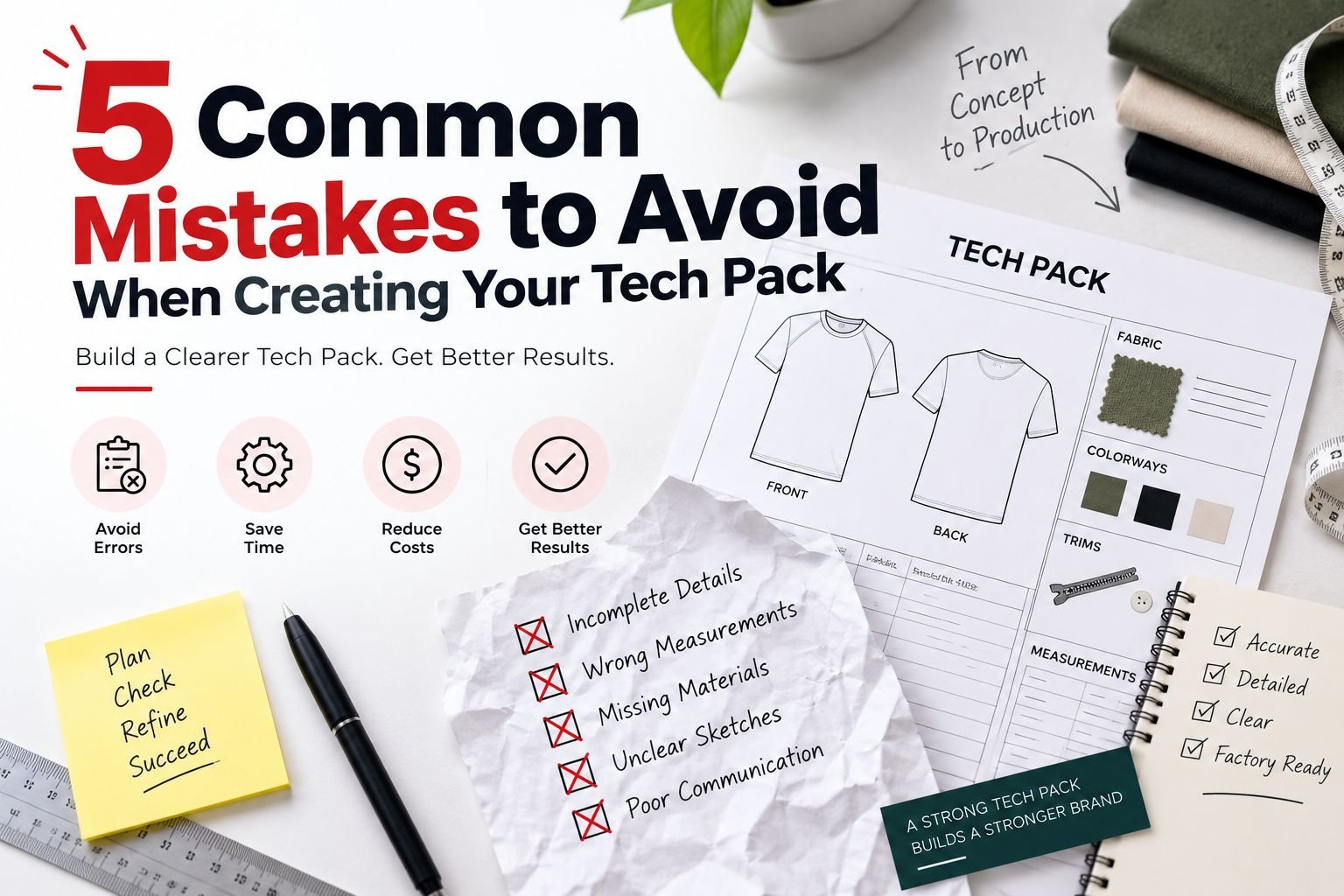
A tech pack missing even two or three of these sections can lead to samples that don’t match your expectations, so completeness matters far more than polish.
Common Beginner Terms Explained Simply
If you’re new to this space, a few terms trip up almost everyone:
- MOQ (Minimum Order Quantity): The smallest number of units a factory will produce per style or color.
- GSM (Grams per Square Meter): A measurement of fabric weight/thickness — higher GSM usually means a heavier, thicker fabric.
- POM (Points of Measure): The exact spots on a garment where measurements are taken, like chest width or shoulder-to-shoulder.
- Grading: Scaling a base size pattern up or down to create all other sizes in your range.
- BOM (Bill of Materials): The complete list of materials used to build the garment.
- Sampling round: Each time a factory sends you a physical sample for approval or revision.
Knowing these terms helps you communicate confidently with any factory, no matter where they’re based.
Practical Steps to Take Right Now
If you’re currently stuck between choosing a 3D prototype or a tech pack, here’s a simple action plan:
- Start with your tech pack first, even if it’s basic. This is the non-negotiable document every serious factory will ask for.
- Use 3D tools for internal decisions — colorways, silhouette comparisons, or investor pitch decks — not as your production file.
- Send both when possible. A tech pack plus a 3D reference image often produces the fastest, most accurate first sample.
- Never skip the size spec sheet. This single section prevents more sampling disasters than any other part of a tech pack.
- Ask your factory directly what format they prefer before you invest heavily in either 3D design or tech pack creation — this saves you rework later.
- If you don’t have design software experience, get a tech pack made professionally. A tech pack with errors is often worse than no tech pack at all, since it can send a factory in the wrong direction confidently.
The Bottom Line
3D prototypes are a fantastic tool for visualizing, pitching, and speeding up your own decision-making. But when it’s time to actually manufacture your product, factories run on tech packs — not renders. The businesses that scale smoothly are almost always the ones that treat the tech pack as their real production document, and use 3D design as a supporting tool alongside it, not a replacement for it.
If you’re preparing to approach manufacturers and you’re not sure your tech pack has everything a factory needs, get it reviewed or professionally built before you send it out. It’s one of the cheapest ways to avoid expensive sampling mistakes down the line.
Frequently Asked Questions
1. Can I get a factory to manufacture my product using only a 3D render?
Most established factories will decline or ask for a tech pack first. A 3D render alone doesn’t provide the measurements or construction details needed to build the garment.
2. Is a 3D prototype the same as a technical drawing in a tech pack?
No. A 3D prototype is a photorealistic digital render, while a technical drawing (flat sketch) inside a tech pack is a simple, precise line drawing used for construction reference.
3. Do I need both a 3D prototype and a tech pack?
Not always, but it’s a smart combination. The tech pack handles production requirements, while the 3D visual helps communicate design intent quickly, especially with factories overseas.
4. Which is more expensive to create — a 3D prototype or a tech pack?
Costs vary, but a detailed tech pack with grading and full specs is generally considered the higher-priority investment, since it directly affects production accuracy and sampling costs.
5. Can small factories work without a tech pack?
Some smaller or informal manufacturers might attempt it, but this usually leads to inconsistent quality, fit issues, and higher revision costs — not a reliable path for a scaling brand.
6. What software is commonly used for 3D garment prototypes?
Popular tools include Clo3D, Browzwear, and Style3D, widely used by designers to visualize garments digitally before physical sampling.
7. I’m a POD creator moving into manufacturing — where should I start?
Start with a tech pack, even a simple one covering sketches, measurements, and materials. This is the document factories will ask for first, regardless of your design background.
Ready for Production?
Get a professional tech pack for your fashion design.
Table of Contents