Fashion Tech Pack Checklist (Free Template): Everything Your Factory Needs to Get Your Design Right
Every new fashion collection begins with excitement — until it reaches the factory floor.
That’s where ideas get lost, measurements get confused, and designs turn into something you never approved.
Almost every clothing brand founder has lived this moment:
The sample arrives… and it looks nothing like the sketch.
The root problem?
No clear tech pack.
And not just a tech pack — a complete one.
If you’ve ever wished for a simple, beginner-friendly guide that explains what exactly goes inside a perfect tech pack, this is your complete checklist (with a free template at the end).
Let’s break it down in the friendliest, clearest way possible.
What Is a Fashion Tech Pack?
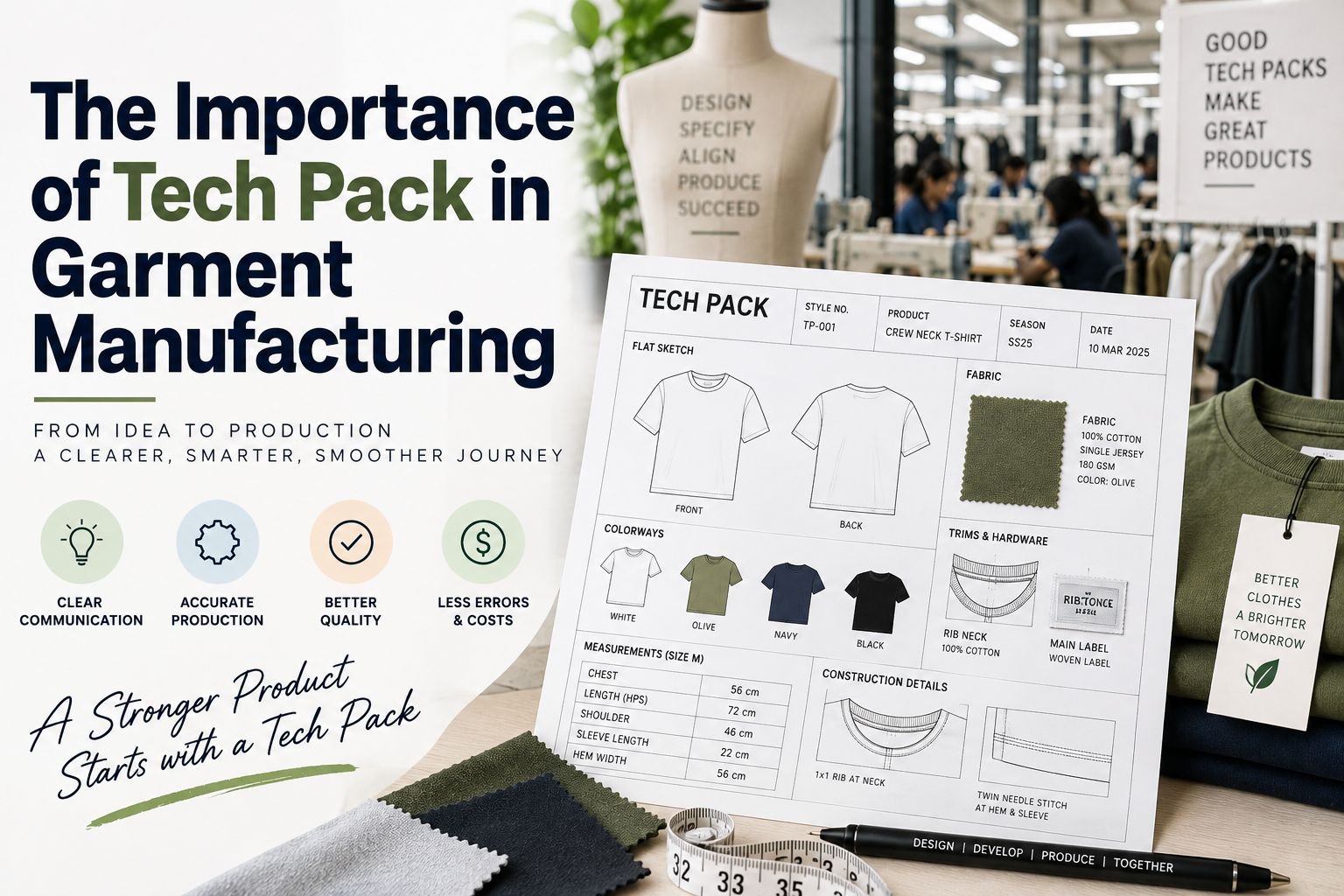
A fashion tech pack is a master document that explains your design in exact detail to your manufacturer.
Think of it as a blueprint of your garment — like an architectural plan but for clothing.
It includes:
- Measurements
- Fabrics
- Trims
- Construction details
- Colors
- Artwork placements
- Packaging
- Labeling
- Fit comments
- Revision notes
Global brands like Nike, Zara, and H&M never produce without tech packs.
It minimizes errors, saves money, and speeds up production.
Now let’s jump into the checklist.
The Ultimate Fashion Tech Pack Checklist
Below is every section your factory must receive.
You can use this as a ready-to-copy template for your next order.
1. Cover Page (Tech Pack Overview)
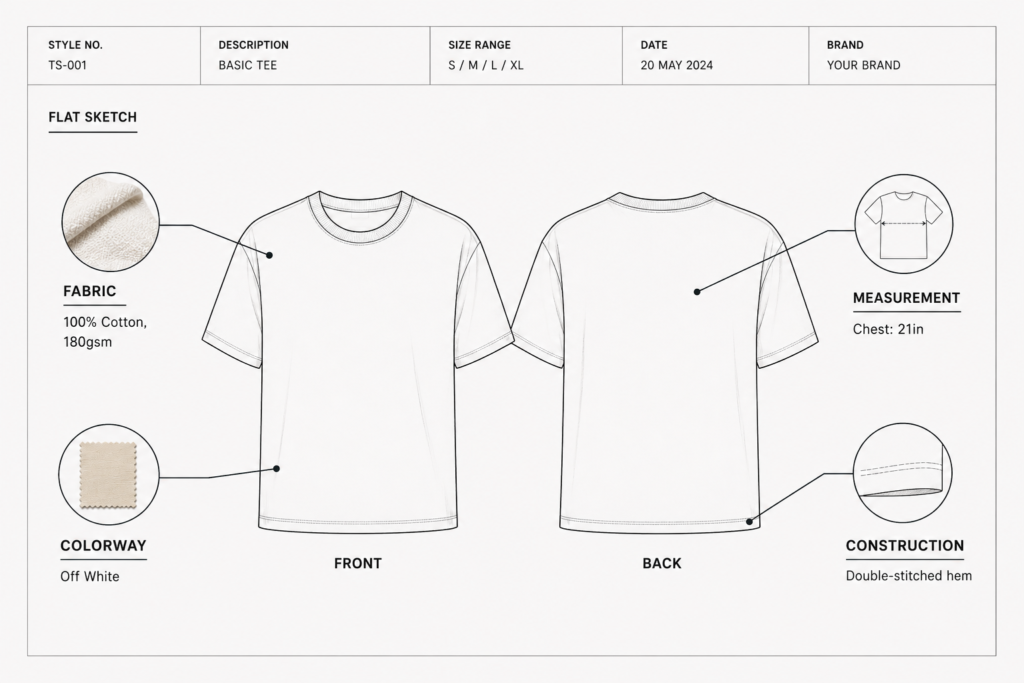
This is the first page manufacturers look at.
It should clearly include:
- Style name
- Style code
- Category (t-shirt, hoodie, dress, etc.)
- Designer name
- Brand name
- Date
- Version number (very important)
- Season (SS25, FW24, Holiday Drop, etc.)
- Garment sketch (front + back)
Why it matters:
Factories use style codes to track samples, fabrics, and revisions.
Without it, your tech pack may get mixed with other orders.
Example:
For a POD streetwear brand in the US, use short codes like:
TS-017-SKULLPRINT
Easy to track, easy to discuss over WhatsApp or email.
2. Technical Flats (Front + Back)
Technical flats are clean, line-drawn sketches that show the garment from all angles.
Include:
- Front view
- Back view
- Side view (if needed)
- Zoomed details (pockets, zippers, neck finish, seams)
Beginner explanation:
Unlike fashion illustration, flats are not for creativity.
They are for clarity — showing the exact construction.
Example:
A Korean athleisure brand may include a zoomed detail for their heat-sealed seams.
An Indian ethnic wear brand may include zari embroidery zoom-ins with stitch directions.
3. Measurements (Spec Sheet)
This is one of the most critical sections.
The spec sheet tells the manufacturer the exact size of the garment.
Include:
- Point of Measure (POM) list
- Measurements for each size (XS–3XL or your custom range)
- Tolerances (+/- allowed difference)
What is tolerance?
Factories cannot cut fabric with 100% precision every time.
Tolerances allow 0.5–1 cm variation without counting as an error.
Practical tip:
Keep tolerances tighter for fitted garments (e.g., bodycon dresses).
Relax tolerances for oversized or streetwear fits.
Example:
US athleisure brands usually give +/– 0.5 cm.
Indian kurti brands usually allow up to +/– 1 cm.
4. Bill of Materials (BOM)
BOM is the list of materials required to make your garment.
Include:
- Main fabric
- Lining
- Interlining
- Zippers
- Buttons
- Threads
- Labels
- Tags
- Packaging
Add for each item:
- Material composition
- GSM/oz weight
- Color code
- Supplier
- Consumption (how much fabric per piece)
Why it matters:
Factories often use substitutes if BOM is not detailed.
That’s how a 100% cotton shirt becomes “70% cotton + 30% polyester.”
Example:
For a luxury Dubai-based abaya brand:
Fabric: Korean Nida, 140 GSM, Jet Black, Supplier: Al Madina Textiles
This avoids mistakes.
5. Fabric & Trim Details
This section goes deeper into the materials.
Include:
- Fabric type (rayon, lycra, modal, corduroy, rib knit, etc.)
- Knit or woven
- Stretch percentage
- Weave type (twill, satin, plain)
- Finish (bio-wash, peach finish, anti-microbial)
- Shrinkage
- Color codes (Pantone or supplier-specific)
Pro tip:
Always add fabric swatch photos and Pantone references.
Example:
A UK sustainable brand may specify:
Organic cotton jersey, 5% elastane, GOTS certified, Pantone 11-0602 Snow White
6. Construction Details
This is where you explain how the garment must be stitched.
Include details for:
- Seams (overlock, flatlock, topstitch, double needle)
- Stitch length
- Hem depth
- Neck finish
- Pocket construction
- Zip placements
- Button placements
- Waistband construction
Beginner explanation:
Factories assume their default method if you don’t specify — which may not match your brand’s quality level.
Real-world example:
Streetwear brands in Japan often specify flatlock seams for premium look.
Budget Indian t-shirts use overlock seams to reduce cost.
7. Artwork & Print Details
If your garment has graphics, embroidery, patches, or prints — this section is critical.
Include:
- Artwork file (PNG, AI, or EPS)
- Print size
- Print placement (with measurements from HPS — High Point Shoulder)
- Colors used (Pantone)
- Print type (DTG, screen print, puff print, chenille patch, embroidery, etc.)
- Stitch type for embroidery
- Thread colors
- Texture or finish (matte/glossy/puff)
Example:
A US streetwear brand uses “Puff screen print, 3mm height, Pantone Yellow C.”
8. Colorways
If you’re producing multiple colors, every single colorway must include:
- Color name
- Color code
- Artwork color adjustments
- Fabric availability
- Trims availability
Practical tip:
Factories may assume all colors use the same trims unless you specify.
If your pink colorway needs rose-gold buttons — mention it here.
9. Size Range & Grading Rules
If you’re offering XS–3XL or any custom range, include:
- Base size measurements
- Grading increments (how much each size increases)
Beginner example:
If your M chest is 100 cm and grading is +4 cm per size:
L = 104 cm
XL = 108 cm
XXL = 112 cm
Why this matters:
Incorrect grading is the #1 reason for poor fit across sizes.
10. Labels & Packaging Details
This section ensures your product looks branded and premium.
Include:
- Main label (brand logo)
- Size label
- Wash care label (with icons)
- Hang tags
- Price tags
- Polybag printing
- Box packaging (if applicable)
Specifications:
- Label dimensions
- Placement (e.g., center back neck)
- Material (woven/satin/printed)
- Thread color
- Packing method (folding style + polybag size)
Example:
A Korean streetwear brand includes 2 hangtags tied with black wax thread for premium feel.
11. Fit Notes & Sample Comments
After receiving your prototype sample, add:
- Fit issues
- Correction notes
- Additional requests
- Photos with arrows
- Version update (V2, V3, etc.)
Real example:
If sleeve length feels too long by 2 cm, mark it as:
“Reduce sleeve length by –2 cm in all sizes.”
Always update version numbers.
12. Final Checklist Before You Send the Tech Pack
Here’s a quick final review:
- Front & back flats
- Measurement chart with tolerances
- BOM
- Fabric details
- Stitch/Construction details
- Print/Embroidery details
- Colorways
- Grading
- Labels & packaging
- Fit comments
- Version number updated
If everything above is checked, production will run smoothly.
Free Tech Pack Template (Copy & Use)
You can copy this structure and create your own tech pack instantly:
1. Cover Page
- Style Name:
- Style Code:
- Category:
- Designer:
- Brand:
- Season:
- Version:
- Date:
- Flats: (front/back)
2. Technical Flats
- Front
- Back
- Zoomed views
3. Measurements
| POM | XS | S | M | L | XL | XXL | Tol. |
|---|
4. Bill of Materials
- Fabric:
- GSM:
- Color:
- Trims:
- Zippers:
- Threads:
- Labels:
5. Fabric Details
- Composition
- Stretch
- Finish
- Shrinkage
6. Construction Details
- Seams
- Stitch length
- Hems
- Neckline
- Pockets
7. Artwork Details
- Size
- Placement
- Colors
- Print type
8. Colorways
- Color 1
- Color 2
- Color 3
9. Grading
- Base size
- Grading rules
10. Labels & Packaging
- Label placements
- Hang tags
- Wash care
- Polybag
11. Sample Comments
- V1
- V2
- Final approved
Practical Tips for Perfect Tech Packs
1. Add version numbers
Factories often get confused if you keep sending updated images without marking V2, V3, etc.
2. Don’t assume anything
If it’s not written, factories won’t follow it.
3. Use real measurements
Don’t guess; measure your reference sample.
4. Keep everything visual
Factories understand photos 10x faster than text.
5. Save your tech pack as PDF
Formats like Word/Google Docs can shift layouts.
Global Examples of Brands Using Strong Tech Packs
1. US Streetwear Brands
Use detailed print layers for puff and DTG.
2. European Luxury Brands
Specify seam types and fabric handle.
3. Indian Ethnic Brands
Add extra details for embroidery and zari.
4. UAE Abaya Brands
Give precise fall and drape instructions.
5. Australian Swimwear Brands
Add stretch percentages and recovery details.
Conclusion: A Tech Pack Isn’t a Document — It’s Business Insurance
A perfect tech pack protects your time, money, and creativity.
It prevents misunderstandings, reduces sampling mistakes, and keeps your brand consistent — even when you change factories.
Whether you’re a fashion designer, startup founder, POD seller, or growing D2C brand, this checklist is your roadmap to clean, error-free production.
If you want professionally made tech packs within 72 hours, TechPack Genius is always here to support you.
FAQs
1. What is the main purpose of a tech pack?
It tells the manufacturer exactly how to make your garment — with no confusion or guesswork.
2. Who creates tech packs?
Professional tech pack designers, fashion designers, or specialized agencies like Tech Pack Genius.
3. Do I need a tech pack for simple t-shirts?
Yes — even basic garments need measurements, fabric details, and print placements.
4. Can I use the same tech pack for multiple factories?
Yes. That’s the beauty of a well-made tech pack — it works globally.
5. How long should a tech pack be?
Usually 10–20 pages, depending on complexity.
6. What format should tech packs be in?
PDF is best for consistency.
7. Do POD sellers need tech packs?
For bulk manufacturing — yes.
For direct POD platforms like Printful, not required.
Ready for Production?
Get a professional tech pack for your fashion design.
Table of Contents